
Yes. Glabridin can be incorporated into water-based systems using purpose-built grades that enable dispersion in aqueous environments. Standard glabridin is inherently lipophilic — it does not dissolve in water. Huatai has developed two water-compatible grade families that enable incorporation into aqueous systems through specialized formulation technologies while supporting active stability under appropriate formulation conditions.
The Solubility Challenge and Its Solution
Glabridin's isoflavane structure is inherently lipophilic and exhibits very limited water solubility. In water-based systems, unmodified glabridin can be difficult to disperse uniformly and may present formulation challenges such as sedimentation or non-uniform active distribution if not properly solubilized or stabilized.
A traditional approach is to use co-solvents such as propylene glycol or ethanol to improve solubility. However, the solvent levels required may be less desirable for sensitive-skin toners, essences, or hydrogel formulations where mildness and skin comfort are important formulation considerations.
The solution is to select a grade purpose-engineered for water systems.
The Two Water-Compatible Grade Options
Option 1 — 10% Water-Soluble Powder (HP-β-CD Encapsulated)
This is the primary recommended grade for water-based applications.
| Parameter | Detail |
|---|---|
| Physical form | White powder |
| Aqueous dispersibility | Readily dispersible in water-based systems |
| Active content | 10% Glabridin |
| Encapsulation technology | Hydroxypropyl β-cyclodextrin (HP-β-CD) inclusion complex |
| Loading capacity | 15–18% (stably maintained at 10%) |
| Thermal stability | Slow decomposition maintained at ~100°C |
| Photostability | ~10% mass loss over 4 days of light exposure (Huatai internal stability data) |
| Shelf life | 24 months |
| COSMOS status | Certified |
How it works: HP-β-CD has a hydrophilic outer surface and a hydrophobic inner cavity. Glabridin is encapsulated within the hydrophobic cavity of HP-β-CD to form an inclusion complex. When dispersed in water, the entire complex becomes water-dispersible, enabling the formation of a stable aqueous dispersion. The resulting system may appear as a clear to slightly opalescent dispersion depending on concentration and formulation conditions.
Beyond aqueous dispersibility, HP-β-CD encapsulation provides two additional potential performance benefits:
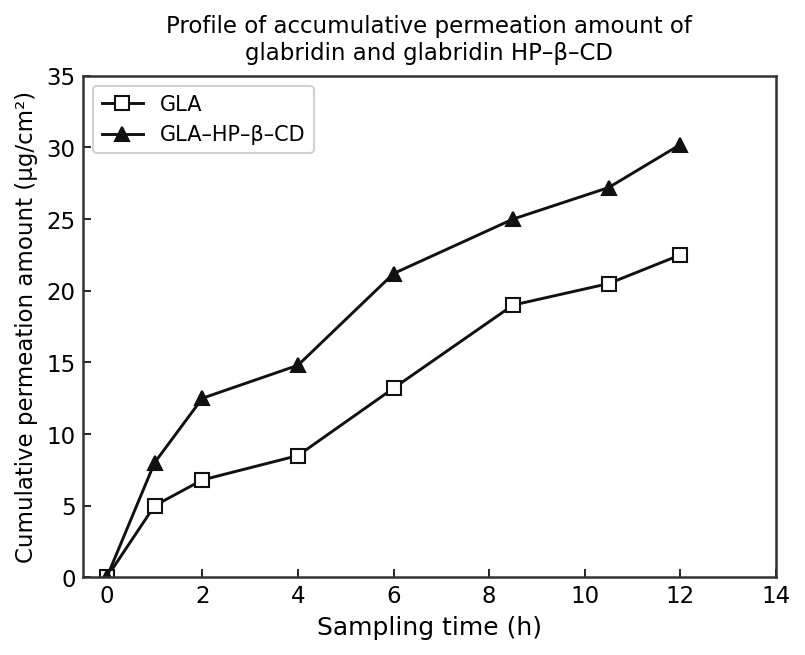
- Potential improved delivery: HP-β-CD may enhance the delivery of encapsulated actives by improving their aqueous dispersibility and apparent solubility.
- Potential controlled-release behavior: HP-β-CD inclusion may contribute to a more gradual release profile compared with free glabridin.
Option 2 — 1–5% Water-Soluble Liquid Grades
Pre-dissolved liquid concentrates available in two variants:
| Variant | Color | Preservative |
|---|---|---|
| Colorless to pale yellow liquid | Colorless | Contains approved preservative |
| Reddish-brown to dark brown liquid | Brown | Contains approved preservative |
Both variants are water-compatible pre-solubilized systems and can be added directly to the aqueous phase. The key formulation consideration: these grades contain approved preservatives. The included preservative should be considered in the overall preservative system of the finished formulation and declared in regulatory documentation.
The 1–5% liquid grades are well-suited for formulations where a pre-dissolved, ready-to-use concentrate is preferred — particularly useful for small-batch compounding or for brands without powder-weighing infrastructure.
Photostability in Water: The Advantage of Encapsulation
In aqueous systems, unencapsulated glabridin may be more susceptible to photodegradation. In water, the polar environment may increase the susceptibility of phenolic hydroxyl groups to oxidative degradation, and the absence of lipid-phase antioxidants (such as tocopherol when present) may reduce antioxidant protection.
HP-β-CD encapsulation may help address this issue. Internal stability testing of the HP-β-CD inclusion complex shows:
| Condition | HP-β-CD Glabridin Complex | Source |
|---|---|---|
| Light exposure, 4 days | ~10% mass loss | Huatai internal stability data |
| Thermal (~100°C processing) | Slow decomposition | Huatai internal stability data |
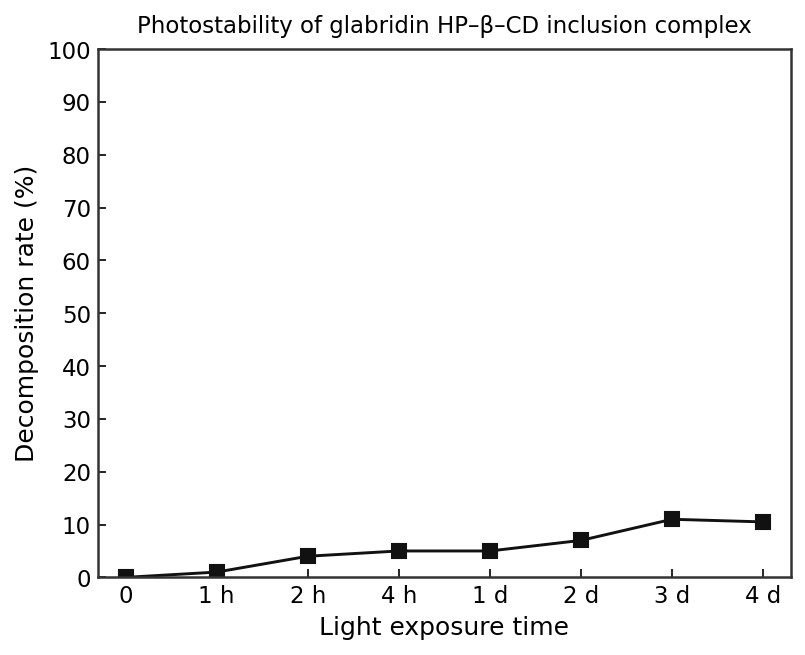
The cyclodextrin cavity may encapsulate the glabridin molecule, reducing its exposure to light and the surrounding aqueous environment, which may help improve stability compared with the unencapsulated form.
For finished product packaging, the same rules apply regardless of grade: UV-protective or opaque packaging is particularly important for water-based clear formats (e.g., toners and essences) to help minimize light-induced degradation during storage and use.
Incorporation Guidelines for Water-Based Systems
10% water-soluble powder
- Add directly to the water phase at room temperature to 40°C; stir until fully dispersed.
- No additional solubilizer is typically required.
- Target use level: adjust based on formulation system and target active level — the 10% grade provides flexibility for a range of active concentrations.
- Verify final pH after all cool-down additions are complete; target pH 4.0–5.5.
1–5% water-soluble liquid grades
- Add directly to the water phase or during cool-down.
- The included preservative should be considered in the overall preservative system.
- Confirm the preservative identity and concentration with the supplier COA before finalizing the preservative declaration.
- Verify final pH after all cool-down additions are complete; target pH 4.0–5.5.
Stability reinforcement for water-based systems
- Include a metal chelator in the water phase: disodium EDTA (0.05–0.1%) or sodium phytate (0.1–0.5%) for COSMOS-compatible systems.
- Use a buffered water phase (citric acid/sodium citrate or lactic acid/sodium lactate) to maintain pH stability over shelf life.
- UV-protective or opaque packaging is particularly important for water-based clear formats (e.g., toners and essences) to help minimize light-induced degradation during storage and use.
Applicable Water-Based Formats
| Format | Recommended Grade | Notes |
|---|---|---|
| Toner / Facial Water | 10% water-soluble powder or 1–5% water-soluble liquid | Direct aqueous incorporation; additional co-solvents are typically not required |
| Hydrogel | 10% water-soluble powder | Disperse in water phase before gelling agent addition |
| Water-based serum | 10% water-soluble powder | High active loading possible; adjust use level per target |
| Sheet mask essence | 10% water-soluble powder or 1–5% water-soluble liquid | Suitable for aqueous sheet mask essence formulations |
| Micellar water | 1–5% water-soluble liquid | Pre-dissolved format suitable for aqueous micellar cleansing formulations |
Every batch ships with COA, TDS, and SDS/MSDS. Additional testing available upon request.
References
- Ao M, Shi Y, Cui Y, Guo W, Wang J, Yu L. Factors influencing glabridin stability. Natural Product Communications, Vol. 5(12), 1907–1912, 2010. DOI: 10.1177/1934578X1000501214. PMID: 21299118.
- Yokota T, Nishio H, Kubota Y, Mizoguchi M. The inhibitory effect of glabridin from licorice extracts on melanogenesis and inflammation. Pigment Cell Research, 11(6), 355–361, 1998. DOI: 10.1111/j.1600-0749.1998.tb00494.x.
- Huatai Bio-Fine Chemical. Water-soluble glabridin inclusion complex internal stability data. Chinese Invention Patent ZL202111026952.7, granted 28 April 2023.


 English
 German
 Italian
 French
 Spanish
 Japanese
 Korean
 Russian