
Stabilizing glabridin in cosmetic formulations requires systematic management of the key factors that drive its degradation, including oxidative exposure, trace metal ion contamination, formulation pH, and processing and storage temperature. As these factors often interact with one another, optimizing only one while neglecting others typically does not achieve satisfactory long-term stability.
The Four Stabilization Controls
Control 1 Temperature: The Processing Constraint
Maximum processing temperature: 60°C.
This thermal stability window has been established under defined conditions (Ao et al., Natural Product Communications, 2010, DOI: 10.1177/1934578X1000501214): below 60°C, glabridin generally demonstrates good stability with minimal content change. However, once this temperature threshold is exceeded, thermal degradation accelerates significantly, resulting in active content loss.
In formulation practice, this translates to a single non-negotiable rule: glabridin must be added to the main batch only during cool-down, never into a hot phase.
Standard incorporation sequence:
| Processing Stage | Temperature | Action |
|---|---|---|
| Pre-dissolution | 40–50°C | Dissolve glabridin in propylene glycol, butylene glycol, or ethanol; stir until clear |
| Main batch cool-down | Below 50°C | Add pre-dissolved active; stir to incorporate |
| Maximum brief exposure | 60°C | Acceptable for short durations; do not hold above this |
| Storage (finished product) | 15–25°C | Away from heat, light, and humidity |
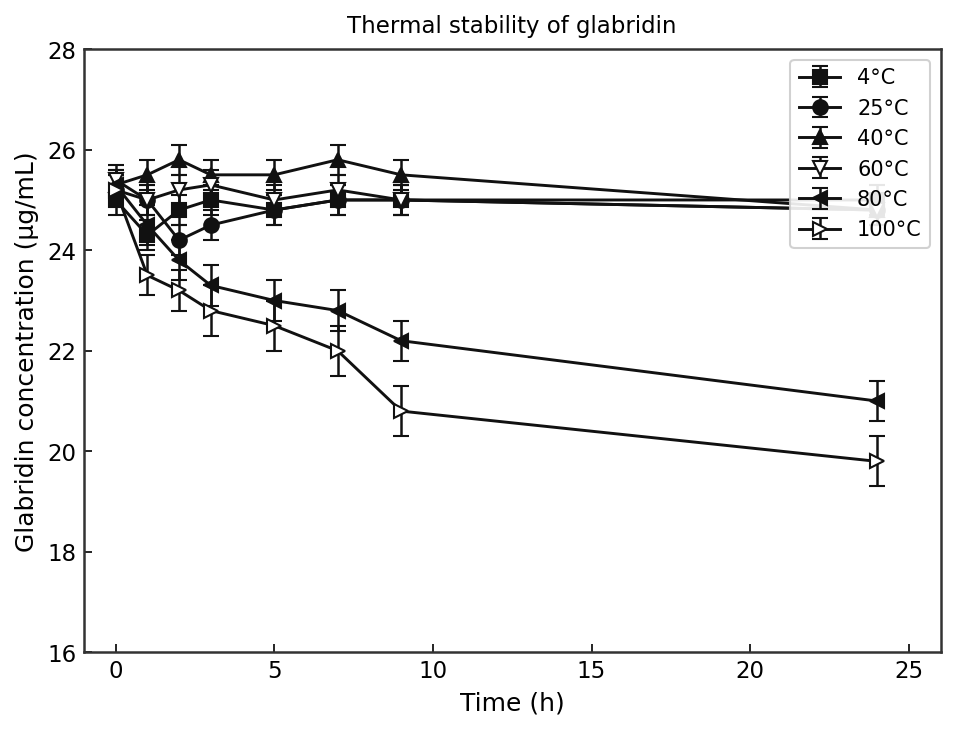
What happens when glabridin is added above 60°C: Active loss occurs before emulsification is complete. The finished product may assay within specification at T=0 (because degradation was partial), but accelerated stability will reveal accelerated color development and assay drop — because the antioxidant capacity of the system was already partially consumed at manufacture.
The same study also identified humidity as an important environmental factor affecting glabridin stability. At 75% and 90% relative humidity (RH), glabridin content was significantly lower than under dry storage conditions, with higher humidity correlating with greater degradation. Both raw materials and finished products are therefore recommended to be stored under light-protected, dry, and sealed conditions to achieve optimal stability.
Control 2 Antioxidant Protection
Glabridin's two phenolic hydroxyl groups are the structural source of its tyrosinase-inhibiting activity — and simultaneously the site of oxidative vulnerability. An effective antioxidant system sacrificially intercepts free radicals before they reach the glabridin molecule.
Recommended antioxidant system by formulation type:
| Formulation Type | Primary Antioxidant | Secondary Antioxidant | Notes |
|---|---|---|---|
| Standard O/W emulsion | Tocopherol 0.2–0.5% | BHT 0.02–0.05% | Most robust; BHT in oil phase |
| COSMOS / clean-label | Tocopherol 0.2–0.5% | Rosemary extract 0.05–0.2% | Both COSMOS-certified |
| Face oil / anhydrous | Tocopherol 0.3–0.5% | Ascorbyl palmitate 0.05–0.1% | High antioxidant load; minimal water |
| Water-based toner/essence | — (use 10% HP-β-CD grade) | Sodium ascorbyl phosphate 0.2–0.5% | HP-β-CD encapsulation handles oil-phase protection; water-phase antioxidant optional reinforcement |
Placement matters: Tocopherol must be incorporated in the oil phase or dissolved with the active, not added to the water phase. It is a lipid-phase antioxidant and has no protective effect when dispersed in an aqueous system.
For the clean-label COSMOS route: rosemary extract (standardized by carnosic acid content) provides comparable protection to BHT in accelerated testing, with the added benefit of being COSMOS-certified and compatible with Huatai's COSMOS-certified glabridin grades.
Control 3 Metal Chelation
Antioxidants function by terminating free radical chain reactions, while chelating agents work by binding transition metal ions such as Fe and Cu, suppressing their ability to catalyze oxidative reactions. The two strategies are complementary and address different points in the degradation pathway.
| Chelator | Use Level | Compatibility | Notes |
|---|---|---|---|
| Disodium EDTA | 0.05%–0.1% | Universal | Most effective; standard industry choice |
| Sodium phytate | 0.1%–0.5% | COSMOS-compatible | Natural chelating agent; also demonstrates antioxidant and skin-conditioning properties |
| Sodium gluconate | 0.1%–0.3% | Universal | Milder; for minimal-additive formulations |
Removing EDTA without introducing an alternative effective chelating agent often increases the risk of oxidative discoloration and stability issues. Botanical extracts, vitamin derivatives, and plant oils may contain residual trace amounts of Fe, Cu, and other metal ions, which can catalyze oxidative reactions under certain conditions. This catalytic effect may manifest as visible stability changes within weeks depending on the formulation system.
Sodium phytate is the recommended COSMOS-compliant replacement. It is effective in the pH range used for glabridin formulations (4.0–6.5), demonstrates antioxidant and skin-conditioning properties, and is accepted under COSMOS v4.
Control 4 pH Management
Glabridin demonstrates good stability under mildly acidic to neutral conditions, while its degradation rate increases in alkaline environments. Based on formulation experience and stability studies on polyphenolic compounds, a pH range of approximately 4.0–5.5 is generally considered favorable for maintaining glabridin stability in cosmetic systems.
| pH Range | Stability | Recommendation |
|---|---|---|
| 4.0–5.5 | Favorable | Target range; buffer to maintain |
| 5.5–6.5 | Good | Acceptable; reinforce antioxidant system |
| 6.5–7.0 | Marginal | Higher degradation risk; monitor closely in stability testing |
| >7.0 | Poor | Avoid — accelerated oxidative degradation under alkaline conditions, progressive color change |
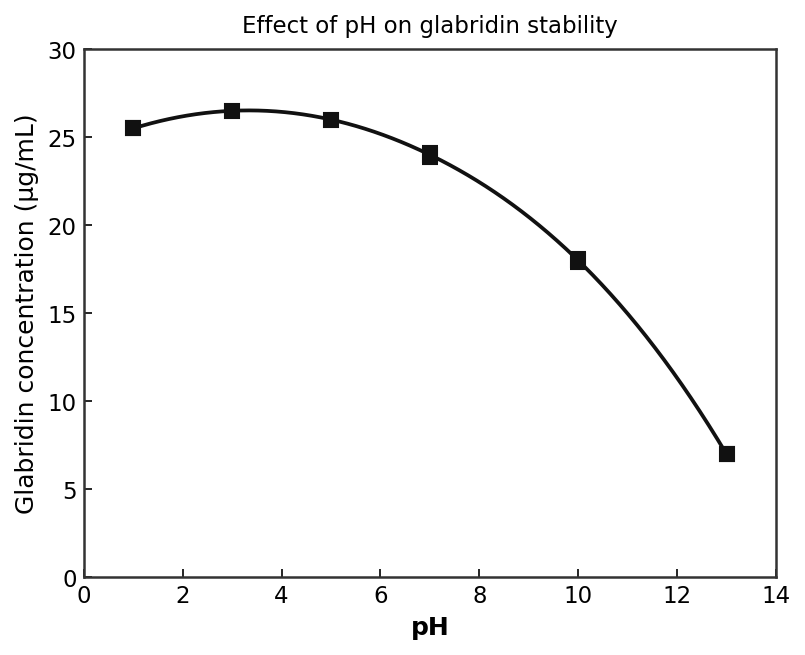
pH verification rule: Always measure final pH after all cool-down additions are complete — not before. Certain co-actives such as niacinamide, tranexamic acid, and some peptides may influence the final pH of the formulation system. Even if the base system reads approximately pH 5.8 before active addition, the final pH may shift after all cool-down phase ingredients are fully incorporated and homogenized. If pH is not re-measured and adjusted in the final equilibrated state, the actual pH of the finished product may deviate from the intended target, potentially affecting long-term stability.
Organic buffer systems such as citric acid/sodium citrate (effective range pH 3.0–6.2) or lactic acid/sodium lactate (effective range pH 3.6–5.8) are commonly used in cosmetic formulations. Both offer good formulation compatibility and generally carry a lower risk of introducing trace metal contamination compared to inorganic buffer systems.
Packaging: A Key External Factor Affecting Stability
Beyond formulation chemistry, packaging plays an important role in managing glabridin stability during consumer use by limiting exposure to light, oxygen, and other environmental stressors.
| Packaging Choice | Protection Mechanism | Applicable Format |
|---|---|---|
| Airless pump | Eliminates repeated headspace O₂ exposure with each press | Serums, emulsions, lotions |
| Opaque or UV-blocking container | Reduces photodegradation risk; light exposure has been identified as a primary degradation factor for glabridin (Ao et al., 2010) | Transparent oil serums, toners in clear bottles |
| Nitrogen blanket during filling | Reduces dissolved O₂ at point of manufacture | Premium formulations with long shelf-life claims |
| Sealed aluminum foil sachet | Provides effective light and oxygen barrier | Single-use formats, travel sizes |
The combination of airless pump + opaque container is the most practical solution for most retail formulations. It requires no change to the formulation itself and directly addresses the two primary finished-product degradation routes.
Stability Testing Protocol
Align stability testing with ICH standards to generate defensible shelf-life data:
| Condition | Parameters | Duration | Regulatory Basis |
|---|---|---|---|
| Accelerated | 40°C / 75% RH | 12 weeks | ICH Q1A(R2) |
| Freeze-thaw | −10°C ↔ 25°C, 24h cycles | 5 cycles | PCPC/CTFA guideline |
| Photostability | D65 + UV per ICH Q1B | 6 weeks | ICH Q1B |
| Real-time | 25°C / 60% RH | 24 months | ICH Q1A(R2) |
Assessment parameters at each timepoint:
- pH — flag any shift greater than 0.3 units
- Color: CIE L*a*b* — track Δb* specifically (yellowing index)
- Glabridin assay by HPLC
- Viscosity
- Organoleptic: odor, visual phase separation
Accelerated stability testing at 40°C/75% relative humidity for approximately 12 weeks is commonly used in cosmetic development as an early predictive model for evaluating formulation robustness and degradation trends. While temperature-dependent degradation behavior can be described using Arrhenius relationships, a direct equivalence between accelerated and real-time storage periods cannot be universally established and requires product-specific kinetic evaluation in accordance with ICH Q1E.
A well-stabilized glabridin formulation should exhibit minimal active degradation and limited color change under accelerated stability conditions, with active loss typically targeted at less than 5% and Δb* maintained at a low level according to predefined product specifications.
Stabilization Checklist
Before releasing a glabridin-containing formulation to stability, verify each of the following:
Every batch ships with COA, TDS, and SDS/MSDS. Additional testing available upon request.
References
- Ao M, Shi Y, Cui Y, Guo W, Wang J, Yu L. Factors influencing glabridin stability. Natural Product Communications, Vol. 5(12), 1907–1912, 2010. DOI: 10.1177/1934578X1000501214. PMID: 21299118.
- Yokota T, Nishio H, Kubota Y, Mizoguchi M. The inhibitory effect of glabridin from licorice extracts on melanogenesis and inflammation. Pigment Cell Research, 11(6), 355–361, 1998. DOI: 10.1111/j.1600-0749.1998.tb00494.x.
- ICH Q1A(R2): Stability Testing of New Drug Substances and Products. International Council for Harmonisation, 2003.
- ICH Q1B: Photostability Testing of New Drug Substances and Products. International Council for Harmonisation, 1996.
- ICH Q1E: Evaluation for Stability Data. International Council for Harmonisation, 2003.

 English
 German
 Italian
 French
 Spanish
 Japanese
 Korean
 Russian