
Yes. Glabridin is not only safe for sensitive skin — its mechanism of action makes it specifically well-suited for it. Two properties distinguish glabridin from most brightening actives in this context: a well-tolerated human-use safety profile with no significant adverse reactions reported in available studies, and direct COX inhibitory activity that helps regulate inflammatory pathways associated with post-inflammatory hyperpigmentation (PIH).
The Safety Evidence
The safety case for glabridin in sensitive skin formulations rests on a human patch test study conducted by an accredited third-party testing institute.
| Parameter | Detail |
|---|---|
| Testing Institute | Guangdong Weipu Testing Technology Co., Ltd. (CMA accredited, No. 202119135666) |
| Report No. | GZA01-23080632-JC-01 |
| Test Product | Skincare water containing 0.03% Glabridin |
| Subjects | 30 volunteers (4M / 26F, age 21–53) |
| Method | Closed patch test; observations at 0.5h / 24h / 48h post-removal |
Result: 30 out of 30 subjects — Grade 0 at all observation timepoints. No significant adverse skin reactions.
This data was generated by Guangdong Weipu Testing Technology Co., Ltd., an independent CMA-accredited testing institution. The result confirms that glabridin at its clinically relevant use concentration produces no measurable skin irritation or adverse reaction under standardized closed-patch conditions. The real-world tolerability finding supports the potential use of glabridin in leave-on skincare formulations at similar use levels.
Why Sensitive Skin Specifically Needs Anti-Inflammatory Brightening
Sensitive skin and reactive skin types share a common underlying dynamic: the inflammatory response is amplified and prolonged compared to non-sensitive skin. This heightened inflammatory state is a key contributor to the increased risk of post-inflammatory hyperpigmentation (PIH), which is primarily driven by inflammation, while ultraviolet exposure may further exacerbate the process.
The standard brightening pathway — tyrosinase inhibition alone — addresses the enzymatic synthesis of melanin but does not modulate the upstream inflammatory pathways that contribute to melanogenesis. For sensitive skin, this matters:
- A tyrosinase-only inhibitor applied after a breakout or irritation episode may help reduce new melanin synthesis, but it does not address the upstream inflammatory pathways that can continue to promote melanogenesis.
- An ingredient that targets both inflammatory pathways and melanin synthesis may provide a more comprehensive approach to managing inflammation-associated pigmentation.
Glabridin does both. Its multi-pathway mechanism — including tyrosinase inhibition, modulation of COX-related inflammatory pathways, and antioxidant radical scavenging — acts on multiple key biological pathways involved in inflammation-associated pigmentation.
Mechanism Mapped to Sensitive Skin Pathology
| Mechanism | Target | Benefit for Sensitive Skin |
|---|---|---|
| Non-competitive tyrosinase inhibition | Melanin synthesis | Reduces new pigment production at the enzymatic step |
| COX inhibition / PGE₂ suppression | Inflammatory pathways associated with melanogenesis | May help reduce inflammatory mediators associated with post-inflammatory hyperpigmentation (PIH) (COX activity inhibition confirmed in primary literature; subtype specificity not fully characterized in Yokota 1998) |
| Antioxidant ROS scavenging | Oxidative stress-driven melanogenesis | Scavenges UV- and environment-induced reactive oxygen species (ROS) that can contribute to melanogenic signaling in sensitive and reactive skin |
In Fitzpatrick skin types III–VI, PIH is a predominant pigmentation concern and is closely linked to inflammation. Inflammatory modulation, including COX-related pathways, may help reduce inflammation-associated pigmentation triggers. Glabridin supports skin calming and barrier-friendly brightening, making it well-suited for sensitive and reactive skin.
Efficacy Data in Context
The human clinical brightening study provides efficacy reference data relevant to sensitive skin applications.
| Parameter | Result |
|---|---|
| Testing Institute | Guangdong Weipu Testing Technology Co., Ltd. (CMA accredited) |
| Report No. | GZA01-23080632-JC-01 |
| Glabridin concentration | 0.03% in leave-on skincare water |
| Subjects | 35 volunteers (8M / 27F, age 28–60) |
| Study duration | 4 weeks |
| Melanin Index (MI) reduction | Statistically significant from Week 1 (P<0.05); 4-week total reduction 16.8% |
| Skin brightness (ITA°) | Significant improvement from Week 2 (P<0.05) |
This result indicates that glabridin can deliver statistically significant brightening effects in a low-concentration leave-on system, providing efficacy evidence to support its use in daily skincare formulations. In vitro tyrosinase inhibition studies show that glabridin exhibits strong enzymatic inhibitory activity (IC₅₀ = 0.09 μmol/L), suggesting its potential role in the melanogenesis pathway.
The antioxidant and firming data from separate in-vitro studies (Guangdong Youjie Testing Technology Co., Ltd.) adds further context:
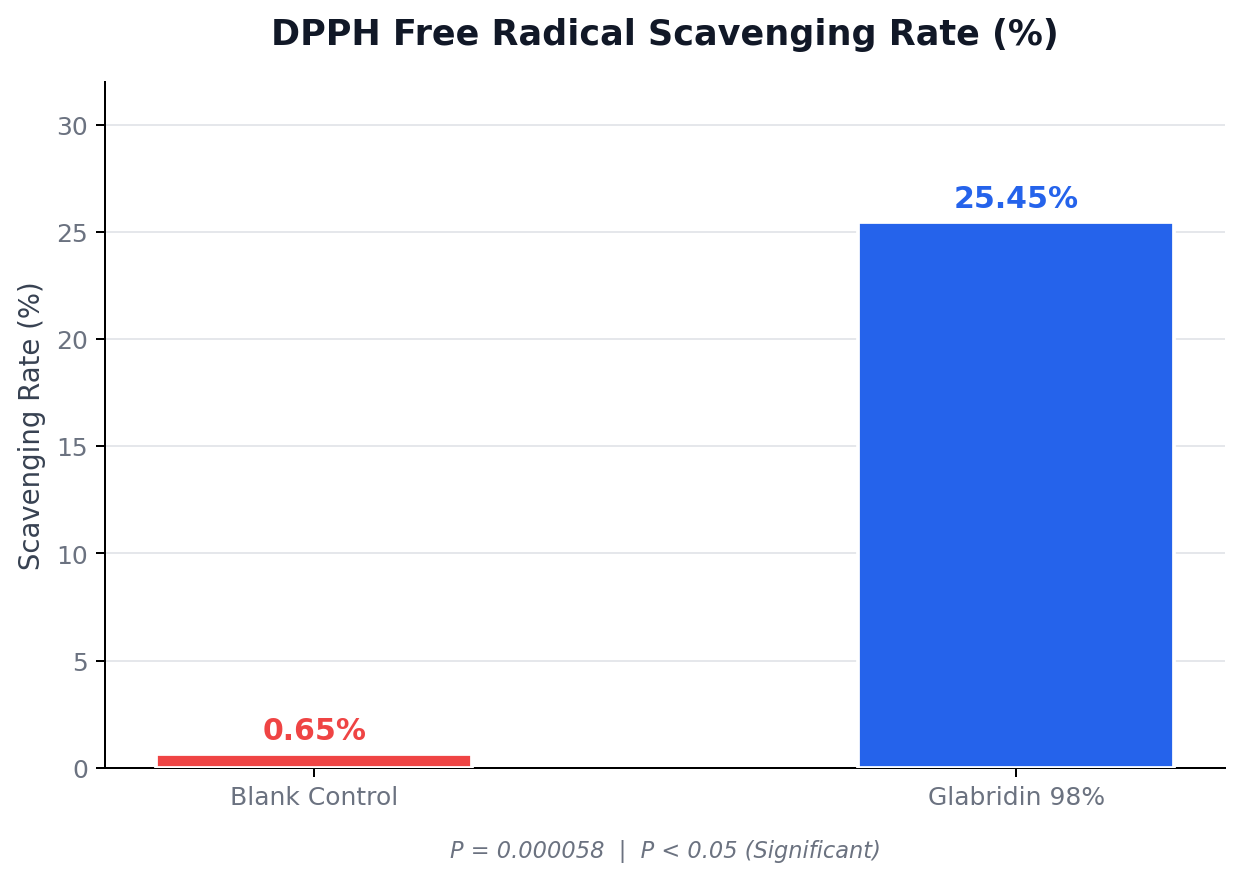
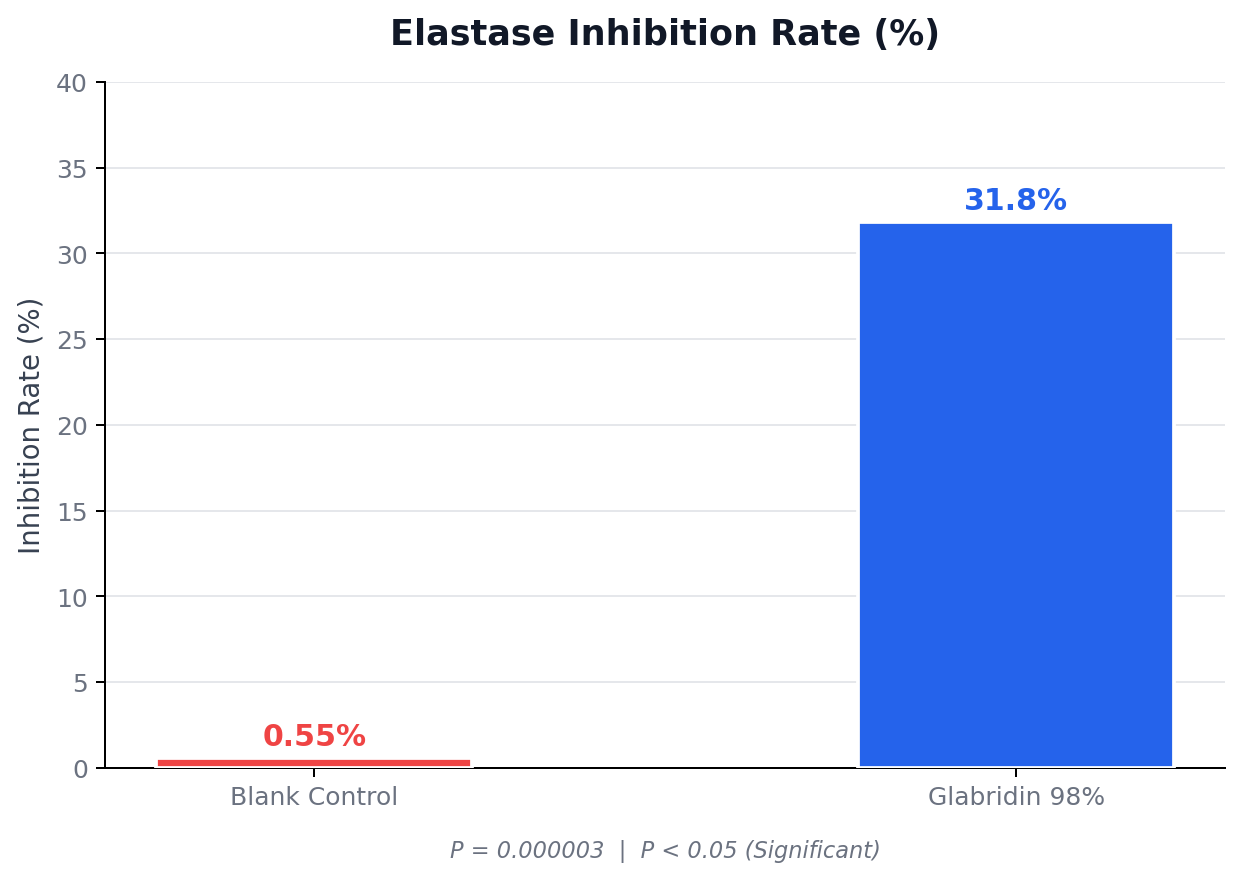
These results demonstrate antioxidant activity and elastase inhibitory potential in vitro, suggesting that glabridin may be relevant to oxidative stress regulation and pathways associated with skin resilience. Oxidative stress is a key contributor to barrier impairment and increased skin reactivity, while extracellular matrix degradation is associated with reduced dermal integrity and diminished resistance to environmental stressors, both of which are characteristics commonly observed in sensitive and reactive skin.
Recommended Co-Active System for Sensitive Skin Brightening
Glabridin's multi-pathway activity anchors a sensitive skin brightening stack. The following co-actives extend coverage across independent points in the pigmentation and inflammation pathways without introducing the irritation risk of aggressive exfoliants or high-dose ascorbic acid.
| Co-Active | Mechanism | Synergy with Glabridin | Sensitive Skin Rationale |
|---|---|---|---|
| Tranexamic Acid (TXA) | Reduces inflammation-related melanocyte activation | TXA modulates inflammatory pigmentation signals; glabridin inhibits melanin synthesis | Suitable for PIH-prone, sensitive skin; well tolerated |
| Ectoin | Membrane stabilization; stress protection (extremophile-derived amino acid derivative) | Reduces environmental and stress-related inflammatory responses; glabridin modulates melanin synthesis via tyrosinase inhibition | Specific benefit for stressed, environmentally compromised, or post-procedure skin |
| Dipotassium Glycyrrhizate (DPG) | Surface-level anti-inflammatory support | DPG provides surface-level anti-inflammatory support, while glabridin targets inflammation-associated pigmentation and melanin synthesis — both licorice-derived actives with complementary formulation functions | Helps reduce discomfort associated with active brightening formulations |
| Niacinamide | Melanosome transfer inhibition | Glabridin reduces melanin production, while niacinamide limits melanosome transfer to keratinocytes | Well-tolerated; barrier-supporting; compatible pH window (5.0–6.0) |
What to avoid in a sensitive skin brightening formula alongside glabridin:
- Raw L-ascorbic acid at high concentrations — requires low pH and may challenge sensitive-skin tolerability
- Hydroxy acids at exfoliating concentrations — may increase irritation and inflammation-related pigmentation risk
- Retinoids — may cause irritation in sensitive skin; compatibility depends on formulation and tolerance strategy
Formulation Guidelines for Sensitive Skin Applications
Active concentration
The clinical study confirms efficacy at 0.03% active. For sensitive skin formulations targeting brightening maintenance and PIH prevention, 0.1–0.3% active is a practical target. For active PIH correction in non-reactive skin, 0.3–0.5% is appropriate.
Grade selection
- Leave-on serum or essence: 10% water-soluble powder (HP-β-CD encapsulated) or 1–5% water-soluble liquid grade
- Emulsion or moisturizer: 90% oil-soluble powder in oil phase (0.2%), or 40% white powder in cool-down alcohol phase
- Face oil or balm for PIH-prone skin: 90% oil-soluble powder at 0.2%
Texture and base considerations
Sensitive skin formulations benefit from lightweight, non-occlusive textures that minimize heat and occlusion. Avoid high-concentration emollient esters that may trigger milia in acne-sensitive populations. A water-based serum or light fluid emulsion is typically preferred over a heavy cream for PIH-focused sensitive skin positioning.
pH target
Target pH typically in the mildly acidic range (approx. 4.5–5.5) — aligned with both glabridin stability requirements and physiological skin surface pH. This pH range supports barrier function and microbiome balance, which are both relevant to sensitive skin management.
Every batch ships with COA, TDS, and SDS/MSDS. Additional testing available upon request.
References
- Yokota T, Nishio H, Kubota Y, Mizoguchi M. The inhibitory effect of glabridin from licorice extracts on melanogenesis and inflammation. Pigment Cell Research, 11(6), 355–361, 1998. DOI: 10.1111/j.1600-0749.1998.tb00494.x. — Establishes COX inhibition and non-competitive tyrosinase inhibition mechanisms.
- Guangdong Weipu Testing Technology Co., Ltd. (CMA No. 202119135666). Report No. GZA01-23080632-JC-01. Human skin patch test + 4-week skin brightening efficacy study, 0.03% Glabridin. Commissioned by Huatai Bio-Fine Chemical.
- Guangdong Youjie Testing Technology Co., Ltd. Report Nos. YJ-R-GX202503-0099, YJ-R-GX202503-0098. DPPH radical scavenging and elastase inhibition studies, Glabridin 98%. Commissioned by Huatai Bio-Fine Chemical.



 English
 German
 Italian
 French
 Spanish
 Japanese
 Korean
 Russian