
Post-acne pigmentation is a form of post-inflammatory hyperpigmentation (PIH) with pathogenic drivers distinct from UV-induced spots and melasma. The challenge is not only residual pigmentation but also the underlying inflammatory processes associated with acne lesions that drive melanogenesis. Formulations that target only existing pigmentation, without addressing upstream inflammation, may be less effective in preventing recurrent PIH.
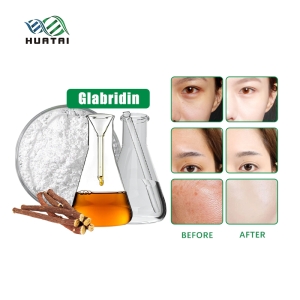
Glabridin and Totarol address this problem through complementary pathways — one targeting microbial and inflammatory factors associated with acne lesions, and the other modulating inflammatory and melanogenic responses involved in PIH formation. Together, they form a conceptual layered approach combining upstream control and downstream pigment regulation.
The Post-Acne PIH Problem
Why Brightening Alone Is Not Enough
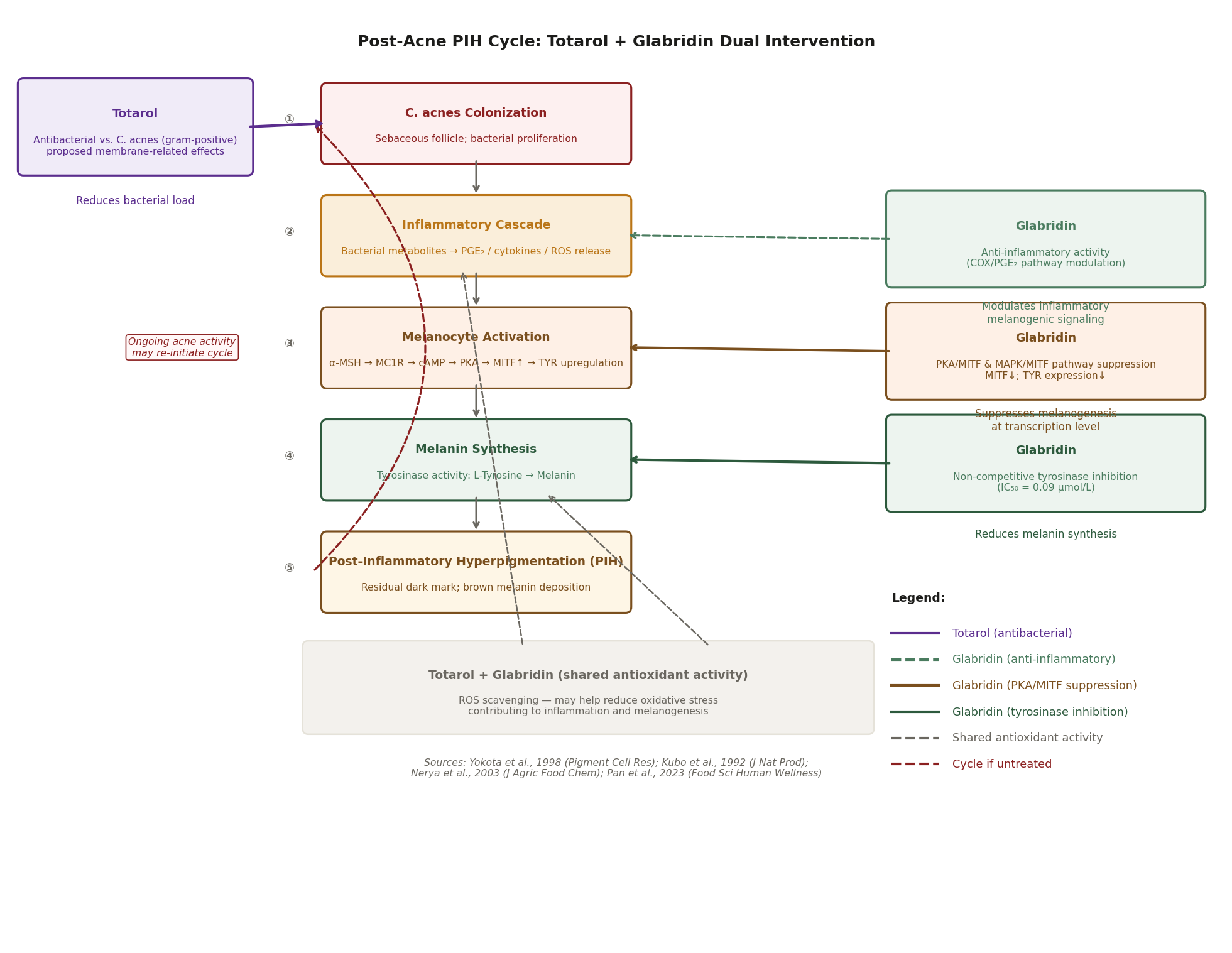
Post-acne PIH follows a well-established sequence:
- Cutibacterium acnes (C. acnes) colonizes the sebaceous follicle
- Bacterial metabolites trigger an inflammatory response in surrounding skin
- The inflammatory cascade — via prostaglandin E₂ and other mediators — stimulates melanocytes to increase melanin synthesis
- Inflammation resolves (or continues subclinically), leaving a residual dark mark: PIH
- If the bacterial trigger is not controlled, ongoing acne activity may re-initiate the sequence starting from step 1
Standard brightening actives — tyrosinase inhibitors, vitamin C derivatives, niacinamide — address step 4 (the pigmentation) but not steps 1–3 (the bacterial trigger and inflammatory cascade). For skin with ongoing acne activity, this means brightening treatment is applied to a system that keeps producing new PIH. The treatment is continuously less effective in the presence of persistent inflammatory activity.
Effective post-acne PIH repair requires simultaneous action at two levels: the acne-related inflammatory triggers and the pigmentation consequence.
The Two-Active Architecture
Totarol: Targeting the Bacterial Trigger
Totarol is a diterpenoid phenol extracted from the heartwood of Podocarpus totara, typically sourced from sustainably managed New Zealand forests. It is available as a COSMOS-certified raw material and is distributed exclusively through Huatai in Mainland China.
Antimicrobial mechanism: Totarol exhibits antimicrobial activity against gram-positive bacteria and has shown inhibitory effects against C. acnes in vitro. Propionibacterium acnes (now C. acnes) was identified as the most sensitive bacterium in the original Totarol antimicrobial characterization study (Kubo et al., 1992). Proposed mechanisms include interference with bacterial cell division, with FtsZ-related processes suggested in some studies, as well as disruption of bacterial membrane integrity at effective concentrations.
Totarol also shows antioxidant activity and may help reduce lipid oxidation in sebum-related environments. Lipid oxidation products are associated with comedogenic and inflammatory processes in acne-prone skin.
Additional activity: Totarol has documented antioxidant activity and may contribute to the reduction of ROS in skin-related environments. This effect works in synergy with glabridin's antioxidant activity, contributing to a reduction in overall oxidative stress.
Formulation profile:
- Oil-soluble; belongs in the oil phase or polyol phase
- COSMOS-certified (Totarol 99%, 100% PPAI)
- Compatible with glabridin in the same phase
- Typical cosmetic use level: 0.05–0.2%
Glabridin: Managing the Inflammatory and Melanogenic Consequences
Glabridin addresses the post-acne PIH consequence through multiple mechanisms:
Anti-inflammatory activity: Glabridin exhibits anti-inflammatory effects through modulation of inflammatory signaling pathways, including reported downregulation of COX-2 and related mediators in cellular models. This helps reduce inflammatory signaling associated with post-acne pigmentation.
PKA/MITF & MAPK/MITF pathway suppression: Glabridin has been shown to suppress both PKA/MITF and MAPK/MITF signaling pathways, significantly downregulating the transcription and protein expression of MITF, TYR, TRP-1, and TRP-2 in melanocytes (Pan et al., 2023). This upstream transcriptional suppression reduces the melanogenic capacity of activated melanocytes — addressing the root of new melanin production rather than only the enzymatic step.
Tyrosinase inhibition: Glabridin inhibits tyrosinase activity and reduces melanin synthesis, resulting in decreased formation of new melanin (IC₅₀ = 0.09 μmol/L, Nerya et al., 2003).
Antioxidant ROS scavenging: Reduces intracellular reactive oxygen species (ROS), thereby lowering oxidative stress that can contribute to inflammation and melanogenesis.
The Layered Coverage Framework
| Phase | Active | Mechanism | Outcome |
|---|---|---|---|
| Prevention | Totarol | C. acnes antibacterial activity; proposed membrane-related effects | Reduces bacterial trigger and follicular inflammatory environment |
| Signal modulation | Glabridin (anti-inflammatory activity) | Anti-inflammatory signaling involving reported modulation of COX-2 expression | Reduces inflammatory melanogenic signal from residual or resolved inflammation |
| Transcriptional control | Glabridin (PKA/MITF) | Suppression of PKA/MITF & MAPK/MITF pathways; MITF↓; TYR expression↓ | Reduces melanogenic capacity at transcription level |
| Synthesis inhibition | Glabridin (tyrosinase) | Non-competitive tyrosinase inhibition | Reduces new melanin production |
| Oxidative control | Totarol + Glabridin | ROS scavenging (both actives) | May help reduce oxidative stress contributing to inflammation and melanogenesis |
This is not a brightening formula with an antimicrobial additive, nor an acne formula with a pigmentation afterthought. It is a system designed to address multiple interconnected pathways involved in post-acne pigmentation.
Complementary Actives for the Full System
| Active | Role | Notes |
|---|---|---|
| Tranexamic Acid (TXA) | Modulation of keratinocyte–melanocyte signaling (via plasmin-related pathways) | Water-soluble; add to water phase; compatible at pH 4.5–6.0 |
| Niacinamide | Melanosome transfer reduction; sebum regulation (relevant for acne-prone skin) | 2–5%; water phase |
| Licochalcone A | Anti-inflammatory; sebum control; mild brightening | Also licorice-derived; oil-phase compatible; COSMOS-certified |
| Zinc PCA | Sebum regulation; anti-inflammatory; supports C. acnes environment disruption | Water-soluble; 0.1–0.5% |
| Azelaic acid | Keratinization modulation; tyrosinase inhibition; C. acnes activity reduction | Addresses multiple post-acne targets; pH 4.5–6.5 |
Note on azelaic acid: Azelaic acid and glabridin are pH-compatible and address different aspects of the post-acne PIH system. Azelaic acid exhibits effects on keratinization and has additional activity on melanogenesis and C. acnes, while glabridin primarily targets melanin synthesis and inflammatory signaling. The combination is functionally complementary.
Formulation Guidelines
Texture and Base Considerations
Post-acne and acne-prone skin benefits from a light, non-comedogenic texture. Heavy emollient esters, high-viscosity silicones, and thick cream bases may increase occlusivity, which can contribute to a less favorable follicular environment in acne-prone skin.
Recommended base approaches:
- Light fluid emulsion (O/W, low oil phase, ≤15%)
- Water-based serum with Totarol and glabridin via appropriate solubilization
- Light ester-based serum (isononyl isononanoate, C12–15 alkyl benzoate) — low viscosity, skin-compatible emollients
Grade Recommendations
| Active | Recommended Grade | Phase | Notes |
|---|---|---|---|
| Glabridin | 40% white powder | Polyol phase (pre-dissolved) | Skin-compatible ester or polyol system preferred |
| Glabridin | 90% oil-soluble | Oil phase (if oil fraction present) | Typical use level: ~0.2% |
| Totarol | 99% COSMOS-certified | Oil phase | 0.05–0.2% |
Target Use Levels
| Active | Target Level | Notes |
|---|---|---|
| Glabridin | 0.1–0.3% active | Expressed as final active content in finished product |
| Totarol | 0.05–0.2% | Typical cosmetic use range depending on formulation system |
| TXA | 2–5% | Water phase |
| Niacinamide | 2–5% | Water phase |
| Zinc PCA | 0.1–0.5% | Water phase |
pH Management
Target pH: 4.5–5.5
Both glabridin and TXA are compatible with this pH range under typical formulation conditions. Azelaic acid (if included) is effective at pH 4.5–6.5. Niacinamide functions at pH 5.0–7.0 — the lower end may be used with appropriate formulation control. Buffer with citric acid/sodium citrate. Verify pH after all cool-down additions.
Post-Acne PIH Serum — Structural Blueprint
| Phase | Ingredient | Target % | Function |
|---|---|---|---|
| Water phase | Purified water | q.s. | Carrier; buffered |
| Water phase | Citric acid / Sodium citrate | Buffer | Target pH 4.8–5.0 before actives |
| Water phase | Disodium EDTA | 0.05–0.1% | Metal chelation |
| Water phase | Niacinamide | 2–5% | Melanosome transfer reduction; sebum regulation |
| Water phase | Tranexamic Acid | 2–5% | Modulation of keratinocyte–melanocyte signaling (plasmin-related pathway) |
| Water phase | Zinc PCA | 0.1–0.5% | Sebum regulation; anti-inflammatory |
| Water phase | Azelaic acid (if included) | 5–10% | Keratinization modulation; tyrosinase inhibition; C. acnes activity reduction |
| Oil/polyol phase | Non-comedogenic ester | 5–15% | Lightweight carrier |
| Oil/polyol phase | Glabridin 40% white (pre-dissolved) | 0.1–0.3% active | Primary brightening anchor; tyrosinase inhibition; anti-inflammatory |
| Oil/polyol phase | Totarol 99% | 0.05–0.2% | Antibacterial activity against C. acnes; lipid-phase antioxidant |
| Oil/polyol phase | Mixed Tocopherols | 0.2–0.5% | Lipid-phase antioxidant (strongly recommended) |
| Emulsifier | Low HLB + high HLB combination | As required | Light, non-greasy emulsification |
| Cool-down | pH correction if needed | — | Citric acid solution (10% w/w) |
| Cool-down | Preservative system | As required | Appropriate for pH 4.5–5.5 |
Every batch ships with COA, TDS, and SDS/MSDS. Additional testing available upon request.
Huatai is the exclusive distributor of Totarol in Mainland China. Totarol samples and technical data sheets available on request.
References
- Yokota T, Nishio H, Kubota Y, Mizoguchi M. The inhibitory effect of glabridin from licorice extracts on melanogenesis and inflammation. Pigment Cell Research, 11(6), 355–361, 1998. DOI: 10.1111/j.1600-0749.1998.tb00494.x.
- Kubo I, Muroi H, Himejima M. Antibacterial activity of totarol and its potentiation. Journal of Natural Products, 55(10), 1436–1440, 1992. DOI: 10.1021/np50088a008. PMID: 1453180. — Propionibacterium acnes identified as the most sensitive bacterium to Totarol.
- Nerya O, Vaya J, Musa R, Izrael S, Ben-Arie R, Tamir S. Glabrene and isoliquiritigenin as tyrosinase inhibitors from licorice roots. Journal of Agricultural and Food Chemistry, 51(5), 1201–1207, 2003. — IC₅₀ comparative data.
- Pan C, Liu X, Zheng Y, et al. The mechanisms of melanogenesis inhibition by glabridin: molecular docking, PKA/MITF and MAPK/MITF pathways. Food Science and Human Wellness, 12(1), 212–222, 2023. DOI: 10.1016/j.fshw.2022.07.011.
- Maeda K, Nishino H. Mechanism of the inhibitory effect of tranexamic acid on melanogenesis in cultured human melanocytes in the presence of keratinocyte-conditioned medium. Journal of Health Science, 53(4), 389–396, 2007. DOI: 10.1248/jhs.53.389.
- Guangdong Weipu Testing Technology Co., Ltd. (CMA No. 202119135666). Report No. GZA01-23080632-JC-01. Human skin brightening efficacy study, 0.03% Glabridin. Commissioned by Huatai Bio-Fine Chemical.



 English
 German
 Italian
 French
 Spanish
 Japanese
 Korean
 Russian