The Supplier Landscape: Manufacturers, Traders, and Everyone in Between
The first thing to understand about sourcing cosmetic ingredients from China is that the market is not transparent about who actually makes what. On Alibaba, Made-in-China, or even through direct sales outreach, you will encounter three types of suppliers — and they do not always identify themselves clearly.
Own production facilities, run extraction and purification in-house, hold certifications in their own name, and can provide batch-specific documentation tied to their own production records. When something goes wrong with a batch, they can trace it.
Purchase finished ingredients from manufacturers and resell them, sometimes repackaging under their own brand. The underlying manufacturing documentation — HPLC chromatograms, heavy metal data, production records — belongs to the factory they sourced from. In a quality dispute, they cannot always provide what you need.
Represent multiple manufacturers without holding inventory. Their value is market access and logistics; their limitation is the same as traders when it comes to traceability and documentation depth.
None of these models is inherently wrong — the problem arises when a brand assumes they are dealing with one type when they are dealing with another. The practical consequence is that traceability, documentation depth, and quality accountability differ significantly across these three categories.
How to Verify a Chinese Supplier Is Legitimate
Confirming manufacturer status requires more than a self-declaration. The most reliable signals are structural ones that can be independently verified rather than simply stated.
- 1Check the business license scopeChinese business licenses list the permitted scope of operations explicitly. A manufacturer's license will include production-related terms (生产, meaning production); a trading company's license will list sales or trading activities only, without production authorization. Business license information is publicly registered and can be cross-referenced through Chinese business registry databases.
- 2Compare addresses on certifications against the supplier's contact addressCOSMOS certificates and ISO 9001 certificates issued to a specific facility will carry the facility address. If the address on the certificate differs from the supplier's commercial address — particularly if they are in different cities — this warrants clarification.
- 3Request a live facility walkthroughA video call showing active production lines, extraction equipment, and cleanroom facilities in real time is difficult to replicate without an actual facility. A direct manufacturer will accommodate this without hesitation.
- 4Cross-reference in trade data platformsFor significant volume commitments, platforms such as Panjiva or ImportGenius (where data is available) allow you to review a supplier's export history. A genuine cosmetic active manufacturer will show a consistent export history concentrated in their product category. A trading company will typically show a broader and more varied range of exported goods.
What COA Data Actually Tells You — and What It's Worth Reading Carefully
A Certificate of Analysis is the most commonly requested document in cosmetic ingredient sourcing, and most worth reading carefully rather than treating as a formality.
A COA tells you what the supplier measured, using their own method, on the specific batch they tested. It does not tell you whether the testing was conducted correctly, whether the batch you receive matches the batch they tested, or whether the method they used is appropriate for the ingredient.
What to Look for on a COA
The purity figure is the headline number, but the method matters as much as the result. For high-purity actives like glabridin, HPLC (High Performance Liquid Chromatography) is the appropriate method. If a COA for a 98% glabridin powder reports purity by UV spectroscopy rather than HPLC, the number is not directly comparable — UV methods are less specific than HPLC and may not distinguish the target molecule from structurally related compounds.
The batch number and production date should appear on every COA. A COA without a batch number is a specification sheet, not an analysis certificate — it tells you what the product should be, not what this specific batch actually is.
Loss on drying (moisture content), residue on ignition (ash content), and microbial counts should all appear alongside the purity figure. A COA that only reports purity is incomplete for cosmetic ingredient qualification.
What a COA cannot tell you: A COA cannot confirm whether the sample submitted for testing was representative of the full batch. For high-value or high-risk ingredients, independent retesting of the received material against the COA is the only way to close this gap.
Reading a COSMOS Certificate: What Most Brands Miss
COSMOS certification is increasingly required or expected for clean beauty ingredient sourcing, but most brands verify only that a certificate exists — not what it actually covers. A COSMOS certificate issued by Ecocert Greenlife SAS specifies three things that matter for sourcing:
The certificate is issued to a specific legal entity. If the supplier you are buying from is different from the entity named on the certificate — for example, a distributor reselling a manufacturer's certified ingredient — the certification applies to the manufacturer, not to your supplier's operation. This does not automatically invalidate the certification for the ingredient, but it means your supplier cannot make COSMOS claims in their own name.
Each COSMOS certificate lists specific ingredients and grades covered. A manufacturer may hold COSMOS certification for glabridin 40% and 90% but not for 98% — or for alcohol-soluble grades but not oil-soluble. Buying a non-listed grade from a COSMOS-certified manufacturer does not make that grade COSMOS-certified. Always cross-check the exact grade and form you are purchasing against the certificate scope.
COSMOS certificates run on annual renewal cycles. A certificate that expired recently is not a minor administrative issue — it means the ingredient has not been audited under the current standard for at least one cycle. Check the expiry date every time, not just at initial qualification.
All of this is verifiable at cosmos-standard.org using the certificate number the supplier provides.
The Certification Trap: When More Is Not Better
Chinese manufacturers frequently list every certification they hold, and procurement teams can treat a longer list as a proxy for higher quality. This logic does not hold.
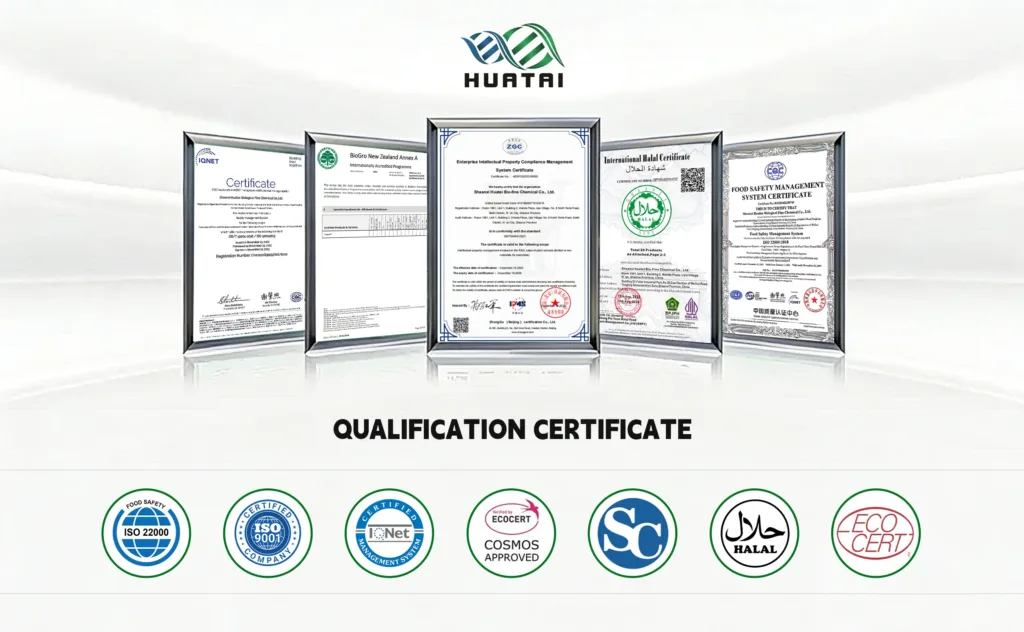
Some certifications that appear in supplier profiles apply to entirely separate product lines. A manufacturer that produces both food-grade licorice extracts and cosmetic-grade glabridin may hold food safety certifications for the food line, and COSMOS and ISO 9001 for the cosmetic line. These are separate scopes. Confirming which certifications apply specifically to the cosmetic-grade product you are purchasing — and asking the supplier to demonstrate this — is a standard part of supplier qualification.
For cosmetic actives, the certifications that matter are: ISO 9001 (quality management, cosmetic scope), COSMOS (if natural/organic compliance is required), and HALAL (if market access requires it).
Third-Party Testing: What It Confirms and What It Doesn't
Third-party purity reports from labs like Intertek, SGS, or Eurofins are a meaningful signal — but only when you understand what was actually tested.
A third-party HPLC report confirming 99.3% glabridin purity tells you that a specific sample, submitted by the manufacturer at a specific point in time, tested at that purity level by that lab. It does not guarantee that every batch will test at that level, and it says nothing about heavy metals, pesticide residues, microbial counts, or solvent residues unless those were specifically included in the test scope.
Third-party testing is most useful as a qualification tool — confirming that the manufacturer can produce to the stated specification — and as an ongoing audit mechanism when you have incoming batches independently retested against the COA. For ingredients where purity directly affects formulation performance and regulatory compliance, incoming retesting is worth building into your quality process rather than treating as an exceptional measure.
Huatai Bio as a Case Study
Shaanxi Huatai Bio-Fine Chemical Co., Ltd. is a direct manufacturer of glabridin powder and other licorice-derived cosmetic actives, operating production facilities in Yangling, Shaanxi Province since 2008.
Applied against the framework above:
Frequently Asked Questions
References
- ISO 9001:2015 Quality Management Systems — iso.org
- COSMOS Standard v4.0 — cosmos-standard.org
- Ecocert Greenlife SAS — COSMOS v4 Certificate N°277614-20251216_0226 (Huatai Bio-Fine Chemical)
- Intertek Testing Services Ltd., Shanghai — HPLC Purity Report SHAH01681145
- Bureau Veritas (Xinuo, Shandong) — Pesticide Residue Report XN-20211207001
- CAS Testing (CMA certified) — Heavy Metal Reports GXC22070392 / GXC22070393
-300x300.jpg)

 English
 German
 Italian
 French
 Spanish
 Japanese
 Korean
 Russian