
Glabridin and niacinamide are among the most commonly paired brightening actives in modern formulations. This combination is based on their complementary roles in pigmentation biology: glabridin primarily targets melanin synthesis through tyrosinase-related pathways, while niacinamide helps reduce melanosome transfer from melanocytes to keratinocytes. Together, they address different stages of the pigmentation process — from melanin formation to visible pigment accumulation in the epidermis.
Where Each Acts in the Pigmentation Pathway
The pigmentation pathway involves several stages, from melanin synthesis inside melanocytes to melanosome transfer and distribution within keratinocytes. Glabridin and niacinamide act at different stages of this process.
Glabridin — Melanin Synthesis and Upstream Signaling
Glabridin acts primarily at the melanin synthesis stage within melanocytes. It has been reported to inhibit tyrosinase activity through a non-competitive mechanism, reducing tyrosinase-catalyzed conversion of L-tyrosine to L-DOPA and L-DOPA to dopaquinone — key steps in melanin biosynthesis. It may also modulate inflammation-related melanogenesis pathways, including COX/PGE₂-associated signaling (Yokota et al., 1998).
More recent research has further characterized glabridin's upstream signaling activity. Glabridin has been shown to suppress both PKA/MITF and MAPK/MITF signaling pathways in melanocytes, significantly downregulating the transcription and protein expression of melanogenesis-related factors including MC1R, MITF, TYR, TRP-1, and TRP-2 (Pan et al., 2023). This means glabridin acts at multiple levels: upstream at the signaling cascade (reducing MITF-driven enzyme expression) and at the enzymatic level (directly inhibiting tyrosinase catalytic activity).
The result: less melanin is produced, resulting in reduced melanin content within melanosomes and lower downstream pigment accumulation.
Niacinamide — Melanosome Transfer
Niacinamide (vitamin B3) acts downstream of melanin synthesis — at the transfer step. The mechanism is proposed to involve modulation of keratinocyte–melanocyte signaling pathways associated with melanosome transfer. By reducing this transfer, niacinamide limits the delivery of melanosomes to keratinocytes, where they contribute to visible pigmentation (Hakozaki et al., 2002).
Niacinamide does not inhibit tyrosinase or melanin production directly. It intervenes after melanin has been produced, reducing how much reaches the keratinocyte layer where it becomes visible. It also contributes indirect anti-inflammatory support through barrier function improvement, which is relevant in reactive and sensitive skin contexts.
Mechanism Comparison
| Parameter | Glabridin | Niacinamide |
|---|---|---|
| Primary mechanism | Non-competitive tyrosinase inhibition | Reduction of melanosome transfer |
| Upstream signaling | PKA/MITF & MAPK/MITF pathway suppression; MITF↓; COX/PGE₂ modulation | No direct upstream signaling activity |
| Targets melanosome transfer? | No | Yes — associated with reduced transfer |
| Anti-inflammatory? | Yes — COX/PGE₂ pathway modulation | Yes — indirect anti-inflammatory (barrier-mediated) |
| Addresses visible pigmentation? | Indirectly (reduces melanin production → lowers transfer burden) | More directly (reduces melanosome transfer to keratinocytes) |
| Formulation phase | Oil / polyol phase (standard grades); water phase (10% HP-β-CD grade) | Water phase |
| Compatible pH range | ~pH 4.0–6.5 | ~pH 5.0–7.0 |
The Complementary Logic
Glabridin reduces the amount of melanin available for transfer; niacinamide reduces the transfer of melanosomes to keratinocytes. When both are used together, the combined effect operates at both functional stages — reduced production and reduced transfer — providing broader control of pigmentation formation and distribution compared with either alone.
A 2026 study (Pharmaceuticals) further confirmed that in α-MSH-treated melanocytes, both glabridin and niacinamide suppress dendrite formation and elongation, and in a UVB-irradiated co-culture system, both inhibit melanin transfer to keratinocytes through regulation of Rho GTPases — suggesting the two actives have mechanistically distinct but potentially complementary effects even at the transfer step (Fang et al., 2026).
Niacinamide's Additional Co-Benefits
Niacinamide contributes to brightening formulations not only through its role in pigmentation regulation but also through additional skin health functions — making it a multifunctional active rather than a secondary brightening agent:
- Barrier function support: Stimulates ceramide synthesis and improves stratum corneum integrity — directly relevant for sensitive and reactive skin formulations
- Sebum regulation: Reduces sebum production through sebaceous gland activity modulation — relevant for oily skin and acne-adjacent formulations
- Pore appearance: Reduces visible pore size with consistent use at 5–10%
- Soothing: Indirect anti-inflammatory activity via barrier improvement reduces skin reactivity over time
These co-benefits mean that niacinamide contributes to brightening formulations not only through its role in pigmentation regulation but also through its additional skin health functions — making it a multifunctional active rather than a secondary brightening agent.
Formulation Compatibility
Glabridin and niacinamide are directly compatible in the same formulation. Their pH windows overlap at approximately pH 5.0–6.0 — a range that is also appropriate for most sensitive skin and brightening leave-on formats. There is no reported physicochemical incompatibility between the two actives.
Formulation note: While glabridin and niacinamide are compatible within the same formulation, overall stability should still be evaluated based on the complete system, including pH, oxidation control, packaging, and other active ingredients.
Recommended use levels
| Active | Recommended Range | Notes |
|---|---|---|
| Glabridin | 0.1–0.5% active in finished product | Clinical data available at 0.03%; higher levels may be used for more intensive pigmentation concerns |
| Niacinamide | 2–10% | Brightening and barrier support: 2–5%; sebum regulation and pore appearance benefits: commonly used at 5–10% |
Niacinamide is one of the well-studied cosmetic actives with concentration-dependent effects across different skin benefits, although the optimal level depends on the specific target. At 2%, brightening benefits can be observed. Around 5%, barrier support and sebum-related benefits are commonly reported. Higher concentrations (such as 10%) are used in some formulations, but may increase the likelihood of irritation or sensitivity in some users.
Complete Brightening System Design
Glabridin and niacinamide form two of the five key nodes in a complete multilevel brightening system. When combined with TXA, stable vitamin C derivatives, and barrier actives, the system covers the major modifiable stages of the pigmentation pathway:
| Pathway Stage | Active | Mechanism |
|---|---|---|
| Keratinocyte signaling (upstream) | TXA | Plasminogen pathway inhibition; reduces melanogenic signaling |
| Melanocyte activation / MITF | Glabridin | PKA/MITF & MAPK/MITF pathway suppression; MITF↓ |
| Tyrosinase activity | Glabridin | Non-competitive tyrosinase inhibition |
| Melanin synthesis | AA-2G or MAP (stable Vitamin C) | Antioxidant reduction of dopaquinone and inhibition of melanin polymerization |
| Melanosome transfer | Niacinamide | Reduces melanosome transfer |
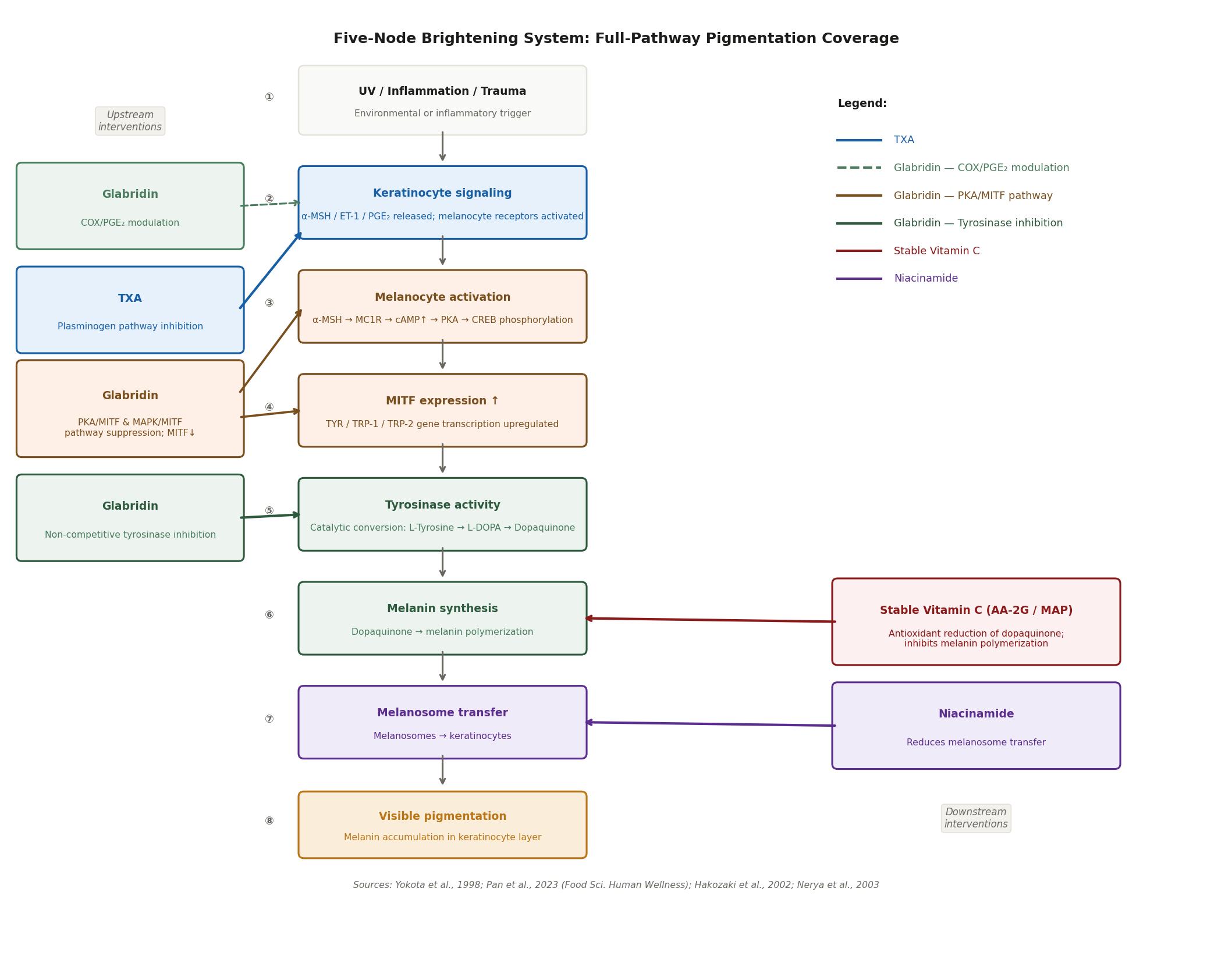
This five-point system — TXA + glabridin + niacinamide + stable vitamin C derivatives — provides comprehensive coverage of key modifiable nodes in pigmentation biology, within compatible pH windows (4.5–6.0).
Application Contexts
| Application | Rationale |
|---|---|
| Post-acne PIH repair | Glabridin (tyrosinase inhibition + anti-inflammatory activity) addresses inflammatory origin; niacinamide reduces melanosome transfer; barrier function support aids recovery |
| Products targeting Fitzpatrick III–VI | PIH and pigment distribution are key concerns; glabridin + niacinamide addresses both production and transfer |
| Sensitive skin brightening | Both actives are well-tolerated; niacinamide's barrier support actively supports skin recovery alongside brightening |
| General brightening maintenance | Cost-effective multilevel system with broad formulation compatibility |
| Oily skin / acne-adjacent brightening | Niacinamide adds sebum regulation; glabridin adds anti-inflammatory support |
Every batch ships with COA, TDS, and SDS/MSDS. Additional testing available upon request.
References
- Yokota T, Nishio H, Kubota Y, Mizoguchi M. The inhibitory effect of glabridin from licorice extracts on melanogenesis and inflammation. Pigment Cell Research, 11(6), 355–361, 1998. DOI: 10.1111/j.1600-0749.1998.tb00494.x.
- Pan C, Liu X, Zheng Y, et al. The mechanisms of melanogenesis inhibition by glabridin: molecular docking, PKA/MITF and MAPK/MITF pathways. Food Science and Human Wellness, 12(1), 212–222, 2023. DOI: 10.1016/j.fshw.2022.07.011.
- Hakozaki T, Minwalla L, Zhuang J, et al. The effect of niacinamide on reducing cutaneous pigmentation and suppression of melanosome transfer. British Journal of Dermatology, 147(1), 20–31, 2002. DOI: 10.1046/j.1365-2133.2002.04834.x.
- Fang Y, et al. Glabridin inhibits melanogenesis and melanin transfer via Wnt/β-catenin pathway and Rho family GTPase-mediated dendritic formation suppression. Pharmaceuticals, 19(3), 469, 2026. DOI: 10.3390/ph19030469.
- Nerya O, Vaya J, Musa R, Izrael S, Ben-Arie R, Tamir S. Glabrene and isoliquiritigenin as tyrosinase inhibitors from licorice roots. Journal of Agricultural and Food Chemistry, 51(5), 1201–1207, 2003.


 English
 German
 Italian
 French
 Spanish
 Japanese
 Korean
 Russian