
Glabridin and TXA are two of the most scientifically supported brightening actives in modern cosmetic formulations. Unlike many ingredient comparison discussions, the conclusion is straightforward: these two actives do not compete — they target different regulatory points within the melanogenesis pathway. Their combination offers complementary pathway coverage that a single active alone may not provide.
Where Each Acts in the Pigmentation Pathway
Melanin synthesis follows a cascade:
- Environmental or inflammatory stimulus (UV, pollution, trauma, acne) triggers keratinocytes to release signaling molecules
- Keratinocyte-derived mediators, including plasminogen activator-related signals and arachidonic acid metabolites, can stimulate melanocyte activity and promote pigmentation
- Tyrosinase activation — within melanocytes, tyrosinase functions as the rate-limiting enzyme responsible for initiating melanin biosynthesis
- Melanin production — tyrosinase converts L-tyrosine → L-DOPA → dopaquinone → melanin
- Melanosome transfer — melanosomes are transferred from melanocytes to surrounding keratinocytes, where they accumulate as visible pigmentation
TXA — Modulates Upstream Signaling (Step 2)
Tranexamic acid is a synthetic lysine derivative. Its primary brightening mechanism is mediated through inhibition of the plasminogen–plasmin pathway, leading to reduced inflammatory mediators involved in melanogenesis.
TXA acts upstream in the melanogenic signaling cascade, modulating the signals that regulate melanocyte activation.
Glabridin — Intercepts at Step 3 (Tyrosinase), with Step 2 Anti-inflammatory Support
Glabridin acts at two levels simultaneously:
- Primary (Step 3): Non-competitive tyrosinase inhibition — reduces enzymatic melanin synthesis. By inhibiting tyrosinase activity, glabridin blocks the entire synthesis cascade from L-tyrosine through to melanin.
- Secondary (Step 2): Anti-inflammatory modulation via downregulation of COX-2 and PGE₂, attenuating inflammation-driven melanogenic signaling.
The two anti-inflammatory mechanisms operate through distinct pathways — TXA via plasminogen inhibition and glabridin via COX/PGE₂ modulation — potentially resulting in complementary regulation of inflammation-induced pigmentation signaling.
Combined Mechanism: Layered Pathway Coverage
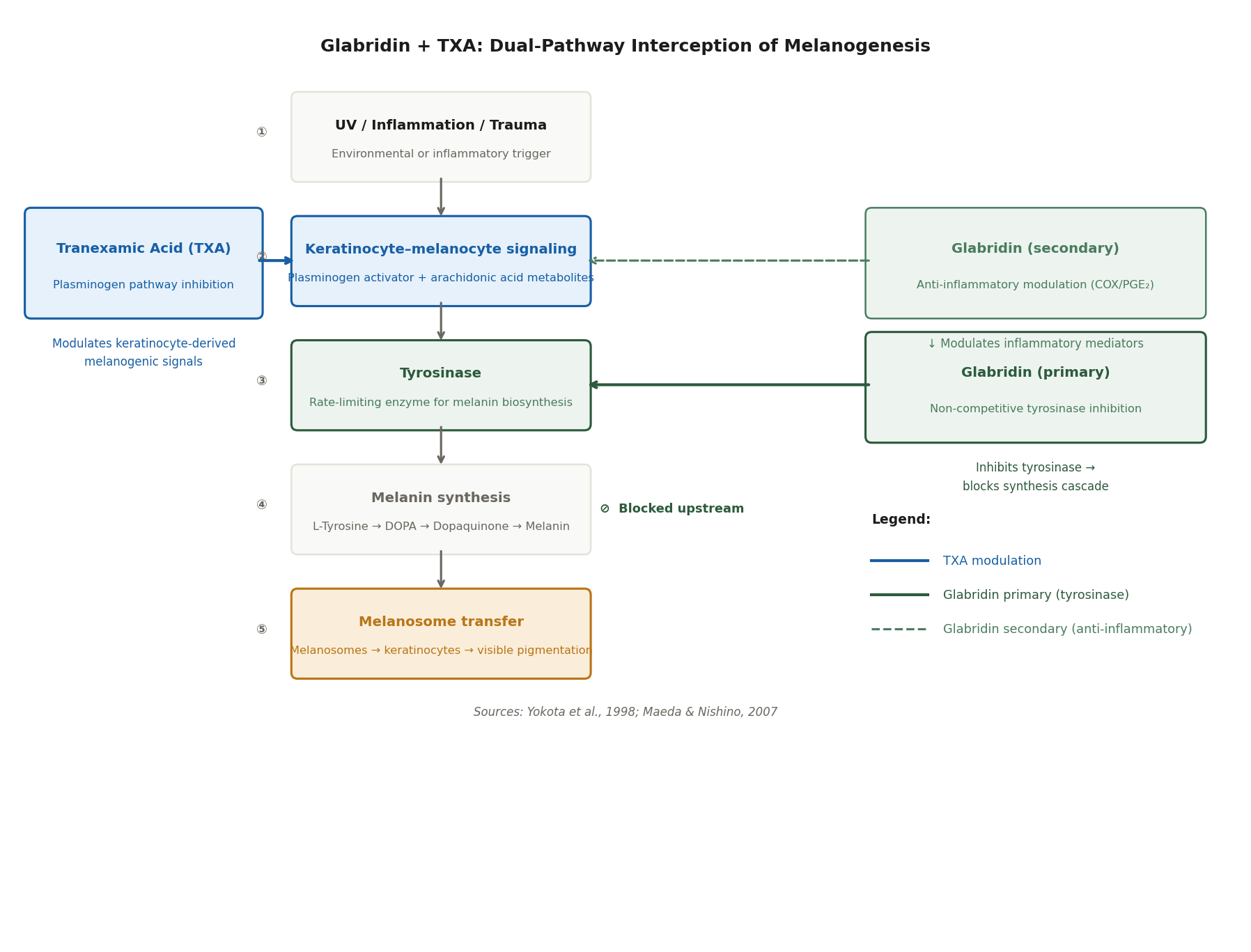
The practical value of the glabridin + TXA combination is not simply additive. It provides layered mechanistic coverage across key stages of melanogenesis, with partial overlap at the signaling level.
When TXA reduces keratinocyte-derived signaling associated with the plasmin pathway, downstream melanogenic signaling, including tyrosinase activation, may be attenuated. In parallel, glabridin inhibits tyrosinase activity and modulates inflammatory mediators that contribute to signaling amplification. Together, they act on different but connected stages of the melanogenesis cascade.
Mechanism Comparison at a Glance
| Parameter | Glabridin | Tranexamic Acid (TXA) |
|---|---|---|
| Primary mechanism | Non-competitive tyrosinase inhibition | Plasminogen activator inhibition (keratinocyte signaling) |
| Secondary mechanism | Antioxidant activity + COX/PGE₂ modulation | Downregulation of inflammatory signaling |
| Acts before or after tyrosinase? | Directly at tyrosinase (enzyme level) | Upstream of tyrosinase (indirect regulation) |
| Mechanistic scope | Multi-pathway (enzyme inhibition + anti-inflammatory + antioxidant) | Single dominant signaling cascade (plasmin-mediated keratinocyte–melanocyte pathway) |
| Anti-inflammatory component? | Yes | Indirect (via signal suppression) |
Formulation Compatibility: Why They Work Together
TXA is highly water-soluble and is typically incorporated into the water phase of emulsions, toners, and aqueous systems. It is generally stable under mildly acidic to neutral formulation conditions (approximately pH 4.5–6.5 in cosmetic systems). This overlaps with the mildly acidic stability range commonly used for glabridin-containing formulations (typically around pH 4.0–5.5).
| Parameter | Glabridin | TXA |
|---|---|---|
| Solubility | Lipophilic (standard grades); water-soluble (10% HP-β-CD grade) | Water-soluble |
| Recommended formulation phase | Oil phase / polyol phase / water-soluble grade | Water phase |
| pH stability | In mildly acidic systems (~pH 4.0–6.5) | In mildly acidic to neutral systems (~pH 4.5–6.5) |
| pH compatibility when combined | ✅ Compatible in mildly acidic formulation range (pH ~4.5–6.0) | ✅ Compatible in mildly acidic formulation range (pH ~4.5–6.0) |
| Processing temperature | ≤60°C | Standard cosmetic temperatures |
| COSMOS compatibility | Yes (certified grades available) | Check with supplier |
There is no significant pH incompatibility within common cosmetic formulation ranges for glabridin and tranexamic acid, and no reported physicochemical incompatibility has been observed in standard cosmetic formulations. The two ingredients are typically incorporated into different phases: TXA is added to the water phase, while standard lipophilic grades of glabridin are incorporated into the oil or polyol phase. In fully aqueous systems, water-soluble glabridin (e.g., 10% HP-β-CD complexed grade) can be used in combination with TXA.
Clinical Positioning: PIH, Melasma, and Sensitive Brightening
The glabridin + TXA combination has a specific and well-defined clinical sweet spot.
Post-inflammatory hyperpigmentation (PIH)
PIH is driven by the inflammatory cascade — precisely the pathway that both TXA (via keratinocyte signaling) and glabridin (via modulation of inflammatory mediators) target upstream. This is the most compelling clinical rationale for the combination: two independent anti-inflammatory mechanisms both contributing to reduced tyrosinase activation, with glabridin adding direct enzymatic inhibition at the synthesis step.
Melasma
TXA has well-documented clinical efficacy in melasma, including oral administration studies. In topical cosmetic application, it is among the more clinically supported depigmenting ingredients for melasma-associated pigmentation. Glabridin's enzymatic inhibition complements TXA's signaling suppression for a multi-level approach to melanogenesis regulation.
Sensitive skin and reactive skin
Neither glabridin nor TXA is an irritant at recommended use concentrations. Glabridin has reported patch test data indicating low irritation potential (30 subjects, zero adverse reactions at all observation timepoints, Report No. GZA01-23080632-JC-01). TXA is well-tolerated across skin types. The combination is suitable for sensitive skin populations where aggressive brightening actives (hydroxy acids, high-dose L-ascorbic acid) may be less appropriate.
Recommended Formulation Approach
Use levels:
- Glabridin: 0.1–0.5% active (expressed as final active content in finished formulation)
- TXA: 2–5% (commonly used topical cosmetic range)
Incorporation:
- TXA: add to water phase or cool-down aqueous additions
- Glabridin (40%/90%/98% grades): pre-dissolve in propylene glycol or butylene glycol; add at cool-down
- Glabridin (10% water-soluble grade): add directly to water phase; compatible with TXA in the same phase
pH: Target 4.5–5.5 for good stability and compatibility of both actives. Buffer with citric acid/sodium citrate. Verify final pH after all cool-down additions are complete.
Complementary additions to complete the pathway:
- Niacinamide (1–5%): supports melanosome transfer inhibition
- Ascorbyl glucoside (AA-2G) or magnesium ascorbyl phosphate (MAP) (0.5–2%): contributes to melanin reduction downstream of melanogenesis
Every batch ships with COA, TDS, and SDS/MSDS. Additional testing available upon request.
References
- Yokota T, Nishio H, Kubota Y, Mizoguchi M. The inhibitory effect of glabridin from licorice extracts on melanogenesis and inflammation. Pigment Cell Research, 11(6), 355–361, 1998. DOI: 10.1111/j.1600-0749.1998.tb00494.x.
- Maeda K, Nishino H. Mechanism of the inhibitory effect of tranexamic acid on melanogenesis in cultured human melanocytes in the presence of keratinocyte-conditioned medium. Journal of Health Science, 53(4), 389–396, 2007. DOI: 10.1248/jhs.53.389.
- Guangdong Weipu Testing Technology Co., Ltd. (CMA No. 202119135666). Report No. GZA01-23080632-JC-01. Human skin brightening efficacy study, 0.03% Glabridin. Commissioned by Huatai Bio-Fine Chemical.


 English
 German
 Italian
 French
 Spanish
 Japanese
 Korean
 Russian