
Oil-based and anhydrous systems provide a favorable formulation environment for glabridin. The absence of water reduces key stability risks, including hydrolytic degradation (which may be accelerated under alkaline conditions) and metal-catalyzed oxidation pathways. In addition, oil-phase systems facilitate the partitioning of lipophilic actives into stratum corneum lipid domains, supporting their interaction with the skin barrier.
Why the Oil Phase Is a Highly Stable Environment for Glabridin
Glabridin's key degradation pathways are associated with water-containing systems:
Metal-catalyzed oxidation: Metal ions can catalyze the oxidative degradation of glabridin through redox cycling and free radical formation. Aqueous environments may facilitate this process by increasing metal ion mobility, while oil-based systems reduce such metal-mediated interactions, resulting in improved stability.
Alkaline-related oxidative degradation: In aqueous systems, alkaline conditions can promote oxidative degradation of glabridin by increasing the reactivity of phenolic groups through deprotonation. This pH-dependent effect is less pronounced in oil-based systems due to the absence of an aqueous ionization environment.
In a well-formulated anhydrous system with an appropriate antioxidant system, the stability of glabridin can be improved compared to many emulsion-based systems, particularly those involving water and metal-ion-containing environments. Accordingly, face oils and anhydrous serums can provide a more favorable environment for maintaining stability under controlled formulation conditions.
The 90% Oil-Soluble Grade: Technical Specifications
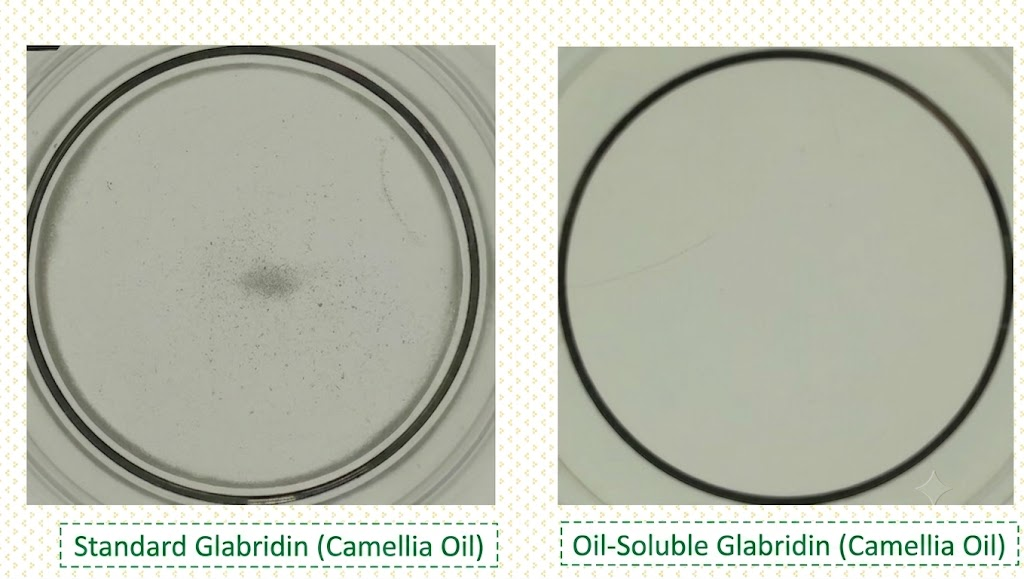
Standard glabridin powder grades are lipophilic but exhibit limited dispersibility in vegetable oils. Without appropriate processing, glabridin may form a suspension that can lead to sedimentation over time — which is undesirable in premium oil-based formulations.
Huatai's 90% oil-soluble grade resolves this through a patented manufacturing process that restructures glabridin into uniform 50 μm spherical particles. This modification substantially improves dispersibility in the oil phase.
Sedimentation Testing Across 5 Oil Types
| Oil Type Tested | Standard Glabridin (unmodified) | 90% Oil-Soluble Grade |
|---|---|---|
| Camellia oil | Visible sedimentation | No visible sedimentation |
| Corn germ oil | Visible sedimentation | No visible sedimentation |
| Torreya oil | Visible sedimentation | No visible sedimentation |
| Torreya:Camellia (1:1) | Visible sedimentation | No visible sedimentation |
| Torreya:Camellia (2:1) | Visible sedimentation | No visible sedimentation |
Storage stability (camellia oil medium): Standard glabridin showed sedimentation from Day 1 onward during storage. The oil-soluble grade showed no visible sedimentation throughout the observation period.
Grade Specifications
| Parameter | Detail |
|---|---|
| Active content | 90% Glabridin |
| Physical form | White powder |
| Particle structure | Uniform 50 μm spherical particles (patented) |
| Solubility | Oil-soluble — direct dispersion in vegetable oils |
| Recommended use level | ~0.2% in finished formulation |
| Shelf life | 24 months |
| COSMOS status | Certified |
Use level note: The recommended use level for the oil-soluble grade is approximately 0.2% in finished formulations, corresponding to the target active level of glabridin in oil-based systems. This grade is designed and optimized for performance within this usage range. Use levels outside the recommended range should be evaluated through formulation and stability testing.
Active System Design for Oil-Based Brightening
The Core Active: 90% Oil-Soluble Glabridin at ~0.2%
Glabridin exerts its activity through multiple pathways, including tyrosinase inhibition, anti-inflammatory activity, and antioxidant ROS scavenging. In oil-based systems, its lipophilic nature supports good compatibility with lipid-rich environments:
- Tyrosinase inhibition: contributes to melanin synthesis regulation and skin brightening activity
- Anti-inflammatory activity: may help reduce inflammation-related pigmentation (PIH-associated processes)
- Antioxidant: lipid-phase radical scavenging, working synergistically with tocopherol-based antioxidant systems
Co-Active Selection for Oil-Based Systems
Oil-based systems limit co-active selection to oil-soluble or lipid-compatible actives. The following complement glabridin effectively in the oil phase:
| Co-Active | Function | Notes |
|---|---|---|
| Bakuchiol | Retinol-like anti-aging activity (collagen support, MMP modulation) | No pH dependency; compatible across formulation systems; widely used in natural positioning |
| Tetrahexyldecyl Ascorbate (THDC) | Oil-soluble Vitamin C — antioxidant support and brightening-related activity | Highly stable oil-soluble derivative with good lipid-phase compatibility |
| Ascorbyl Palmitate | Oil-soluble Vitamin C — antioxidant function | Slower conversion profile; mainly functions as auxiliary antioxidant |
| Rosemary extract (standardized for carnosic acid) | Natural antioxidant | COSMOS-compatible antioxidant ingredient; alternative or complement to synthetic antioxidants |
| Mixed tocopherols | Primary lipid-phase antioxidant | Commonly used antioxidant component in oil systems |
| Squalane | Emollient and stable carrier oil | Highly oxidation-stable base oil with excellent skin compatibility |
| Sea buckthorn oil (diluted) | Lipid-rich botanical oil with antioxidant components | Typically used at low levels due to strong color and odor |
What to avoid in oil-phase brightening:
- Raw L-ascorbic acid — not oil-soluble; pH incompatibility; limited functionality in anhydrous systems
- Oxidation-prone carrier oils (e.g., undiluted rosehip, evening primrose) — high PUFA content increases oxidation risk and may increase demand on antioxidant systems
Oil Base Selection
The base oil system influences both sensory profile and the stability of active ingredients.
| Oil Type | Oxidation Stability | Notes |
|---|---|---|
| Squalane | Highly stable | One of the most oxidation-stable emollients; very low peroxide formation tendency; ideal carrier oil |
| Camellia oil (Tsubaki) | Stable | High oleic acid content; relatively good oxidative stability; pleasant sensory profile |
| Jojoba oil (liquid wax) | Highly stable | Wax ester structure contributes to excellent oxidative stability; non-comedogenic profile |
| MCT (fractionated coconut) | Highly stable | Saturated medium-chain triglycerides; light texture and good stability |
| Rosehip oil | Moderately stable | High linoleic and linolenic acid content; requires antioxidant system support |
| Sea buckthorn (diluted) | Low-moderate | Dilute to 1–5%; strong color and oxidation sensitivity |
For brightening face oils, the recommended base approach: squalane or jojoba as primary carrier (50–70%), with functional oils (camellia, rosehip, sea buckthorn) at lower concentrations for specific co-benefits.
Formulation Blueprints
Blueprint 1 — Brightening Face Oil (Standard)
| Ingredient | % Range | Function |
|---|---|---|
| Squalane | 40–60% | Primary carrier; highly oxidation-stable |
| Jojoba oil | 15–25% | Wax ester; stable; non-comedogenic |
| Camellia oil | 10–20% | Emollient; high-oleic carrier |
| Glabridin 90% oil-soluble | ~0.2% | Primary brightening active |
| Bakuchiol | 0.5–1.0% | Skin conditioning / anti-aging support |
| Tetrahexyldecyl Ascorbate (THDC) | 2–5% | Oil-soluble Vitamin C; brightening support / antioxidant support |
| Mixed Tocopherols | 0.3–0.5% | Primary antioxidant (strongly recommended) |
| Rosemary extract | 0.05–0.2% | Secondary natural antioxidant (COSMOS-compatible) |
Packaging: Opaque dropper bottle or airless pump. Amber or dark glass acceptable if aluminum foil inner seal is included.
Blueprint 2 — Brightening Lip Oil
| Ingredient | % Range | Function |
|---|---|---|
| Jojoba oil | 30–50% | Stable; non-comedogenic; comfortable on lips |
| Castor oil | 20–30% | Viscosity; gloss; adherence |
| Squalane | 10–20% | Stable emollient |
| Glabridin 90% oil-soluble | 0.1–0.2% | Brightening and anti-inflammatory activity |
| Tetrahexyldecyl Ascorbate / Ascorbyl Palmitate | 1–3% | Oil-soluble Vitamin C; antioxidant / brightening support |
| Mixed Tocopherols | 0.3–0.5% | Primary antioxidant (strongly recommended) |
| Flavor (if used) | Per regulatory limit | Fragrance-free preferred for sensitive positioning |
Regulatory note: Confirm regional compliance for lip product use (including incidental ingestion considerations) prior to commercialization of formulations containing glabridin.
Blueprint 3 — Anhydrous Brightening Balm (High-Performance)
| Ingredient | % Range | Function |
|---|---|---|
| Squalane | 30–45% | Stable carrier |
| Beeswax or plant wax | 10–20% | Structure; semi-solid texture |
| Shea butter (refined) | 15–25% | Emollient; occlusive; lipid-rich butter |
| Jojoba oil | 10–15% | Wax ester; stable |
| Glabridin 90% oil-soluble | ~0.2% | Primary brightening active |
| Bakuchiol | 0.5–1.0% | Skin conditioning / anti-aging support |
| Mixed Tocopherols | 0.5% | Antioxidant (higher level recommended for balm systems due to semi-solid structure) |
Stability Protocol for Oil-Based Systems
Oil-based systems require a stability protocol adapted to their specific degradation risks.
| Test | Condition | Duration | Regulatory Reference |
|---|---|---|---|
| Accelerated (high temp) | 40°C / ambient humidity | 12 weeks | ICH Q1A(R2) |
| Freeze-thaw | −10°C ↔ 25°C, 24h cycles | 5 cycles | PCPC/CTFA guideline |
| Photostability | D65 + UV per ICH Q1B | 6 weeks | ICH Q1B |
| Rancidity (oil-specific) | Peroxide value (PV) and p-anisidine value (AV) | At each timepoint | AOCS methods |
Assessment parameters specific to oil systems:
- Glabridin assay by HPLC (active integrity)
- Peroxide value (PV) — primary oxidation products in the oil base
- Color: CIE L*a*b* — track Δb* (yellowing index)
- Organoleptic: odor rancidity, visual sedimentation
- Sedimentation assessment: visual check at each timepoint under standardized lighting
The rancidity parameter is specific to oil-based systems and is not typically included in emulsion protocols. Oil oxidation can generate off-odors and peroxide products that may affect both sensory properties and overall product quality.
Every batch ships with COA, TDS, and SDS/MSDS. Additional testing available upon request.
References
- Yokota T, Nishio H, Kubota Y, Mizoguchi M. The inhibitory effect of glabridin from licorice extracts on melanogenesis and inflammation. Pigment Cell Research, 11(6), 355–361, 1998. DOI: 10.1111/j.1600-0749.1998.tb00494.x.
- Ao M, Shi Y, Cui Y, Guo W, Wang J, Yu L. Factors influencing glabridin stability. Natural Product Communications, Vol. 5(12), 1907–1912, 2010. DOI: 10.1177/1934578X1000501214. PMID: 21299118.
- ICH Q1A(R2): Stability Testing of New Drug Substances and Products. International Council for Harmonisation, 2003.
- ICH Q1B: Photostability Testing of New Drug Substances and Products. International Council for Harmonisation, 1996.



 English
 German
 Italian
 French
 Spanish
 Japanese
 Korean
 Russian