The skincare industry loves creating gods. Yesterday it was a specific acid. Today it is a fancy peptide. But if you strip down the ingredient list of any top-tier global brightening serum, Glabridin always holds a core seat. The market calls it “Whitening Gold.” Frankly, that hype ruined the ingredient. It tricked rookie formulators into thinking that simply slapping “Glabridin” on a label guarantees an effective product.
It does not. Nearly 90% of products claiming to feature Glabridin are just performing marketing stunts. Why? They either cut corners with cheap, low-grade crude extracts, or their formula completely fails to handle solubility and skin penetration. Consumers pay premium prices for zero results. As an upstream manufacturer of cosmetic active ingredients, we deal with real factories every day. We see the failed trial batches. We help brands rebuild their brightening systems from scratch. Let us drop the marketing filters. We will break down Glabridin through pure technical, data-driven, and supply-chain realities.
Genetics Dictate the Ceiling: Not All Licorice is Glycyrrhiza Glabra
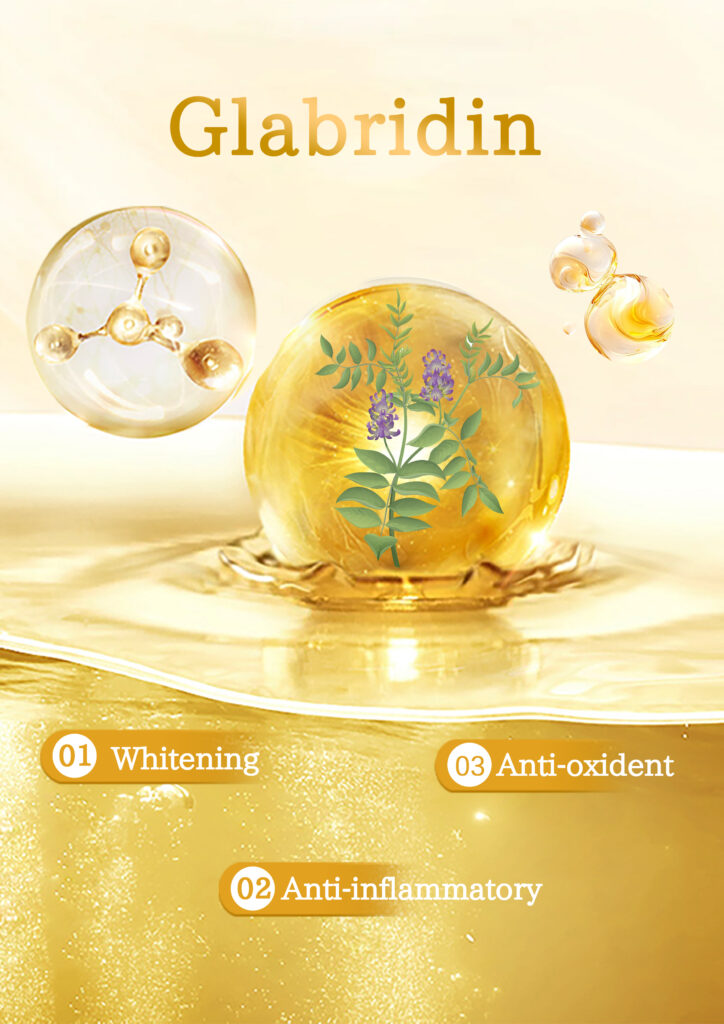
Glabridin does not just come from any random licorice plant. It exists specifically and exclusively in the roots of Glycyrrhiza Glabra.
What is the biggest headache in the current supply chain? Adulteration. Shady traders frequently take common licorice extracts, spike them with cheap chemical whiteners, and sell them as authentic Glabridin. This practice destroys formula stability and spikes skin allergy rates in finished products.
How does a real source factory operate? Extracting 1 kilogram of high-purity Glabridin requires metric tons of premium Glycyrrhiza Glabra roots. It is a capital-intensive, equipment-heavy process of physical and chemical isolation. Old-school, crude extraction leaves behind a mess of dark pigments and unknown flavonoids. We threw that out. Instead, we use targeted molecular enrichment backed by our national patent (No. ZL201210501850.0). We strip away the impurities and push the purity to a staggering 99%. This extreme purity delivers an undeniable edge in crystal-clear color, stability, and biological activity.
Targeted Sniping: Cell-Level Non-Competitive Inhibition
The skincare market loves to stack ingredients. Formulators dump Vitamin C, Kojic Acid, and high-percentage Niacinamide into a single bottle. This aggressive approach often ends up breaking the consumer’s skin barrier. Brightening should not be a war of attrition.
Glabridin works elegantly through non-competitive inhibition. It does not fight with the substrate for the active site on the tyrosinase enzyme. Instead, it binds elsewhere, altering the enzyme’s structural shape and paralyzing it completely. Consequently, even at incredibly low concentrations, it shuts down the melanin switch effectively.
Let us look at the hard data. The definitive 1998 study by Yokota et al. proved that Glabridin’s inhibitory activity against tyrosinase is roughly 15 times more potent than Kojic Acid. Furthermore, it shows a clear, dose-dependent inhibition of A375 melanoma cell proliferation.
But there is more. Dark spots often start with UV-induced micro-inflammation. Our internal lab data reveals a crucial synergy: combining 0.2% Glycyrrhizic Acid with 0.1% Glabridin heavily suppresses the inflammatory cascade and photoaging triggered by UVB radiation. By blocking melanin production and cutting off the upstream inflammation signals simultaneously, it hits the multi-target pathway that premium skincare demands.
Data Specifications: The Technical Blueprint
Purity dictates performance. For a formulation chemist, choosing the correct grade determines the final product architecture, skin feel, and BOM (Bill of Materials) cost. Here is the raw data from our factory floor.
| Purity (Content) | Physical Form | Solubility | Recommended Use Level | Shelf Life | Target Application |
| 1% – 5% | Clear to reddish-brown liquid | Water / Alcohol Soluble | 1.0% – 5.0% | 12 Months | Mass-market toners, sheet mask essences |
| 10% | White powder | Water Soluble | 0.01% – 0.5% | 24 Months | Color-sensitive water solutions, light lotions |
| 40% | Reddish-brown / White powder | Alcohol Soluble | 0.01% – 0.5% | 24 Months | Cost-effective anti-aging creams, body lotions |
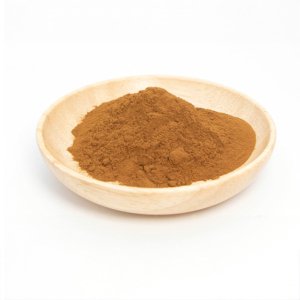
| 90% | White powder | Oil / Alcohol Soluble | 0.01% – 0.5% | 24 Months | Advanced efficacy serums, oil-infused systems |
| 98% / 99% | Ultra-pure white powder | Alcohol Soluble | 0.01% – 0.5% | 24 Months | High-end luxury creams, clinical-grade lines |
Note: Core CAS No.: 59870-68-7. Full portfolio carries COSMOS, ISO 9001, and HALAL certifications.
Why do both 10% water-soluble powder and 99% ultra-pure powder share a recommended use level of 0.01%–0.5%? This involves the industry jargon of “active dilution math.” The general range covers theoretical safety and efficacy margins. However, if you dump 0.5% of raw 99% Glabridin directly into a standard Oil-in-Water (O/W) emulsion, your product cost will skyrocket, and the molecule will likely oversaturate and crystallize out of the formula.
Smart supply chain design uses a matrix strategy. For luxury lines, deploy 99% pure powder at around 0.05% to capture maximum efficacy with zero color shift (ΔE < 1.0). For mass-market sheet masks, opt for a 1% liquid grade added at 2% to ensure absolute formula stability and clean marketing claims.
Defeating Crystallization: The Hardcore Formulation Playbook
Did you purchase a 99% pure powder only to end up with a gritty, crystallized batch of ruined product? We see this happen all the time. High-performance actives require proper structural engineering.
Challenge 1: Dissolution and Penetration
Never throw high-purity Glabridin powder directly into cold water. It is a complete waste. The standard SOP requires pre-dissolving the powder in glycols (like Butylene Glycol or Propylene Glycol) or highly polar oils at elevated temperatures. Ensure the solution is completely transparent before emulsification. To bypass the stratum corneum, top-tier brands use nano-liposome encapsulation. Packing Glabridin into a nano-carrier carries it straight to the basal layer for true transdermal delivery.
Challenge 2: The Art of Blending
Consider the Triple-Threat Brightening Scheme: Glabridin + Tranexamic Acid + Niacinamide. Tranexamic acid cuts off the upstream inflammatory trigger. Glabridin locks down tyrosinase in the middle. Niacinamide blocks the transfer of melanosomes at the tail end. This full-pathway closure creates an explosive brightening effect. For sensitive skin lines, pair Glabridin with Ceramides. This combo stabilizes osmotic pressure and repairs the barrier while allowing Glabridin to manage pigment metabolism with zero irritation.
Real-World Case Studies: From Lab to Market Success
Case 1: A European Clean Beauty Brand
They demanded a 100% plant-derived formula, zero synthetic preservatives, and verifiable clinical fading of dark spots. We supplied our 99% pure Glabridin and guided their OEM factory through optimizing the polarity of their alcohol-solvent phase. The final formula utilized a precise, optimized active concentration. Independent human clinical trials showed a massive improvement in the Individual Typology Angle (ITA°) within 14 days. Crucially, our complete COSMOS certification and Technical Data Sheets (TDS) allowed the brand to clear the strict European CPSR compliance check within a single month.
Case 2: A Southeast Asian Anti-Aging Manufacturer
The hot, humid tropical climate caused their brightening serums to turn a harsh yellow color. Worse, after six months on the shelf, the formula developed visible crystal sedimentation. The factory had been sourcing low-grade material from an unverified trader. We stepped in, audited their solvent polarity, and replaced the raw material with our high-purity, alcohol-soluble powder engineered with a specific anti-crystallization process. This modification eliminated the sedimentation defect entirely and refined the skin feel. High-temperature oven testing proved the emulsion remained perfectly white over time.
Global Compliance: The Invisible Gatekeeper
If you are building a global product line, compliance is your lifeline. A formula can deliver incredible results, but if your documentation is messy, customs will impound your shipment and destroy your brand launch.
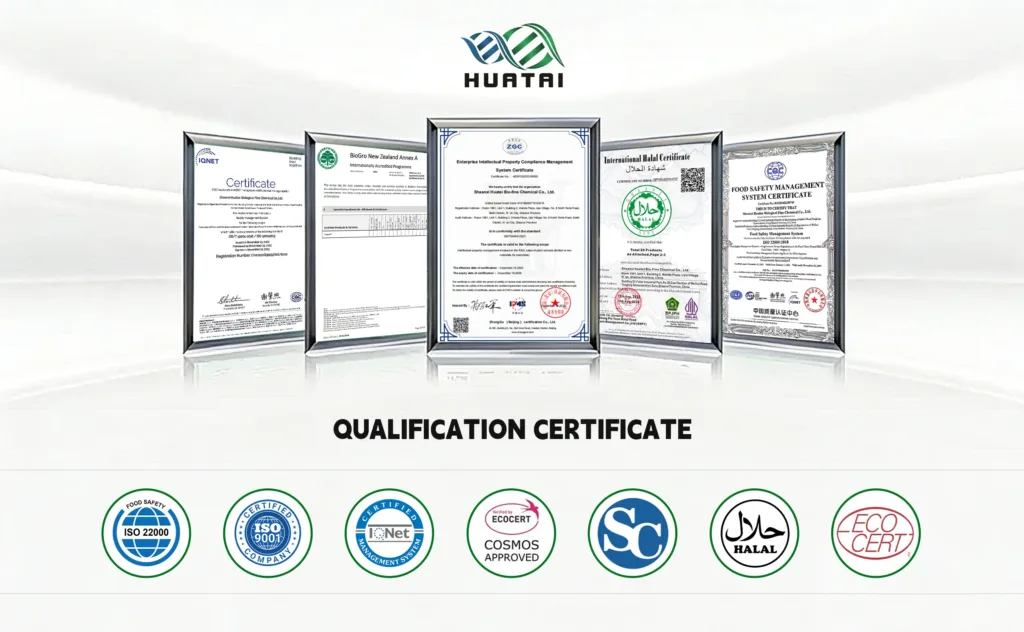
As a primary manufacturer, compliance is our absolute baseline. Every batch of Glabridin we ship comes with an extensive Technical Dossier. Heavy metal limits, pesticide screening, and microbial counts are just the bare minimum. We back our production with ISO 9001, ISO 22000, IQNet, and HALAL certifications. These are not decorative pieces of paper. They are your golden passport into heavily regulated international cosmetics markets. We provide immediate access to complete Certificates of Analysis (COA) and Material Safety Data Sheets (MSDS), removing any regulatory friction.
Bring Science Back to Formulation
Skincare should be driven by hard science, not marketing fairy tales. As the market matures, consumers are actively reading ingredient decks and checking peer-reviewed literature. Brands that rely on microscopic “concept additions” to milk consumer wallets will be forced out of the market.
To win in the hyper-competitive efficacy space, your R&D team needs a sharp weapon. Authentic Glabridin extract is that weapon. Mastering the purity grades, identifying impurities, and engineering the right solvent system is how you deploy it successfully. We push our purification to 99%, drop the color shift to zero, and lay out all the hard data. The rest is up to your formulation team.
Stop staring at slides. Put it to the test. Have your R&D lab request a sample, run an HPLC test, and put a batch into a high-temperature stability oven. Hard analytical data beats marketing copy every single time.
Technical References & Open Data Sources:
- Yokota, T., et al. (1998). “The inhibitory effect of glabridin from licorice extracts on melanogenesis and inflammation.” Pigment Cell Research, 11(6), 355-361. (The landmark paper establishing that Glabridin’s tyrosinase inhibition is roughly 15 times more potent than Kojic Acid).
- Nerya, O., et al. (2003). “Glabrene and isoliquiritigenin as tyrosinase inhibitors from licorice roots.” Journal of Agricultural and Food Chemistry, 51(5), 1201-1207.
- Guo, et al. (2022). Comparative study on tyrosinase inhibition efficacy between Glabridin and Kojic Acid.
- Core product specifications, UVB photoaging synergy data (0.2% Glycyrrhizic acid + 0.1% Glabridin), A375 melanoma cell assays are compiled from the Huatai Bio Technical Database



 English
 German
 Italian
 French
 Spanish
 Japanese
 Korean
 Russian