
Glabridin and alpha-arbutin are both tyrosinase inhibitors — but their mechanisms, potency levels, formulation requirements, and clinical positioning differ in ways that matter for system design. Rather than discussing which ingredient is better, it is more meaningful to explore how they regulate melanin production through different mechanisms, and under what formulation conditions they may be used in combination to achieve complementary effects.
Mechanism: Where Each Intervenes
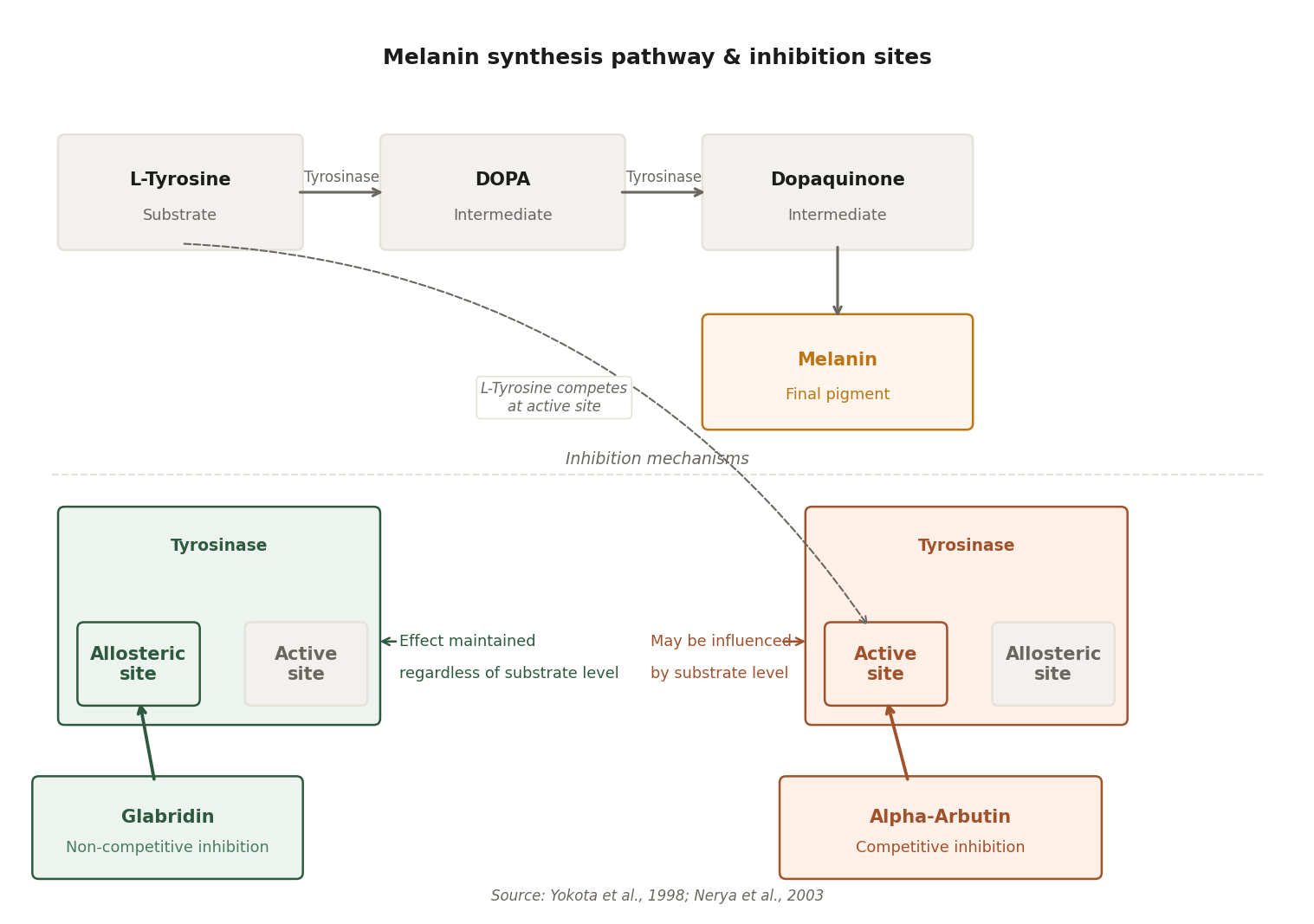
Both glabridin and alpha-arbutin act on tyrosinase, a key rate-limiting enzyme in melanin synthesis. However, their mechanisms of inhibition are fundamentally different.
Glabridin — Non-Competitive Inhibition
Glabridin has been reported to inhibit tyrosinase activity through a non-competitive mechanism in enzyme kinetic studies, suggesting that its inhibitory effect is not solely dependent on competition with the substrate (L-tyrosine) at the active site (Yokota et al., 1998).
The practical implication: glabridin's inhibitory effect is less dependent on substrate competition. Under conditions of high melanogenic stimulation — such as UV exposure or inflammation — competitive inhibitors may show reduced apparent efficacy, whereas glabridin may retain relatively more stable inhibitory effects.
Beyond tyrosinase, glabridin may act through additional biological activities:
- Anti-inflammatory activity: Helps regulate inflammation-related signaling involved in PIH development and upstream melanogenic activation.
- Antioxidant radical scavenging: Neutralizes ROS and reduces oxidative stress-induced stimulation of melanogenesis.
Alpha-Arbutin — Competitive Inhibition
Alpha-arbutin is a glycosylated derivative of hydroquinone. It inhibits tyrosinase through competitive inhibition: it binds to the active site of the enzyme, competing directly with L-tyrosine for the same binding position.
At sufficient alpha-arbutin concentrations, competitive inhibition is effective. Under conditions of increased melanogenic activity, such as UV exposure or inflammation, upregulated tyrosinase expression and pathway flux may reduce the apparent efficacy of competitive inhibition.
Alpha-arbutin primarily acts as a tyrosinase inhibitor involved in melanin synthesis, with no well-established anti-inflammatory activity.
Potency: The IC₅₀ Data
IC₅₀ is the concentration required to inhibit 50% of tyrosinase activity — lower values indicate greater potency.
| Ingredient | IC₅₀ (μmol/L) | Relative Potency vs Glabridin |
|---|---|---|
| Glabridin | 0.09 | — |
| Alpha-Arbutin | 2.70 | 30× less potent |
| Kojic Acid | 16.67 | 185× less potent |
| Vitamin C | 40.10 | 446× less potent |
Source: Nerya et al., 2003 — under comparable in vitro assay conditions.
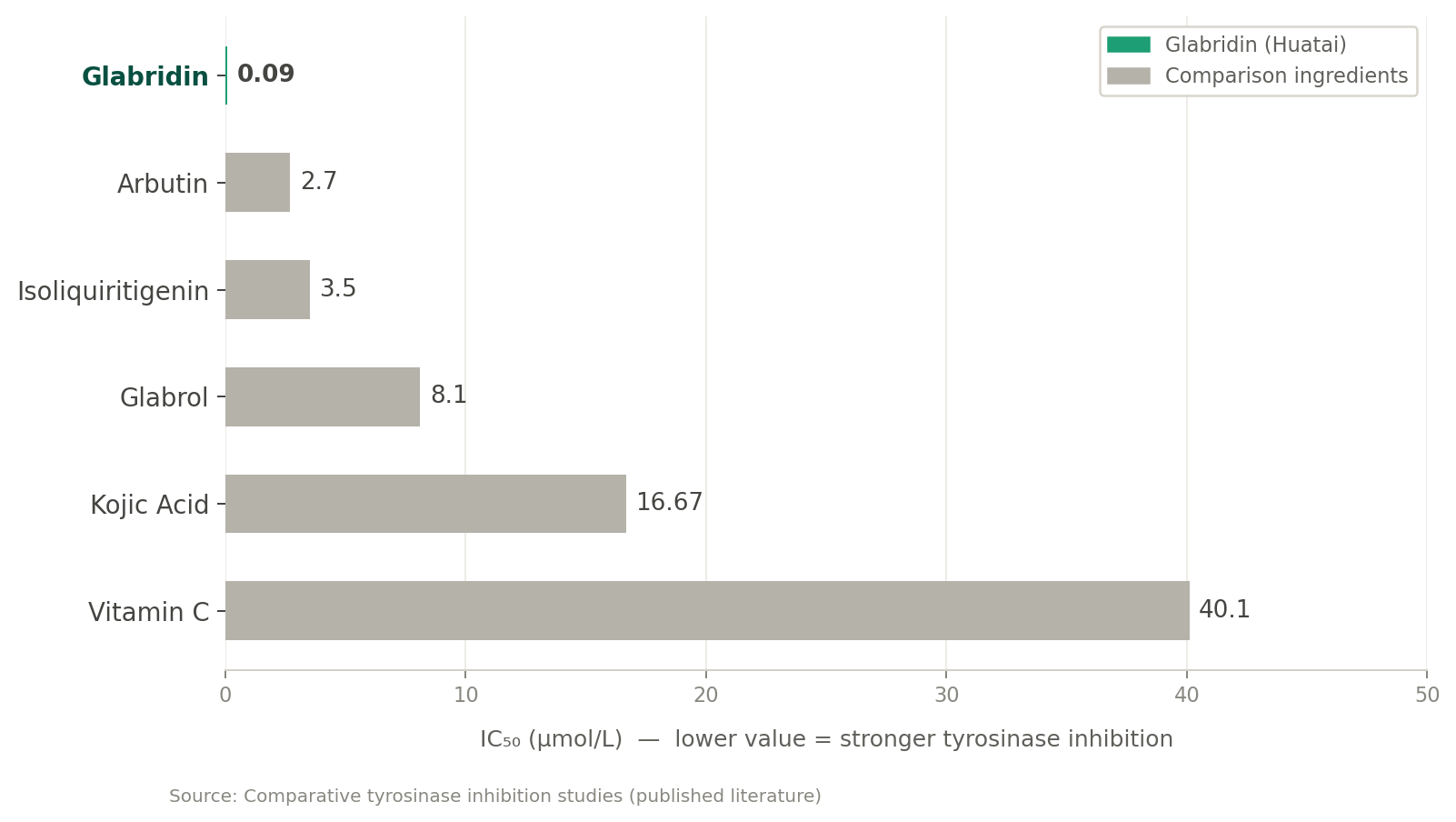
This does not imply that glabridin is universally superior, but rather that the two actives operate at different effective concentration ranges and formulation thresholds. Glabridin demonstrates potent in vitro tyrosinase inhibition at lower concentrations compared with alpha-arbutin.
Formulation Compatibility
Despite both being brightening actives, their formulation requirements differ in ways that affect system design.
| Parameter | Glabridin | Alpha-Arbutin |
|---|---|---|
| pH stability range | 4.0–6.5 (optimal 4.0–5.5) | 3.5–6.5 |
| Solubility | Lipophilic; requires polyol, alcohol, or oil phase (standard grades) | Hydrophilic; water-soluble |
| Water-compatible form | 10% HP-β-CD powder or 1–5% water-soluble liquid | Direct aqueous dispersion |
| Formulation system | Oil phase, polyol phase, or water-soluble grade | Water phase |
| Photostability | Moderate; UV-protective packaging required | Good; more photostable than beta-arbutin |
| Processing temperature | ≤60°C | Standard cosmetic temperatures |
| COSMOS compatibility | Yes (COSMOS-certified grades available) | Yes |
The pH windows overlap well — both are stable at pH 4.0–6.5 — making them compatible co-actives in the same formulation without pH conflict. The key formulation note: they occupy different phases in most emulsion systems. Glabridin (standard grades) is dissolved in the polyol or oil phase; alpha-arbutin is added to the water phase. This phase separation actually simplifies the formulation design.
Clinical and Regulatory Positioning
Both ingredients have clinical backing — but the data type and claim pathway differ.
Glabridin: Human clinical study (35 subjects, 0.03% active in leave-on skincare water) — 16.8% Melanin Index reduction over 4 weeks, statistically significant from Week 1 (P<0.05, Report No. GZA01-23080632-JC-01, Guangdong Weipu Testing Technology Co., Ltd., CMA accredited). Additionally, zero adverse reactions in 30-subject closed patch test.
Alpha-Arbutin: Well-established safety and efficacy profile; multiple published clinical studies. Widely used globally; accepted in most major regulatory markets. Hydroquinone release at normal use concentrations is well below safety thresholds — but regulatory scrutiny varies by region. In some Asian markets, alpha-arbutin is classified under specific brightening/whitening ingredient frameworks with defined use limits.
Glabridin combines tyrosinase inhibition with reported anti-inflammatory and antioxidant activities, whereas alpha-arbutin is primarily positioned as a tyrosinase inhibitor. This may provide broader biological support in pigmentation-focused formulations.
The Case for Using Both Together
The most important insight from this comparison: glabridin and alpha-arbutin are complementary, not competing.
| Role | Glabridin | Alpha-Arbutin |
|---|---|---|
| Tyrosinase inhibition type | Non-competitive | Competitive |
| Response under increased melanogenic activity | May retain inhibitory activity under stimulated conditions | May be influenced by melanogenic system activity |
| Anti-inflammatory PIH-related activity | Anti-inflammatory activity (including modulation of inflammatory pathways) | Not well-established |
| Formulation phase | Oil/polyol phase | Water phase |
| Primary positioning | Multi-functional brightening (including PIH-related and sensitive skin positioning) | Tyrosinase-focused brightening |
Used together in a dual-phase system — glabridin in the oil or polyol phase, alpha-arbutin in the water phase — they provide:
- Non-competitive tyrosinase inhibition by glabridin, which is less influenced by changes in substrate concentration
- Competitive tyrosinase inhibition by alpha-arbutin via competition with L-tyrosine at the enzyme active site
- Anti-inflammatory activity associated with modulation of melanogenesis-related signaling pathways (glabridin)
- Broader support across pigmentation-related pathways associated with UV exposure and inflammation
This combination may be of particular interest in formulations intended for skin types prone to both UV-associated and post-inflammatory pigmentation, where multiple biological factors contribute to visible discoloration.
Formulation Design Summary
| Formulation Goal | Recommended Approach |
|---|---|
| Maximum tyrosinase inhibition potency | Glabridin primary; alpha-arbutin as water-phase complement |
| PIH repair (post-acne, post-procedure) | Glabridin primary (tyrosinase inhibition + anti-inflammatory activity); alpha-arbutin optional secondary |
| UV-triggered hyperpigmentation | Alpha-arbutin primary; glabridin for breadth of mechanism |
| Sensitive skin brightening | Glabridin primary; alpha-arbutin where pH and skin tolerance allow |
| Multi-pathway approach | Glabridin (oil/polyol phase) + alpha-arbutin (water phase) combined |
| COSMOS-certified clean-label system | Glabridin (COSMOS-certified grade) — verify alpha-arbutin COSMOS status with supplier |
Every batch ships with COA, TDS, and SDS/MSDS. Additional testing available upon request.
References
- Yokota T, Nishio H, Kubota Y, Mizoguchi M. The inhibitory effect of glabridin from licorice extracts on melanogenesis and inflammation. Pigment Cell Research, 11(6), 355–361, 1998. DOI: 10.1111/j.1600-0749.1998.tb00494.x. — Establishes non-competitive inhibition mechanism and anti-inflammatory activity.
- Nerya O, Vaya J, Musa R, Izrael S, Ben-Arie R, Tamir S. Glabrene and isoliquiritigenin as tyrosinase inhibitors from licorice roots. Journal of Agricultural and Food Chemistry, 51(5), 1201–1207, 2003. — IC₅₀ comparative data under comparable in vitro assay conditions.
- Kim YJ, Uyama H. Tyrosinase inhibitors from natural and synthetic sources: structure, inhibition mechanism and perspective for the future. Cellular and Molecular Life Sciences, 62(15), 1707–1723, 2005.
- Guangdong Weipu Testing Technology Co., Ltd. (CMA No. 202119135666). Report No. GZA01-23080632-JC-01. Human skin brightening efficacy study, 0.03% Glabridin. Commissioned by Huatai Bio-Fine Chemical.

 English
 German
 Italian
 French
 Spanish
 Japanese
 Korean
 Russian