Glabridin Powder Grades Explained: 40%, 90%, 98%, 99%
Glabridin powder is available in multiple purity grades, each with different physical properties, solubility options, and use levels. Choosing the wrong grade for a formulation system leads to compatibility problems, stability issues, or unnecessary cost.
Here is how the main grades compare:
| Grade | Form | Solubility | Recommended Use Level | Shelf Life | COSMOS |
|---|---|---|---|---|---|
| 40% (white) | White powder | Alcohol-soluble | 0.1%–1.0% | 24 months | ✓ |
| 40% (reddish-brown) | Reddish-brown powder | Alcohol-soluble | 0.1%–1.0% | 24 months | — |
| 90% (alcohol-soluble) | White powder | Alcohol-soluble | 0.01%–0.5% | 24 months | ✓ |
| 90% (oil-soluble) | White powder | Oil-soluble | ~0.2% (adjust per system) | 24 months | ✓ |
| 98% | White powder | Alcohol-soluble | 0.01%–0.5% | 24 months | ✓ |
| 99% | White powder | Alcohol-soluble | 0.01%–0.5% | 24 months | — |
A few points worth noting:
- The 40% grade comes in two SKUs — white and reddish-brown. Both have the same assay content and alcohol-soluble profile. The color difference is mainly due to a higher degree of decolorization in the white grade, resulting in lower color-related compounds; the reddish-brown grade retains more of the natural color components from the raw material. The white grade is preferred for light-colored or visually sensitive formulations (e.g., clear serums, essences, pale emulsions), while the reddish-brown grade is more suitable for darker or opaque systems where color impact is less critical.
- The 90% oil-soluble grade is a distinct product from the alcohol-soluble 90%. It uses a patented process to restructure glabridin into uniform 50 μm spherical particles, allowing stable dispersion in anhydrous systems, face oils, and O/W emulsion oil phases. Recommended usage level is around 0.2% in typical oil-phase systems; adjust based on formulation system and target glabridin concentration.
- There are also 1%–5% liquid grades (both alcohol-soluble and water-soluble) and a 10% water-soluble powder produced via HP-β-cyclodextrin inclusion complex technology, suited to aqueous systems where a pre-dissolved format is preferred.
All grades are tested by HPLC. Purity figures on COAs reflect actual glabridin content, not total extract.
How to Choose the Right Grade for Your Product
Grade selection comes down to three factors: formulation system, target active level, and formula color requirements.
By Formulation System
- Water-based toners, essences, hydrogels → 10% water-soluble powder, or 1%–5% water-soluble liquid
- Hydroalcoholic systems (toners, mists) → 1%–5% alcohol-soluble liquid, or 40%/90%/98% powder dissolved in a polyol phase
- O/W emulsions (oil phase addition) → 90% oil-soluble powder
- Anhydrous systems, face oils, lip care → 90% oil-soluble powder
- Clinical, luxury, or high-assay products → 98% powder
By Target Active Level and Cost
Higher-purity grades require a lower use level to achieve the same active concentration in the finished formula. At comparable active delivery, the cost difference between grades narrows significantly. For OEM brightening serum actives where cost per batch matters, the 40% grade is often the practical choice for mass-market formulas. For premium or clinical positioning, 98% offers precise dosing at low use levels.
Formula Color
If finished product appearance is critical — especially in serums, essence toners, and light emulsions — specify white powder grades (40% white, 90%, 98%) and avoid reddish-brown variants.
What Affects Glabridin Powder Pricing?
Understanding what drives glabridin price helps procurement teams make like-for-like comparisons between suppliers.
1. Purity grade
Higher purity requires more processing steps and greater raw material input per kilogram of finished product. 98% grades are priced higher than 40% due to the additional purification stages involved.
2. Raw material origin and supply chain
Glabridin is extracted from Glycyrrhiza glabra (licorice root). Suppliers with secured upstream sourcing — direct grassland management, long-term harvest contracts — tend to offer more stable pricing than those buying spot material. Harvest conditions in Central Asia, where the highest-quality licorice is grown, affect seasonal price fluctuations.
3. Order volume
Per-kilogram pricing decreases at higher volumes. Pricing typically scales with order volume — contact the supplier directly for current tier pricing.
4. Certifications included
COSMOS-certified grades carry a modest premium reflecting certification and audit costs. If your brand requires COSMOS compliance, factor this in when comparing quotes — a non-certified lower price is not a like-for-like comparison.
5. Documentation package
Suppliers who provide full batch documentation — COA, HPLC chromatogram, heavy metal report, pesticide residue report — have higher operating costs reflected in pricing. Quotes that appear lower may not include equivalent documentation.
MOQ and Ordering Process
MOQ for glabridin powder varies considerably between suppliers. Traders often have lower minimum quantities because they hold buffer stock; direct manufacturers may set higher minimums for custom or certified grades.
As a direct manufacturer, Huatai Bio accepts orders from 1g across all grades — 40%, 90%, 98%, and 99% — with no enforced minimum. This makes sample qualification straightforward before committing to commercial volumes.
A typical ordering process with a direct glabridin powder supplier runs as follows:
- Request sample and COA — qualify the product against your internal specifications before ordering
- Submit technical inquiry — specify grade, solubility, quantity, and any certification requirements
- Receive quotation — pricing, lead time, packaging options (typically 1kg sealed aluminum foil bags)
- Place order and confirm documentation — agree on which documents will accompany the batch (COA, HPLC chromatogram, heavy metals, pesticides, COSMOS certificate if applicable)
- Receive shipment and conduct incoming QC — cross-check COA data against your own or third-party retesting
Glabridin for OEM Brightening Formulas
For OEM skincare ingredient supplier contexts, glabridin is typically used in brightening serums, spot correction treatments, and multi-active whitening emulsions. The most common grades specified by OEM formulators are:
- 40% white powder — typical formulation range for brightening serums is 0.1%–0.5%; cost-efficient for mass-market production
- 90% alcohol-soluble — typical formulation range 0.05%–0.2% for premium serum formulas requiring precise low-level dosing
- 90% oil-soluble — for face oil and anhydrous formats where alcohol-soluble grades are not compatible
- 10% water-soluble — for essence toners and water-based brightening ampoules
When sourcing glabridin powder for OEM brightening serum actives, ensure the supplier can provide grade-specific HPLC chromatograms for each batch, not just a generic COA template. Batch-to-batch consistency matters for OEM operations running repeated production cycles.
Why Choose Huatai Bio
Shaanxi Huatai Bio-Fine Chemical Co., Ltd. has supplied high-purity glabridin powder to OEM manufacturers and cosmetic brands across 30+ countries since 2008.
- Full grade range: 40% (white and reddish-brown), 90% (alcohol-soluble and oil-soluble), 98%, 99%, custom
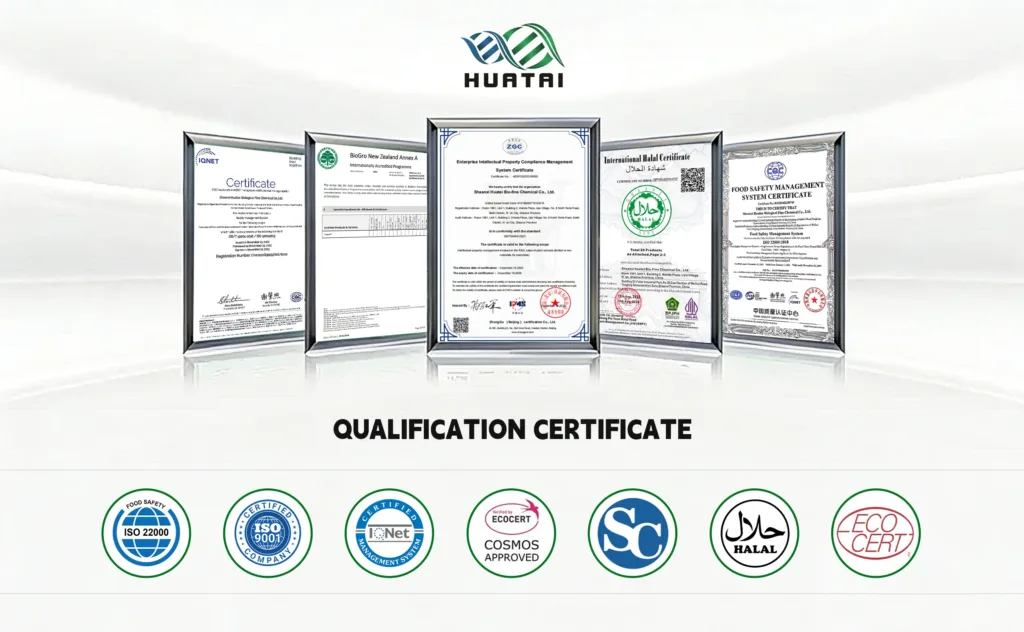
- COSMOS v4 certified (Ecocert Greenlife SAS, N°277614) for 40%, 90%, and 98% grades
- Intertek-verified purity: 99.3% HPLC (Report SHAH01681145)
- Full batch documentation per order: COA, HPLC chromatogram, heavy metal report, pesticide residue report
- No minimum order quantity — samples from 1g, bulk from any volume
- 24-hour COA and sample turnaround on request
Frequently Asked Questions
References
- Huatai Bio-Fine Chemical — Glabridin Product Grade Matrix (internal specification, May 2026)
- Ecocert Greenlife SAS — COSMOS v4 Certificate N°277614-20251216_0226
- Intertek Testing Services Ltd., Shanghai — HPLC Purity Report SHAH01681145



 English
 German
 Italian
 French
 Spanish
 Japanese
 Korean
 Russian