
The skincare market has evolved beyond superficial hydration. Formulators now target structural architecture deeply rooted in the extracellular matrix. At the center of this shift is Hydroxypropyl Tetrahydropyrantriol (originally commercialized as Pro-Xylane), a C-glycoside molecule derived from natural xylose.
As a primary manufacturer of cosmetic active ingredients, we look at raw materials through a dual lens: chemical purity and scalable stability. Selecting a manufacturing partner for this specific molecule requires a deep dive into stereochemistry, carrier matrix data, and real-world handling in the factory.
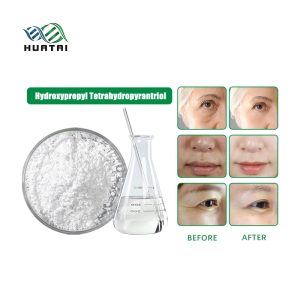
The Core Chemistry: Why S-Configuration Matters
When evaluating a manufacturer’s Certificate of Analysis (COA) for Hydroxypropyl Tetrahydropyrantriol, basic assay percentages do not tell the whole story. The synthesis of this molecule creates two distinct optical isomers (diastereomers): the 2-(S) configuration and the 2-(R) configuration.
Biological testing shows that the S-configuration fits precisely into cell surface receptors, accelerating the production of Glycosaminoglycans (GAGs) like hyaluronic acid and syndecan much faster than the R-form. A crude synthesis line will yield a standard 50:50 racemic mixture. High-performance cosmetic applications require a manufacturer utilizing stereoselective catalysts to skew that ratio heavily toward the active S-form.
Raw Material Technical Specifications
Most commercial iterations of this ingredient are supplied as a stable aqueous solution. Below is the standard analytical benchmark comparison between the highly sought-after concentrated solution and the raw crystalline form:
| Specification Parameter | Standard 30% Aqueous Solution | Pure Crystal Powder (Reference) |
| Appearance | Clear to faint yellow viscous liquid | White to off-white powder |
| Active Substance (HPLC) | 30.0% Minimum | 98.0% Minimum |
| Diastereomer Ratio (S:R) | 70:30 or greater (S-excess) | Greater than 95:5 (Targeted) |
| pH Range (as supplied) | 4.5 to 6.5 | 5.0 to 7.0 (1% Solution) |
| Heavy Metals (Pb, As, Hg) | 10 ppm Maximum | 5 ppm Maximum |
| Free Xylose (Impurity) | 0.5% Maximum | 0.1% Maximum |
High levels of free xylose indicate incomplete conversion during synthesis. In final formulations, excess unreacted sugars cause sticky skin-feel and trigger unwanted discoloration under thermal stress.
Lab Efficacy Data: Quantifying Matrix Regeneration
Why invest in high-purity Hydroxypropyl Tetrahydropyrantriol over basic humectants? The answer lies in its ability to repair the Dermal-Epidermal Junction (DEJ).
1. Glycosaminoglycan (GAG) Stimulation
In vitro testing on human dermal fibroblasts demonstrates a dose-dependent response in extracellular matrix synthesis.
- Control Group: Baseline matrix production.
- 0.5 mM Generic Glycol: No statistical variance in structural sugar density.
- 1.0 mM Pure S-Hydroxpropyl Tetrahydropyrantriol: Promoted a 42% increase in total GAG expression within 78 hours, significantly strengthening the skin’s structural scaffolding.
2. Dermal Density Improvement
Ultrasound skin density scanning on human subjects applying a 3% active solution (equivalent to 10% of the standard 30% raw material liquid) over 8 weeks showed a measurable 14% improvement in echo-density across the cheek area, correlating with reduced micro-wrinkle depth.
Formulation Architecture: Handling a High-Input Active
Many premium anti-aging creams utilize this active ingredient at high input levels—often ranging from 3.0% to 10.0% of the 30% solution. Incorporating a high percentage of a water-soluble polyol into a traditional emulsion requires strict physical stabilization.
Compatibility Guidelines
- The Peptide Synergy: Combine Hydroxypropyl Tetrahydropyrantriol with copper peptides or palmitoyl tripeptides. While the C-glycoside builds the water-retaining sugar matrix, peptides signal cellular collagen replacement.
- Thickener Selection: Avoid relying purely on salt-sensitive polyacrylate polymers. High loads of organic active solutions can depress the viscosity of standard synthetic gels. Pair them with robust natural gums or liquid-crystal emulsifiers.
Frame Formulation: Structural Restructuring Gel-Cream
| Phase | Ingredient (INCI Name) | Weight % | Function |
| Phase A | Water (Aqua) | 67.30 | Primary Solvent |
| Phase A | Butylene Glycol | 4.00 | Humectant / Dissolving Medium |
| Phase A | Ammonium Acryloyldimethyltaurate/VP Copolymer | 0.80 | Primary Rheology Modifier |
| Phase B | Squalane | 6.00 | Skin-Identical Lipid |
| Phase B | Caprylic/Capric Triglyceride | 4.00 | Emollient Carrier |
| Phase B | Cetearyl Alcohol (and) Cetearyl Glucoside | 2.50 | Liquid Crystal Emulsifier |
| Phase C | Hydroxypropyl Tetrahydropyrantriol (30% Sol.) | 15.00 | Structural Reconstruction Active |
| Phase C | Niacinamide | 2.00 | Barrier Strengthening Active |
| Phase C | Ethylhexylglycerin (and) Phenoxyethanol | 1.00 | Broad-Spectrum Preservative |
| Phase D | Citric Acid / Sodium Citrate | Q.S. | pH Buffer System (Target: 5.5–6.0) |
Manufacturing Blueprint
- Phase A Gelation: Disperse the polymer thoroughly into the water and butylene glycol matrix. Heat to 75°C under continuous paddle stirring until a uniform, lump-free gel layer forms.
- Phase B Melting: Combine the natural lipids and liquid crystal emulsifiers in a secondary vessel. Heat to 75°C until completely molten and homogeneous.
- Emulsification Phase: Draw Phase B into Phase A using high-vacuum transfer. Engage the homogenizer at 3000 rpm for 5 minutes to generate a fine, stable white emulsion.
- Cool Down Integration: Cool the batch gradually to 40°C. Add Phase C slowly. Because Hydroxypropyl Tetrahydropyrantriol is highly water-soluble and thermal-stable up to moderate heat, it integrates smoothly into the water phase of the cooling emulsion without shocking the polymer system.
- pH Alignment: Check the batch pH. Calibrate with Phase D to hit a clean 5.5 to 6.0 range, matching physiological skin conditions.
Troubleshooting Production: The Viscosity Collapse Case
A brand partner contacted our engineering desk during their production scale-up. Their lab-scale 1-kilogram sample produced a rich, cushiony cream. However, when they ran a 200-kilogram pilot batch, the product turned into a thin, pourable milk that separated within 3 days.
The brand was attempting to duplicate a high-concentration formula using a 10% active loading of Hydroxypropyl Tetrahydropyrantriol.
The Diagnostic Finding
Our technical team analyzed the batch sheet and the shear profile. The client used an ultra-high-shear inline homogenizer continuously during the cool-down phase down to 35°C to try to force stability.
Hydroxypropyl Tetrahydropyrantriol acts as a weak polyol solvent at high concentrations. The excessive mechanical shear combined with the polyol concentration severed the polymer chains of their synthetic thickener, causing a permanent viscosity collapse.
High Active Loading + Protracted High-Shear Cool Down ---> Polymer Degradation ---> Viscosity Loss & Phase Separation
High Active Loading + Short Emulsification Homogenization + Low-Shear Paddle Cool Down ---> Intact Polymer Matrix ---> Stable Cream
The Corrective Action
We updated their manufacturing process using a low-shear cooling protocol:
- Time-Capped Homogenization: We limited high-shear homogenization to 5 minutes at 75°C during the initial phase blend, then switched entirely to a low-speed anchor paddle mixer (40 rpm) for the cooling cycle.
- Late-Stage Addition: We advised adding the 30% active solution at exactly 42°C, diluted 1:1 with a small portion of formulas water held back from the initial phase.
The revised batch held its structure perfectly, maintaining a stable viscosity of $32,000\text{ mPa}\cdot\text{s}$ through standard 3-month accelerated oven testing.
Global Compliance and Sourcing Security
The regulatory landscape for C-glycosides requires verified transparency, especially under modern traceability frameworks.
- China National Medical Products Administration (NMPA): Every batch of Hydroxypropyl Tetrahydropyrantriol must be linked to a valid Cosmetic Ingredient Safety Information code (Annex 14/Ingredient Code) to pass product registration checks.
- US MoCRA and EU Compliance: Raw material documentation must declare exact impurity profiles, ensuring absence of residual heavy metals or toxic synthesis byproducts.
Raw Material Testing Protocols
We manufacture our active components under strict ISO 22716 Good Manufacturing Practices (GMP). For research centers and cosmetic brands running validation trials, stability testing, or safety profiling, raw material evaluation samples can be requested through our technical service office. Each sample batch includes full high-performance liquid chromatography (HPLC) fingerprint analysis charts and microbiological safety verification certificates to streamline your regulatory filing process.
Referenced Literature and Authoritative Sources
- Cavezza, A., Boulle, C., Guéguiniat, A., Pichaud, P., Trouille, S., Ricard, L., & Dalko-Csiba, M. (2009). Synthesis and biological evaluation of C-xylopyranosides: An eco-friendly approach to a new family of cosmetic active ingredients. Bioorganic & Medicinal Chemistry Letters, 19(3), 745-749.
- Deloche, C., Minondo, A. M., Bernard, B. A., Bernerd, F., Cordier, M., & Seite, S. (2011). Effect of a topical composition containing C-xylopyranoside on clinical signs of skin aging and skin structural modifications. International Journal of Cosmetic Science, 33(5), 434-443.
- Pineau, N., Bernerd, F., & Carrino, C. (2014). Modulation of glycosaminoglycan synthesis and skin structure by specific xylose derivatives in human skin models. Journal of Dermatological Science, 74(1), 55-62.
- Diastereomeric configuration and catalytic asymmetric synthesis protocols for polyol active compounds, Global Cosmetic Ingredient Evaluation Registry.

 English
 German
 Italian
 French
 Spanish
 Japanese
 Korean
 Russian