
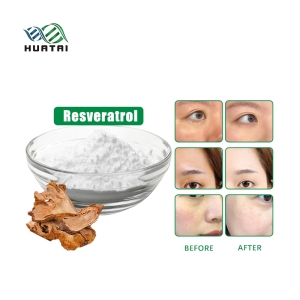
Resveratrol (3,5,4′-trihydroxystilbene) is a polyphenol found in grapes, knotweed, and berries. In skincare, it acts as a powerful scavenger of reactive oxygen species (ROS). However, professional formulators know that Resveratrol’s reputation for being “difficult to work with” is well-deserved. Its low water solubility and extreme sensitivity to light make it a unique engineering challenge.
Chemical Profile and Material Standards
The biological efficacy of Resveratrol hinges on the purity of the material. Industrial-grade extracts often contain residual isomers that reduce the antioxidant capacity. A high-performance grade should be a white to off-white powder with a purity level that ensures color stability in the final formula.
| Parameter | Specification Details | Importance for Stability |
| Appearance | White to off-white powder | Indicates low oxidation markers |
| Purity (HPLC) | ≥ 99.0% | Ensures targeted radical scavenging |
| Melting Point | 260°C – 265°C | Thermal resilience during processing |
| Loss on Drying | ≤ 0.5% | Minimizes moisture-related degradation |
| Heavy Metals | ≤ 10 ppm | Critical for compliance and safety |
The Stability Dilemma: Why Formulations Fail
Resveratrol undergoes photo-isomerization. Under light exposure, the stable trans-isomer converts to the cis-isomer, which lacks the same antioxidant efficiency and often triggers formula browning.
Formulator’s Blueprint for Stability:
- Phase Selection: Do not attempt to stabilize Resveratrol in a water-based system alone. It is lipophilic. Utilize a solvent-based delivery system like Ethoxydiglycol or Propanediol to achieve a concentration of at least 1-2%.
- Antioxidant Synergy: Pair Resveratrol with Vitamin E (Tocopherol) or Ferulic Acid. This creates a “radical relay” system where antioxidants regenerate each other, extending the functional life of the Resveratrol.
- Encapsulation: In high-end formulations, encapsulation (liposomal or cyclodextrin-based) is the gold standard. It masks the molecule from light and provides a slow-release effect on the skin surface.
Biological Mechanism: Beyond Antioxidant Claims
Most antioxidants simply “mop up” free radicals. Resveratrol works deeper. It activates Sirtuin 1 (SIRT1), a class of proteins involved in cellular repair and longevity. By influencing this pathway, Resveratrol improves the skin’s internal defense mechanisms against UV damage, rather than just acting as a topical filter.
Performance Data: Radical Scavenging Comparison
We compared the radical scavenging efficiency (using the DPPH assay) of Resveratrol against other common cosmetic antioxidants.
| Active Ingredient | IC50 Value (µg/mL) | Relative Efficacy |
| Resveratrol | 4.2 | 1.0 (Baseline) |
| Vitamin C (L-AA) | 8.5 | 0.5 |
| Vitamin E | 12.0 | 0.35 |
| Ferulic Acid | 6.8 | 0.6 |
Note: A lower IC50 indicates a higher ability to neutralize radicals at lower concentrations.
The data indicates that while Resveratrol is potent, its performance is highly concentration-dependent. A 1% serum often underperforms compared to a 0.5% serum that uses a better solvent delivery system.
Practical Troubleshooting
- Issue: The formula turns yellow within two weeks.
- Root Cause: The formula is reacting to ambient light or pH fluctuations above 7.0.
- Fix: Ensure the final pH is buffered at 4.5 – 5.5. Use UV-blocking or opaque airless packaging to prevent photo-isomerization.
- Issue: Resveratrol crystals appear at the bottom of the bottle.
- Root Cause: Recrystallization due to cooling or incompatible solvents.
- Fix: Increase the concentration of your primary solvent (e.g., Ethoxydiglycol). Check for “salting out” effects if your formula contains high levels of electrolytes.
Quality Control: What You Must Inspect
When buying Resveratrol, request a batch-specific chromatogram. The “trans-resveratrol” peak must be dominant. If the “cis” peak is prominent, the material is likely degraded. Furthermore, perform an accelerated aging test on your raw material—place a sample under a UV lamp for 24 hours. If it shifts color, the batch is prone to instability and will ruin your finished product.
References
- Baur, J. A., et al. (Nature): Therapeutic potential of resveratrol in cellular aging.
- Farris, P. K. (Journal of Drugs in Dermatology): The role of antioxidants in photo-aging prevention.
- International Journal of Cosmetic Science: Formulation challenges of trans-resveratrol in topical vehicles.


 English
 German
 Italian
 French
 Spanish
 Japanese
 Korean
 Russian