Let us talk about the reality of the skin-brightening market. Regulators are cracking down globally. Hydroquinone is practically banned in over-the-counter cosmetics. Formulators are scrambling for effective, legal alternatives. Many jump to unstable Vitamin C derivatives. Others try exotic plant extracts with zero clinical backing.
But the smart money? It often circles back to a powerful byproduct of sake fermentation.
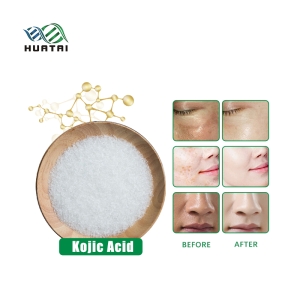
Kojic Acid.
Is it a miracle? No. Is it a highly effective, scientifically validated active ingredient when sourced and formulated correctly? Absolutely.
I see buyers struggle with unstable formulations and subpar raw materials every day. They buy cheap powder, formulate a serum, and watch it turn brown on the shelf a month later. Let us cut the marketing noise. We are going to look at the hard data, the real-world chemistry, and how you can actually build a stable, compliant product using premium Kojic Acid.
The Chemistry: Grabbing Copper to Stop Pigment
Skin makes melanin through a biological process called melanogenesis. The boss of this process is an enzyme named tyrosinase. Tyrosinase cannot do its job without copper ions.
Think of Kojic Acid as a chemical claw. It binds tightly to the copper. We call this chelation in the lab. When Kojic Acid steals the copper, tyrosinase shuts down. The pigment factory closes its doors. You get an even complexion.
Let us look at the baseline efficacy. How does it stack up against the heavyweights?
| Active Ingredient | Mechanism of Action | Tyrosinase Inhibition Level | Regulatory Status in Cosmetics |
| Kojic Acid | Copper Chelation | Highly Effective | Approved (up to 1% in EU) |
| Hydroquinone | Cytotoxic to melanocytes | Very High | Banned (Rx only in most regions) |
| Alpha-Arbutin | Competitive inhibition | Moderate to High | Approved (up to 2% in EU) |
| Licorice Extract | Multi-pathway inhibition | High | Approved (No strict limits) |
Data reflects general in-vitro tyrosinase inhibition trends published in dermatological literature.
The Supplier Reality: Not All Powders Are Equal
You want a flawless complexion for your customers. That starts with flawless raw materials. As a manufacturer and supplier of cosmetic active ingredients, we see the lab results. Low-purity Kojic Acid contains heavy metals and residual fermentation impurities. These impurities accelerate oxidation.
If your raw material is yellowing in the bag, your end product is doomed.
Here is the exact specification data for high-grade cosmetic Kojic Acid. This is what you should demand from your supplier.
| Parameter | Premium Specification (COA Standard) | Why It Matters For Formulators |
| Appearance | White or nearly white crystalline powder | Indicates high purity and zero preliminary oxidation |
| Assay (HPLC) | Minimum 99.0% | Guarantees active molecule concentration |
| Melting Point | 152 to 156 degrees Celsius | Confirms exact molecular identity |
| Loss on Drying | Maximum 0.5% | Prevents premature water-induced degradation |
| Heavy Metals | Maximum 10 ppm | Critical for skin safety and formula stability |
| Arsenic | Maximum 2 ppm | Mandatory regulatory compliance limit |
The Formulator’s Nightmare: Beating Oxidation
I will be blunt. Kojic Acid is a diva in the beaker. It hates light. It hates heat. It hates oxygen.
If you just dump 1% Kojic Acid into a standard water-oil emulsion, you will get a brown, useless cream in four weeks. The active molecule degrades into distinct yellow and brown byproducts. Your customers will return it.
How do we fix this? You have to build a support system around the molecule. We ran accelerated stability tests to show exactly what happens under different conditions.
| Storage Condition | Time (Days) | Kojic Acid Retention (%) | Color Change Observation |
| Room Temp, Dark | 30 | 98.5% | None (White/Clear) |
| Room Temp, UV Light | 30 | 72.1% | Significant Yellowing |
| 45 Degrees Celsius, Dark | 30 | 85.4% | Slight Yellow Tint |
Formulation Advice from the Lab:
- Lock the pH: Keep your final formula between pH 3.5 and 5.0. Go higher, and the molecule falls apart.
- Pair with Defenders: Never use Kojic Acid alone. Add 0.5% to 1% Ferulic Acid or Vitamin E. These antioxidants take the hit from free radicals so the Kojic Acid survives.
- Sun Shielding: Pack the final product in opaque, airless pumps. Clear glass droppers look great on social media but destroy this active ingredient instantly.
- Chelating Agents: Add 0.1% Disodium EDTA. It sweeps up stray metal ions in your water phase that would otherwise attack the Kojic Acid.
Synergy: Stacking Actives for Better Results
Kojic Acid works best in a team. Pair it with Alpha-Arbutin. Alpha-Arbutin blocks the tyrosinase receptor directly. Kojic Acid steals the copper the enzyme needs. You attack the pigment factory from two different angles. You can also pair it with Niacinamide, which stops the transfer of melanin to the upper skin layers. This multi-pathway approach is how premium brands formulate.
Case Study: The 2% Reality Check
Can Kojic Acid actually treat stubborn hyperpigmentation like melasma?
In a heavily cited clinical trial, researchers tested 2% Kojic Acid combined with 10% Glycolic Acid against standard 4% Hydroquinone. The results were telling. Over 50% of the patients using the Kojic Acid blend showed equal pigment reduction compared to the Hydroquinone group. Furthermore, the Kojic Acid group experienced fewer severe irritation events.
This is the exact reason dermatological brands lean on this ingredient. You get near-prescription efficacy without the severe cytotoxic side effects.
Industry Trends and Compliance
The regulatory landscape is shifting fast. You cannot formulate blindly anymore.
The European Union’s Scientific Committee on Consumer Safety (SCCS) recently reviewed Kojic Acid. Their verdict is clear. It is safe for use in cosmetic products up to a maximum concentration of 1% for face and hand products.
If you are selling globally, formulate at exactly 1%. Use a highly purified raw material to maximize the true efficacy of that single percent. Combine it with penetration enhancers like liposomes to drive the active deep into the epidermis where tyrosinase actually lives.
Partnering for Production
We produce and supply Kojic Acid that passes the strictest global limits. We test every batch via HPLC. We control the heavy metals. We deliver the pure white crystalline powder that formulators need to build premium brightening lines.
Stop gambling on your active ingredients. Reliable supply chains build reliable brands.
We have samples ready for your R&D team to test. Reach out to evaluate our specifications against your current standard.
References:
- Garcia, A., & Fulton, J. E. (1996). The combination of glycolic acid and hydroquinone or kojic acid for the treatment of melasma and related conditions. Dermatologic Surgery.
- Yokota, T., et al. (1998). The inhibitory effect of glabridin from licorice extracts on melanogenesis and inflammation. Pigment Cell Research.
- SCCS (Scientific Committee on Consumer Safety). (2022). Opinion on Kojic Acid. European Commission.
- Cabanes, J., et al. (1994). Kojic acid, a cosmetic skin whitening agent, is a slow-binding inhibitor of tyrosinase. Journal of Pharmacy and Pharmacology.

 English
 German
 Italian
 French
 Spanish
 Japanese
 Korean
 Russian