
Hablemos de la realidad del mercado de aclaramiento de la piel. Los reguladores están actuando enérgicamente a nivel mundial. La hidroquinona está prácticamente prohibida en cosméticos de venta libre. Los formuladores buscan alternativas efectivas y legales. Muchos recurren a derivados inestables de la Vitamina C. Otros prueban extractos exóticos de plantas sin respaldo clínico alguno.
¿Pero el dinero inteligente? A menudo regresa a un poderoso subproducto de la fermentación del sake.
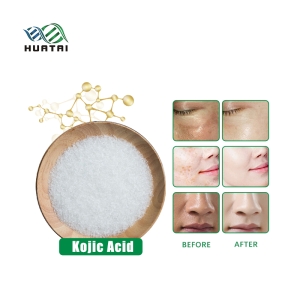
Ácido Kójico.
¿Es un milagro? No. ¿Es un ingrediente activo altamente efectivo y científicamente validado cuando se obtiene y formula correctamente? Absolutamente.
Veo a los compradores luchar con formulaciones inestables y materias primas de baja calidad todos los días. Compran polvo barato, formulan un sérum y lo ven volverse marrón en el estante un mes después. Eliminemos el ruido del marketing. Analizaremos los datos duros, la química del mundo real y cómo puede construir un producto estable y conforme utilizando Ácido Kójico de primera calidad.
La Química: Capturando Cobre para Detener el Pigmento
La piel produce melanina a través de un proceso biológico llamado melanogénesis. El jefe de este proceso es una enzima llamada tirosinasa. La tirosinasa no puede hacer su trabajo sin iones de cobre.
Piense en el Ácido Kójico como una garra química. Se une fuertemente al cobre. Llamamos a esto quelación en el laboratorio. Cuando el Ácido Kójico roba el cobre, la tirosinasa se detiene. La fábrica de pigmentos cierra sus puertas. Usted obtiene una tez uniforme.
Veamos la eficacia básica. ¿Cómo se compara con los pesos pesados?
| Ingrediente activo | Mecanismo de acción | Nivel de inhibición de la tirosinasa | Estado Regulatorio en Cosméticos |
| Ácido kójico | Quelación de cobre | Altamente Efectivo | Aprobado (hasta 1% en la UE) |
| hidroquinona | Citotóxico para los melanocitos | Muy alto | Prohibido (solo con receta en la mayoría de las regiones) |
| Alfa-arbutina | Inhibición competitiva | Moderado a alto | Aprobado (hasta 2% en la UE) |
| Extracto de regaliz | Inhibición multirruta | Alto | Aprobado (Sin límites estrictos) |
Los datos reflejan las tendencias generales de inhibición de la tirosinasa in vitro publicadas en la literatura dermatológica.
La Realidad del Proveedor: No Todos los Polvos Son Iguales
Usted desea una tez impecable para sus clientes. Eso comienza con materias primas impecables. Como fabricante y proveedor de ingredientes activos cosméticos, vemos los resultados de laboratorio. El Ácido Kójico de baja pureza contiene metales pesados e impurezas residuales de fermentación. Estas impurezas aceleran la oxidación.
Si su materia prima se está amarilleando en el envase, su producto final está condenado.
Aquí están los datos de especificación exactos para el Ácido Kójico cosmético de alta calidad. Esto es lo que debe exigir a su proveedor.
| Parámetro | Especificación Premium (Estándar COA) | Por qué es importante para los formuladores |
| Apariencia | Polvo cristalino blanco o casi blanco | Indica alta pureza y cero oxidación preliminar |
| Ensayo (HPLC) | Mínimo 99% | Garantiza la concentración de la molécula activa |
| Punto de fusión | 152 a 156 grados Celsius | Confirma la identidad molecular exacta |
| Pérdida por secado | Máximo 0.5% | Previene la degradación prematura inducida por el agua |
| Metales pesados | Máximo 10 ppm | Crítico para la seguridad de la piel y la estabilidad de la fórmula |
| Arsénico | Máximo 2 ppm | Límite de cumplimiento regulatorio obligatorio |
La Pesadilla del Formulador: Vencer la Oxidación
Seré franco. El Ácido Kójico es una diva en el matraz. Odia la luz. Odia el calor. Odia el oxígeno.
Si simplemente vierte 1% de Ácido Kójico en una emulsión estándar de agua y aceite, obtendrá una crema marrón e inútil en cuatro semanas. La molécula activa se degrada en distintos subproductos amarillos y marrones. Sus clientes la devolverán.
¿Cómo solucionamos esto? Tiene que construir un sistema de soporte alrededor de la molécula. Realizamos pruebas de estabilidad acelerada para mostrar exactamente lo que sucede en diferentes condiciones.
| Condición de Almacenamiento | Tiempo (Días) | Retención de Ácido Kójico (%) | Observación del Cambio de Color |
| Temperatura Ambiente, Oscuro | 30 | 98.5% | Ninguno (Blanco/Transparente) |
| Temperatura Ambiente, Luz UV | 30 | 1% | Amarilleamiento Significativo |
| 45 Grados Celsius, Oscuro | 30 | 4% | Ligero Tinte Amarillo |
Consejo de Formulación del Laboratorio:
- Bloquear el pH: Mantenga su fórmula final entre pH 3.5 y 5.0. Si sube, la molécula se descompone.
- Combinar con Defensores: Nunca use Ácido Kójico solo. Agregue 0.5% a 1% de Ácido Ferúlico o Vitamina E. Estos antioxidantes reciben el golpe de los radicales libres para que el Ácido Kójico sobreviva.
- Protección Solar: Empaque el producto final en bombas opacas y sin aire. Los goteros de vidrio transparente lucen geniales en las redes sociales, pero destruyen este ingrediente activo al instante.
- Agentes quelantes: Agregue 0.1% de Disodio EDTA. Elimina los iones metálicos errantes en su fase acuosa que de otro modo atacarían el Ácido Kójico.
Sinergia: Apilando Activos para Mejores Resultados
El Ácido Kójico funciona mejor en equipo. Combínelo con Alfa-Arbutina. La Alfa-Arbutina bloquea directamente el receptor de la tirosinasa. El Ácido Kójico roba el cobre que la enzima necesita. Ataca la fábrica de pigmentos desde dos ángulos diferentes. También puede combinarlo con Niacinamida, que detiene la transferencia de melanina a las capas superiores de la piel. Este enfoque multirruta es cómo formulan las marcas premium.
Caso de Estudio: El Chequeo de Realidad del 2%
¿Puede el Ácido Kójico tratar realmente la hiperpigmentación persistente como el melasma?
En un ensayo clínico muy citado, los investigadores probaron 2% de Ácido Kójico combinado con 10% de Ácido Glicólico contra 4% de Hidroquinona estándar. Los resultados fueron reveladores. Más del 50% de los pacientes que usaron la mezcla de Ácido Kójico mostraron una reducción de pigmento igual en comparación con el grupo de Hidroquinona. Además, el grupo de Ácido Kójico experimentó menos eventos de irritación severa.
Esta es la razón exacta por la que las marcas dermatológicas confían en este ingrediente. Obtiene una eficacia casi de prescripción sin los severos efectos secundarios citotóxicos.
Tendencias de la industria y cumplimiento
El panorama regulatorio está cambiando rápidamente. Ya no se puede formular a ciegas.
El Comité Científico de Seguridad de los Consumidores (SCCS) de la Unión Europea revisó recientemente el Ácido Kójico. Su veredicto es claro. Es seguro para su uso en productos cosméticos hasta una concentración máxima del 1% para productos faciales y de manos.
Si vende a nivel mundial, formule exactamente al 1%. Utilice una materia prima altamente purificada para maximizar la eficacia real de ese único por ciento. Combínelo con potenciadores de penetración como los liposomas para llevar el activo profundamente en la epidermis donde realmente vive la tirosinasa.
Asociarse para la Producción
Producimos y suministramos Ácido Kójico que cumple con los límites globales más estrictos. Analizamos cada lote por HPLC. Controlamos los metales pesados. Entregamos el polvo cristalino blanco puro que los formuladores necesitan para construir líneas de aclaramiento premium.
Deje de apostar por sus ingredientes activos. Las cadenas de suministro fiables construyen marcas fiables.
Tenemos muestras listas para que su equipo de I+D las pruebe. Póngase en contacto para evaluar nuestras especificaciones frente a su estándar actual.
Referencias:
- Garcia, A., & Fulton, J. E. (1996). La combinación de ácido glicólico e hidroquinona o ácido kójico para el tratamiento del melasma y afecciones relacionadas. Cirugía Dermatológica.
- Yokota, T., et al. (1998). El efecto inhibidor de la glabridina de extractos de regaliz en la melanogénesis y la inflamación. Pigment Cell Research.
- SCCS (Comité Científico de Seguridad de los Consumidores). (2022). Opinión sobre el Ácido Kójico. Comisión Europea.
- Cabanes, J., et al. (1994). El ácido kójico, un agente cosmético para el blanqueamiento de la piel, es un inhibidor de la tirosinasa de unión lenta. Journal of Pharmacy and Pharmacology.


 English
 German
 Italian
 French
 Spanish
 Japanese
 Korean
 Russian