Why Brands Are Moving Away from Hydroquinone
Hydroquinone was the gold standard for skin brightening for decades — and in clinical dermatology it remains effective for treating melasma and other persistent hyperpigmentation. But its regulatory status has shifted significantly across major cosmetic markets, and for OTC cosmetic formulation, it is no longer a straightforward choice.
Regulatory Status by Market
The practical consequence for brands formulating for global distribution is clear: hydroquinone cannot be used in cosmetic products in the EU, UK, or China, and faces a defined regulatory pathway shift in the US market. Brands targeting multi-market distribution are increasingly required to reformulate away from hydroquinone even in high-efficacy positioning scenarios.
Why It Works — and Why It Raises Safety Concerns
Hydroquinone inhibits tyrosinase by acting as a substrate analog, competing with tyrosine and DOPA for the enzyme's active site. It also exerts melanocyte-targeted cytotoxic and oxidative stress–mediated effects, which contribute to its strong depigmenting efficacy but also underlie the safety concerns associated with prolonged use — including potential for ochronosis (paradoxical skin darkening) with long-term or high-concentration application, and reported concerns regarding systemic absorption under excessive or inappropriate use conditions.
These concerns are what drove EU and other regulatory bodies to prohibit cosmetic use. For prescription dermatology under physician supervision, the benefit-risk assessment remains favorable for specific indications. For cosmetic OTC use, the global regulatory trend is toward non-cosmetic or prescription-only restriction frameworks.
Kojic Acid: Effective but Formulation-Challenging
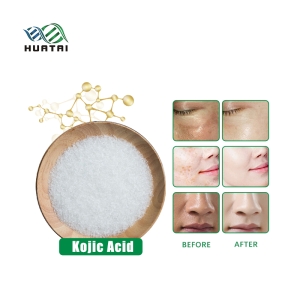
Kojic acid (5-hydroxy-2-(hydroxymethyl)-4H-pyran-4-one) is a naturally derived compound produced by fungal fermentation, most commonly from Aspergillus oryzae. It inhibits tyrosinase through copper chelation at the enzyme's binuclear copper active site, reducing the availability of the copper cofactors required for the oxidation reactions involved in melanin precursor formation.
- Efficacy
- IC₅₀ ~16–17 μmol/L against mushroom tyrosinase (in vitro). Well-established active with decades of use, particularly in Asian markets.
- Stability Challenge
- Metal-ion catalyzed oxidation: In the presence of trace iron (and other metals such as copper), undergoes oxidation leading to reddish-brown discoloration — one of the primary contributors to consumer complaints in kojic acid formulations.
- UV and heat exposure: Photodegradation and thermal oxidation without adequate protection.
- pH sensitivity: Most stable at pH 4.5–5.5; degrades more rapidly at higher pH.
- Regulatory Status
- EU: permitted up to 1% in face and hand products (SCCS/1625/20, 2019). Japan: quasi-drug framework (MHLW). Most other markets: permitted. Status periodically reviewed in some jurisdictions.
- Sensitization
- Associated with sensitization potential at concentrations above 1% in some studies — limits practical use levels in leave-on products for sensitive skin positioning.
Glabridin: A Natural Isoflavonoid with Multi-Pathway Activity
Glabridin is an isoflavanoid extracted from Glycyrrhiza glabra (licorice root). Unlike hydroquinone and kojic acid, glabridin combines documented tyrosinase inhibition with a favorable safety profile, natural origin, and COSMOS certification eligibility.
- Mechanism
- Tyrosinase inhibition through multi-point interactions within the enzyme active site — phenolic hydroxyl groups contribute to hydrogen bonding and stabilization of the ligand–enzyme complex, blocking the oxidation of tyrosine and DOPA to melanin precursors. Additionally inhibits UVB-induced pigmentation through mechanisms partially independent of direct tyrosinase inhibition, likely involving upstream signaling modulation.
- Efficacy Data
- In vitro IC₅₀ against mushroom tyrosinase: ~0.09 μmol/L, compared with kojic acid's ~16–17 μmol/L — a difference of approximately 185-fold under these specific in vitro conditions
- 4-week human clinical study (35 subjects, CMA-certified): 16.8% reduction in Melanin Index at 0.03% active glabridin (Report GZA01-23080632-JC-01)
- Human patch test (30 subjects, CMA-certified): 0 adverse reactions across all observation timepoints
- Stability
- Generally stable under mildly acidic to neutral formulation conditions (approximately pH 5.0–6.5, formulation-dependent). UV-sensitive (natural light: ~20% degradation in 8h; UV: ~27% in 8h). Does not share kojic acid's metal-ion–catalyzed discoloration instability. UV-barrier packaging and antioxidant co-ingredients can mitigate light sensitivity.
- Natural Origin & Certification
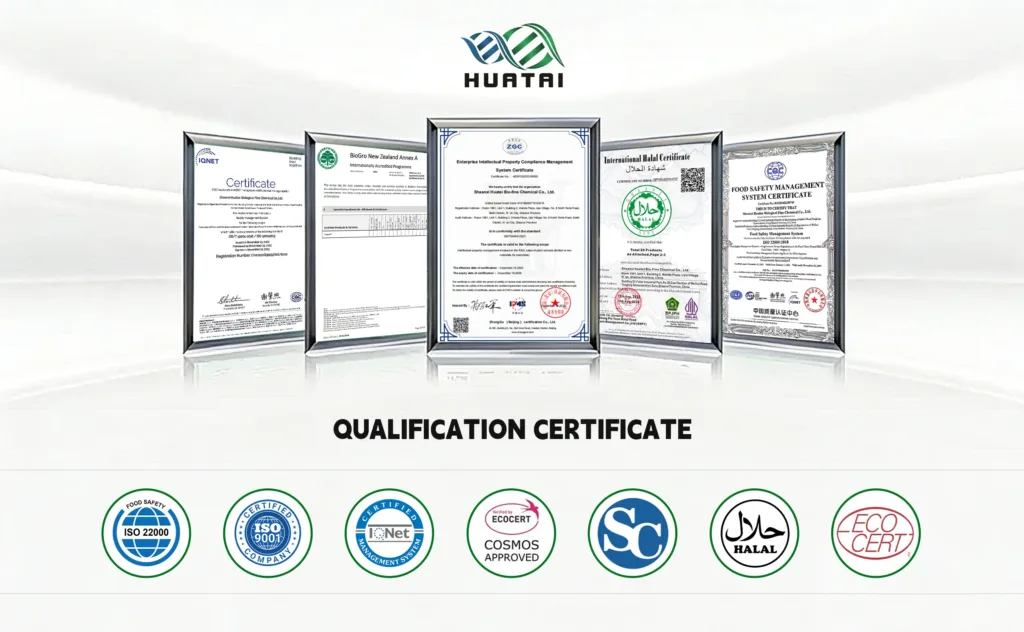
- Eligible under the COSMOS Natural standard as a Physically Processed Agro-Ingredient (PPAI). Huatai Bio's 40%, 90%, and 98% grades are COSMOS v4 certified (Ecocert Greenlife SAS, Certificate N°277614, valid until 31 December 2026).
Side-by-Side Comparison
| Glabridin | Kojic Acid | Hydroquinone | |
|---|---|---|---|
| Mechanism | Multi-point tyrosinase inhibition + UVB-induced pigmentation suppression | Copper chelation at tyrosinase active site | Tyrosinase substrate competition + melanocyte cytotoxicity |
| In vitro IC₅₀ | ~0.09 μmol/L (mushroom tyrosinase assay) | ~16–17 μmol/L (mushroom tyrosinase assay) | Not directly comparable (cytotoxic mechanism) |
| Stability | Good at pH 5.0–6.5; UV-sensitive; no metal-ion discoloration issue | Poor; metal-ion–catalyzed oxidation causes discoloration; requires chelators + antioxidants | Moderate; oxidizes to quinones; pH-sensitive |
| Safety profile | Favorable; non-irritating; 0 adverse reactions in 30-subject patch test; no carcinogenic signals in available topical studies | Moderate; sensitization potential at >1%; regulatory status periodically reviewed | Concerns: ochronosis risk with long-term use; cytotoxicity; systemic absorption under excessive use |
| Regulatory status | Not restricted in major cosmetic markets; COSMOS-certifiable (certain grades) | Permitted in EU (≤1%), Japan (quasi-drug), and most markets; periodically reviewed | Prohibited in EU, UK, China cosmetics; no approved OTC pathway in US; prescription-only in several markets |
| Natural origin | Yes — botanical extract from Glycyrrhiza glabra; COSMOS-eligible | Fungal fermentation; not COSMOS-certifiable | Synthetic; not natural origin |
| Best application | All markets; clean beauty; COSMOS-certified formulas; multi-market brands | Cost-sensitive formulas in permitted markets; requires stabilization strategy | Prescription dermatology under physician supervision; not suitable for OTC cosmetics in major markets |
Which One Should You Choose for Your Formula?
Hydroquinone is not an option. Between kojic acid and glabridin: kojic acid's EU concentration limit (1%) and stabilization requirements constrain premium formulation. Glabridin has no specific maximum concentration limit under EU regulations, delivers lower IC₅₀ in reported in vitro assay systems, and is COSMOS-eligible under specific grades.
Hydroquinone faces a defined regulatory pathway shift following the 2020 FDA OTC monograph withdrawal. Kojic acid is permitted but not regulated as a drug ingredient, limiting efficacy claims. Glabridin is permitted without specific concentration restrictions and supports brightening claims based on in vitro and clinical data.
Glabridin is the only option of the three that is COSMOS-certifiable under specific grades. Neither kojic acid nor hydroquinone qualifies under the COSMOS standard.
Kojic acid remains cost-accessible and effective when properly stabilized in markets where it is permitted. Glabridin's higher raw material cost is partially offset by lower effective use levels in some formulation systems, depending on target performance design.
Glabridin is a highly practical option for cross-market cosmetic positioning — not restricted in major cosmetic markets, eligible for COSMOS Natural classification under appropriate grades, and generally involves fewer formulation constraints compared to hydroquinone and kojic acid in terms of regulatory positioning and stabilization requirements.
Why Choose Huatai Bio
Shaanxi Huatai Bio-Fine Chemical Co., Ltd. supplies COSMOS-certified glabridin powder in grades from 40% to 99% to cosmetic brands and OEM manufacturers across 30+ countries.
- COSMOS v4 certified (Ecocert Greenlife SAS, N°277614, valid until 31 Dec 2026) for 40%, 90%, and 98% grades
- Intertek-verified purity: 99.3% HPLC (Report SHAH01681145)
- Human clinical study data available (4-week, 35 subjects, CMA-certified)
- Full grade range: alcohol-soluble (40%, 90%, 98%, 99%), oil-soluble (90%), water-soluble (10%), liquid grades (1%–5%)
- Batch COA provided with every order; HPLC chromatogram, heavy metal report, pesticide residue report on request
- Samples and technical documentation typically available within 24 hours
Frequently Asked Questions
References
- Kubo I, Kinst-Hori I. Tyrosinase inhibitors from Glabridin. Bioorganic & Medicinal Chemistry, 1999, 7(7):1373-1379
- Yokota T, et al. The inhibitory effect of glabridin from licorice extracts on melanogenesis and inflammation. Pigment Cell Research, 1998, 11(6):355-361
- Ao M, et al. Stability study of glabridin under different conditions. Natural Product Communications, 2010, 5(12):1907-1912
- EU Cosmetics Regulation (EC) No 1223/2009, Annex II — List of substances prohibited in cosmetic products
- SCCS (Scientific Committee on Consumer Safety). Opinion on Kojic Acid. SCCS/1625/20, 2019
- US FDA. Skin Bleaching Drug Products for Over-the-Counter Human Use; Withdrawal of Proposed Rules. Federal Register, 2020
- Guangdong Weipu Testing Technology Co., Ltd. (CMA certified) — Clinical Study Report GZA01-23080632-JC-01
- Ecocert Greenlife SAS — COSMOS v4 Certificate N°277614-20251216_0226 (Huatai Bio-Fine Chemical)
- Intertek Testing Services Ltd., Shanghai — HPLC Purity Report SHAH01681145


 English
 German
 Italian
 French
 Spanish
 Japanese
 Korean
 Russian