Glabridin has a well-established safety profile for cosmetic use. This is supported by patch test data, available toxicological evaluations, and a well-characterized mechanism that has not been shown to involve melanocyte cytotoxicity, DNA disruption, or immunosuppression.
The longer answer addresses the specific questions that formulators and brand R&D teams ask most frequently: whether glabridin is a steroid, what the actual side effect data shows, and what its regulatory status is across major markets.
Chemical Classification: What Glabridin Is — and Is Not
Is Glabridin a Steroid? No.
This question appears frequently because some botanical actives with perceived hormone-related activity — including certain phytoestrogens — are loosely described as "steroid-like" in consumer media. Glabridin is not a steroid.
Steroids are defined by a four-ring carbon framework (the cyclopentanoperhydrophenanthrene skeleton). Glabridin's structure is entirely different: it is an isoflavan-type flavonoid, a member of the polyphenolic flavonoid class. Its molecular formula is C₂₀H₂₀O₄ (MW 324.37), and its structure features an isoflavan skeleton with phenolic hydroxyl substituents — a completely different molecular architecture from any steroid compound.
At cosmetic use concentrations (0.01–0.5%), glabridin does not exhibit:
- Corticosteroid activity (no skin thinning, no immunosuppression)
- No significant androgen or estrogen receptor binding reported in available data
- The rebound effects or atrophy associated with topical steroid use
Is Glabridin a Flavonoid? Yes — Specifically an Isoflavan-Type.
Glabridin belongs to the flavonoid superfamily of plant polyphenols. More specifically, it is classified as an isoflavan-type flavonoid — a group characterized by a 3-phenylchroman core structure.
Within the Glycyrrhiza genus, hundreds of natural compounds have been identified. Glabridin is one of the most potent reported brightening monomers among them. Its phenolic hydroxyl groups on the aromatic rings are structural prerequisites for both tyrosinase inhibition and antioxidant activity. When these groups are substituted or chemically blocked, melanogenesis inhibition is significantly reduced or abolished (Yokota et al., 1998).
Toxicology Data
Skin Irritation — Human Patch Test
Study: Closed patch test commissioned by Huatai (Guangdong Weipu Testing Technology Co., Ltd., CMA certified, Report No. GZA01-23080632-JC-01)
| Parameter | Result |
|---|---|
| Subjects | 30 volunteers (4M / 26F, age 21–53) |
| Method | Closed patch; observations at 0.5h, 24h, and 48h post-removal |
| Adverse reactions | 0 of 30 subjects |
| Grade | Grade 0 (negative) at all three timepoints |
This is a standard primary skin irritation assessment used in cosmetic safety substantiation. A Grade 0 result across all subjects and timepoints indicates no observed irritation under the tested patch conditions.
Glabridin has not been associated with skin sensitization in available cosmetic safety data, and its safety profile is primarily characterized by low irritation potential under tested conditions.
Carcinogenicity
No carcinogenic activity has been identified for glabridin in available long-term toxicological studies. This stands in contrast to hydroquinone, which was restricted by the EU (Annex II, Regulation EC 1223/2009) following SCCP evaluation based on overall safety concerns at cosmetic use concentrations.
Glabridin's mechanism — non-competitive tyrosinase inhibition via allosteric binding — does not involve DNA interaction, reactive metabolite formation, or interference with melanocyte DNA synthesis pathways. These mechanisms are not part of the known safety concerns associated with hydroquinone.
Eye Irritation
No eye irritation has been reported for glabridin at cosmetic use concentrations. As a non-ionic polyphenolic compound, it does not carry the surfactant-related or acid-related eye irritation mechanisms typically associated with other cosmetic actives in those categories.
Phototoxicity
No phototoxicity has been identified for glabridin in the available literature. This is relevant for a brightening ingredient, as some actives in the brightening category (including certain coumarins and furocoumarins present in crude citrus extracts) carry phototoxicity risk. Glabridin's isoflavan structure does not contain the furocoumarin (psoralen-type) structural motif associated with phototoxic photosensitizers.
Clarifying Common Misconceptions
"Glabridin causes discoloration" — This Is a Formulation Stability Issue, Not a Side Effect
The most frequently reported "problem" with glabridin is yellowing or browning in emulsions. This is not a skin side effect. It is oxidative degradation of glabridin's phenolic hydroxyl groups in the formula itself, caused by:
- Trace metal contamination (Fe²⁺, Cu²⁺) catalyzing oxidative reactions
- Alkaline pH (>6.5) accelerating decomposition
- Exposure to UV or visible light
- Insufficient antioxidant protection in the formulation
The skin is not exposed to a side effect — the formulation is experiencing a stability failure. This can be significantly mitigated with tocopherol (0.2–0.5%), disodium EDTA (0.05–0.1%), pH control at 4.5–5.5, and opaque packaging. See: Why Does Glabridin Discolor in Emulsions?
"Glabridin is a phytoestrogen" — Context Matters
Glabridin has been studied for estrogenic activity in vitro at concentrations far above cosmetic use levels. A frequently cited study (Somjen et al., 2004) examined glabridin's interaction with estrogen receptors in cell culture. At cosmetic use concentrations (0.01–0.5% in a rinse-off or leave-on product), the estrogenic activity observed in high-concentration in-vitro assays is not considered relevant at cosmetic exposure levels in current safety assessments.
The EU Scientific Committee on Consumer Safety (SCCS) has not restricted glabridin on estrogenic grounds. It remains a permitted cosmetic ingredient under EC 1223/2009.
Purity and Quality as Safety Factors
Safety data is most meaningful when applied to ingredients of established purity. Impurities in lower-grade glabridin products can introduce safety variables not accounted for in studies performed on pure glabridin.
Huatai's 98% glabridin purity has been independently verified by Intertek Testing Services Ltd., Shanghai (Report No. SHAH01681145, HPLC method, glabridin content 99.3%, main peak relative area 99.71%).
Huatai's internal HPLC comparison with competitor samples detected liquiritigenin in some external materials, while it was not detected (or below detection limits) in Huatai's product. Liquiritigenin is a licorice-derived flavonoid reported in the literature to exhibit weak phytoestrogen-like activity. Its absence is likely related to Huatai's additional purification steps and impurity control.
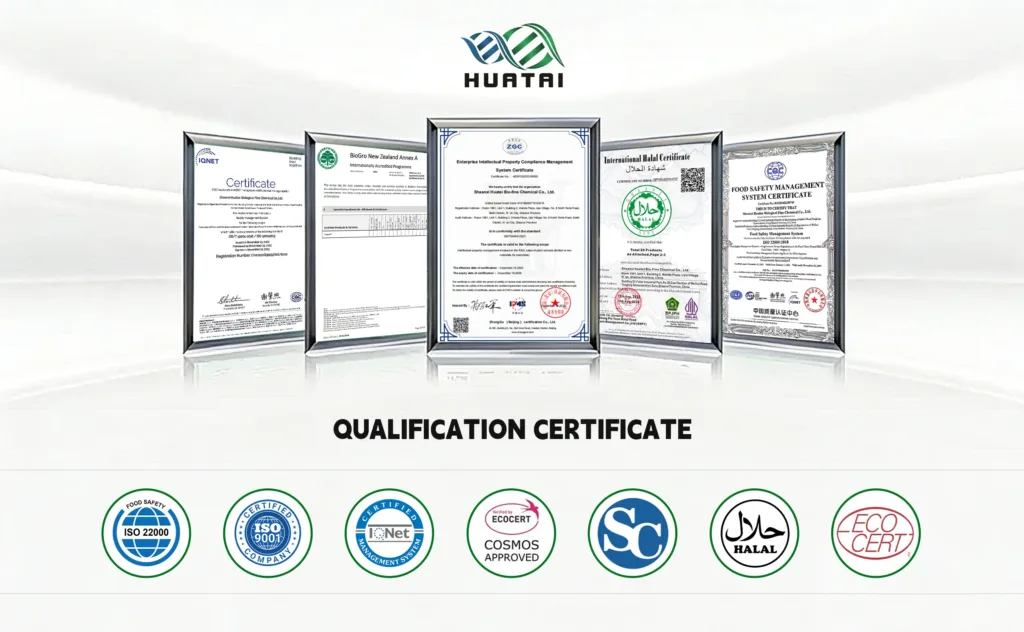
COSMOS v4 natural certification (Ecocert Greenlife SAS, Certificate N°277614-20251216_0226, valid through 31 December 2026) covers Huatai's 40%, 90%, and 98% glabridin grades — indicating compliance with the requirements of the COSMOS natural ingredient standard, one of the most widely recognised natural certification systems globally.
Regulatory Status Summary
| Jurisdiction | Status | Notes |
|---|---|---|
| European Union | Permitted | Not listed in Annex II (prohibited) or Annex III (restricted), Regulation EC 1223/2009 |
| United States | Permitted | No FDA prohibition or concentration limit in cosmetic applications |
| China | Permitted | Used in cosmetic products under NMPA framework |
| COSMOS / Ecocert | Certified | Certificate N°277614, valid to 31 Dec 2026; 40%, 90%, 98% grades |
| HALAL | Certified | Suitable for Muslim markets |
Pregnancy and Sensitive Populations
No specific restrictions on glabridin use during pregnancy have been issued by regulatory bodies in the EU or US. Available safety data does not include dedicated pregnancy-specific assessment for topical glabridin, as is the case for many cosmetic ingredients. This does not constitute a regulatory restriction, and glabridin remains permitted for cosmetic use under general cosmetic safety frameworks.
Every batch ships with COA, TDS, and SDS/MSDS. Additional testing available upon request.
References
- Yokota T, Nishio H, Kubota Y, Mizoguchi M. The inhibitory effect of glabridin from licorice extracts on melanogenesis and inflammation. Pigment Cell Research, 11(6), 355–361, 1998. DOI: 10.1111/j.1600-0749.1998.tb00494.x. PMID: 9870550.
- Somjen D, Knoll E, Vaya J, Stern N, Tamir S. Estrogen-like activity of licorice root constituents: glabridin and glabrene, in vascular tissues in vitro and in vivo. Journal of Steroid Biochemistry and Molecular Biology, 91(3), 147–155, 2004. DOI: 10.1016/j.jsbmb.2004.03.096. PMID: 15261304.
- Nerya O, Musa R, Khatib S, Tamir S, Vaya J. Chalcones as potent tyrosinase inhibitors: the effect of hydroxyl positions and numbers. Journal of Agricultural and Food Chemistry, 51(5), 1201–1207, 2003. DOI: 10.1021/jf020935u. PMID: 12568575.
- European Commission. Regulation (EC) No 1223/2009 of the European Parliament and of the Council on cosmetic products. Annex II. Official Journal of the European Union, 2009.
- Intertek Testing Services Ltd., Shanghai. Report No. SHAH01681145. HPLC purity analysis: Glabridin content 99.3%. Commissioned by Huatai Bio-Fine Chemical.
- Guangdong Weipu Testing Technology Co., Ltd. (CMA certified). Report No. GZA01-23080632-JC-01. Human patch test, 0.03% Glabridin product. Commissioned by Huatai Bio-Fine Chemical.


 English
 German
 Italian
 French
 Spanish
 Japanese
 Korean
 Russian