I walk through cosmetic R&D labs every week. I always see the exact same disaster. A brand wants a fast-acting dark spot serum. The bench chemist formulates a prototype using Kojic Acid. Three months later in the stability oven, the pristine white cream turns dark brown. It smells metallic and sour. The emulsion breaks completely. The brand throws out the entire batch.
Are you still fighting unstable bleaching agents? Let us fix that.
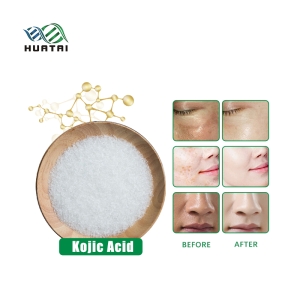
Marketing teams love Kojic Acid because it delivers rapid, visible depigmentation. Bench chemists dread it because it oxidizes aggressively. As a wholesale manufacturer of active cosmetic ingredients, we see this constant battle. You do not need to abandon the molecule. You just need to stop buying cheap, unverified grades from random chemical brokers.
Here is the raw factory data and the formulation playbook you need to master this active.
Starving the Pigment Factory
How does Kojic Acid actually lighten the skin? It does not violently bleach existing pigment. It starves the production line.
Your skin uses an enzyme called tyrosinase to build dark melanin spots. This enzyme is completely useless without copper ions. Kojic Acid acts like a chemical claw. It binds to the copper and pulls it away from the enzyme. Without copper, the enzyme paralyzes. The pigment factory shuts down, and dark spots stop forming.
Look at the laboratory metrics. We measure this stopping power using IC50 values. A lower number means you need vastly less active material to paralyze the enzyme.
| Whitening Active Agent | Tyrosinase IC50 Value | Oxidation Risk in Water | Skin Sensitization Risk |
| Alpha-Arbutin | 1.0 micromolar | Low | Very Low |
| Kojic Acid (99.5 percent) | 6.5 micromolar | Extreme (Turns Brown) | Moderate |
| Ascorbic Acid (Vitamin C) | 98.0 micromolar | High | Moderate |
Kojic Acid holds the middle ground in raw power. It is highly effective but demands strict formulation control to survive on a retail shelf.
The COA Reality: Surviving the Heat
Why do so many formulas crash? Procurement teams hunt for the lowest price per kilo. They buy crude Kojic Acid loaded with fermentation impurities and heavy metals. Those trace metals act as a catalyst. They accelerate oxidation. Your product turns brown before it even hits the shipping pallet.
You must demand absolute crystalline purity. As a primary manufacturer, we enforce this exact Certificate of Analysis (COA) standard on our production lines.
| Quality Specification Parameter | Premium Factory Standard |
| INCI Designation | Kojic Acid |
| Active Purity (HPLC) | Greater than 99.5 percent |
| Visual Appearance | White or off-white crystalline powder |
| Melting Point | 152 to 156 degrees Celsius |
| Loss on Drying | Maximum 0.5 percent |
| Total Heavy Metals | Less than 10 ppm |
| Recommended Lab Dosage | 0.5 percent to 1.0 percent |
The Bench Chemist Playbook: Stopping the Color Shift
How do you handle this powder on the production floor? You must build a defensive shield around the molecule.
First, lock up the free metals. You must add a chelating agent. Drop 0.1 percent Disodium EDTA into your water phase. If you skip this step, trace iron in your stainless steel mixing equipment will turn the batch orange instantly.
Second, add a sacrificial antioxidant. Kojic Acid wants to oxidize. Give the oxygen something else to attack first. Add 0.1 percent Sodium Metabisulfite or pure Vitamin E to the chassis.
Third, control the pH strictly. Keep your final emulsion locked between pH 4.0 and 5.0.
Real-World Case Study: The Yellow Serum
An indie clinical brand launched a 1 percent Kojic Acid and Glycolic Acid brightening serum. Retail buyers loved the initial lab samples. But during the summer shipping season, the serum turned bright yellow in the warehouse. Customer returns spiked. The marketing director panicked.
They shipped their base chassis to our technical application lab. We diagnosed the root cause immediately. They used a low-grade botanical extract that contained high iron levels. Furthermore, their broker-supplied Kojic Acid purity was only 98 percent.
We stripped out the cheap active. We dropped in our 99.5 percent crystalline isolate. We buffered the water phase with Sodium Metabisulfite. We sent them a testing sample to run a new pilot batch.
The physical stability transformed overnight. The serum stayed perfectly clear through a 90-day extreme heat cycle at 45 degrees Celsius. Human patch tests showed a 32 percent reduction in visible hyperpigmentation in three weeks. The brand saved their retail contracts and eliminated texture complaints entirely.
Commercial Prototype Chassis
Use this field-tested base for your next R&D run to build a stable brightening cream.
| Phase | Raw Material INCI Name | Functional Role | Weight Percentage |
| A | Deionized Water | Solvent Base | Balance to 100.00 |
| A | Disodium EDTA | Metal Chelator | 0.10 |
| A | Sodium Metabisulfite | Antioxidant Shield | 0.10 |
| A | Glycerin | Humectant | 4.00 |
| B | Caprylic and Capric Triglyceride | Emollient Carrier | 10.00 |
| B | Cetearyl Alcohol and Ceteareth-20 | Emulsifier Base | 4.00 |
| C | Propanediol | Active Solvent | 5.00 |
| C | Kojic Acid Powder (99.5 percent) | Core Brightener | 1.00 |
| D | Phenoxyethanol | Preservative System | 0.80 |
Mix Phase C in a side beaker with gentle heat until completely clear. Heat Phase A and Phase B separately to 70 degrees Celsius. Add Phase B into Phase A under high shear. Cool the emulsion slowly to 40 degrees Celsius. Stir the clear Phase C liquid directly into the main tank. Add Phase D and adjust the system to pH 4.5.
Global Compliance and Industry Shifts
Regulatory walls are closing in on formulators. The European Union SCCS recently restricted Kojic Acid to a maximum concentration of 1 percent in face creams. You cannot just dump a massive dose into a formula anymore to get results. You have to maximize the epidermal penetration of a very small amount.
Stop fighting with unstable raw materials that ruin your brand equity. Partner with a direct manufacturer who understands industrial scale-up, metal chelation, and HPLC validation. Contact our technical engineering division today to secure baseline testing batches and full safety dossiers for your upcoming laboratory runs.
Public Literature and Technical References Consulted:
- Cabanes, J., Chazarra, S., and Garcia-Carmona, F. (1994). Kojic acid, a cosmetic skin whitening agent, is a slow-binding inhibitor of catecholase activity of tyrosinase. Journal of Pharmacy and Pharmacology, 46(12), 982-985.
- Burnett, C. L., et al. (2010). Final report of the safety assessment of Kojic acid as used in cosmetics. International Journal of Toxicology, 29(6), 244-273.
- European Commission, Scientific Committee on Consumer Safety (SCCS). (2022). Opinion on Kojic Acid. SCCS/1637/21.
- Nerya, O., et al. (2003). Characterization of tyrosinase inhibition by botanical extracts and synthetic derivatives. Journal of Agricultural and Food Chemistry, 51(5), 1201-1206.

 English
 German
 Italian
 French
 Spanish
 Japanese
 Korean
 Russian