
Camino semanalmente por laboratorios de I+D cosmético. Siempre veo el mismo desastre. Una marca quiere un sérum de acción rápida para manchas oscuras. El químico de laboratorio formula un prototipo usando Ácido Kójico. Tres meses después en el horno de estabilidad, la crema blanco impoluto se vuelve marrón oscuro. Huele a metálico y agrio. La emulsión se rompe por completo. La marca desecha todo el lote.
¿Sigues luchando contra agentes blanqueadores inestables? Déjanos arreglarlo.
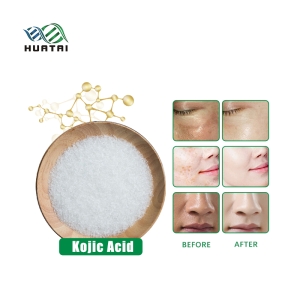
A los equipos de marketing les encanta el Ácido Kójico porque proporciona una despigmentación rápida y visible. Los químicos de laboratorio lo temen porque se oxida agresivamente. Como fabricante mayorista de ingredientes cosméticos activos, vemos esta batalla constante. No necesitas abandonar la molécula. Solo necesitas dejar de comprar grados baratos y no verificados a intermediarios químicos aleatorios.
Aquí están los datos brutos de fábrica y el manual de formulación que necesitas para dominar este activo.
Matando de hambre a la Fábrica de Pigmentos
¿Cómo aclara el Ácido Kójico la piel? No blanquea violentamente el pigmento existente. Mata de hambre a la línea de producción.
Tu piel utiliza una enzima llamada tirosinasa para producir manchas de melanina oscura. Esta enzima es completamente inútil sin iones de cobre. El Ácido Kójico actúa como una garra química. Se une al cobre y lo aleja de la enzima. Sin cobre, la enzima se paraliza. La fábrica de pigmentos se cierra y las manchas oscuras dejan de formarse.
Mira las métricas de laboratorio. Medimos este poder de detención usando valores de IC50. Un número más bajo significa que necesitas mucho menos material activo para paralizar la enzima.
| Agente activo blanqueador | Valor IC50 de Tirosinasa | Riesgo de Oxidación en Agua | Riesgo de sensibilización cutánea |
| Alfa-arbutina | 0 micromolar | Bajo | Muy bajo |
| Ácido Kójico (99.5 por ciento) | 5 micromolar | Extremo (Se Pone Marrón) | Moderado |
| Ácido ascórbico (Vitamina C) | 0 micromolar | Alto | Moderado |
El Ácido Kójico se mantiene en un punto intermedio en potencia bruta. Es muy eficaz pero exige un estricto control de formulación para sobrevivir en un estante minorista.
La Realidad del COA: Sobreviviendo al Calor
¿Por qué fallan tantas fórmulas? Los equipos de adquisiciones buscan el precio por kilo más bajo. Compran Ácido Kójico crudo cargado de impurezas de fermentación y metales pesados. Esos metales traza actúan como catalizadores. Aceleran la oxidación. Tu producto se vuelve marrón antes de llegar siquiera al palé de envío.
Debes exigir una pureza cristalina absoluta. Como fabricante primario, aplicamos este estándar exacto de Certificado de Análisis (COA) en nuestras líneas de producción.
| Parámetro de Especificación de Calidad | Estándar de Fábrica Premium |
| Designación INCI | Ácido kójico |
| Active Purity (HPLC) | Mayor que 99.5 por ciento |
| Apariencia Visual | Polvo cristalino blanco o blanquecino |
| Punto de fusión | 152 a 156 grados Celsius |
| Pérdida por secado | Máximo 0.5 por ciento |
| Metales Pesados Totales | Menos de 10 ppm |
| Dosis de Laboratorio Recomendada | 0,5 por ciento a 1,0 por ciento |
El Manual del Químico de Laboratorio: Deteniendo el Cambio de Color
¿Cómo manejas este polvo en la planta de producción? Debes construir un escudo defensivo alrededor de la molécula.
Primero, atrapa los metales libres. Debes añadir un agente quelante. Añade 0.1 por ciento de Disodio EDTA a tu fase acuosa. Si omites este paso, el hierro residual en tu equipo de mezcla de acero inoxidable volverá el lote naranja al instante.
Segundo, añade un antioxidante sacrificial. El Ácido Kójico quiere oxidarse. Dale al oxígeno algo más que atacar primero. Añade 0.1 por ciento de Metabisulfito de Sodio o Vitamina E pura al chasis.
Tercero, controla estrictamente el pH. Mantén tu emulsión final entre pH 4.0 y 5.0.
Estudio de Caso del Mundo Real: El Sérum Amarillo
Una marca clínica independiente lanzó un sérum iluminador de 1 por ciento de Ácido Kójico y Ácido Glicólico. Los compradores minoristas amaron las muestras de laboratorio iniciales. Pero durante la temporada de envío de verano, el sérum se volvió amarillo brillante en el almacén. Las devoluciones de clientes se dispararon. El director de marketing entró en pánico.
Enviaron su chasis base a nuestro laboratorio de aplicaciones técnicas. Diagnosticamos la causa raíz de inmediato. Utilizaron un extracto botánico de baja calidad que contenía altos niveles de hierro. Además, la pureza del Ácido Kójico suministrado por su intermediario era solo del 98 por ciento.
Eliminamos el activo barato. Añadimos nuestro aislado cristalino del 99.5 por ciento. Tamponamos la fase acuosa con Metabisulfito de Sodio. Les enviamos una muestra de prueba para que ejecutaran un nuevo lote piloto.
La estabilidad física se transformó de la noche a la mañana. El sérum se mantuvo perfectamente claro durante un ciclo de calor extremo de 90 días a 45 grados Celsius. Las pruebas en parches humanos mostraron una reducción del 32 por ciento en la hiperpigmentación visible en tres semanas. La marca salvó sus contratos minoristas y eliminó por completo las quejas sobre la textura.
Vehículo Prototipo Comercial
Usa esta base probada en campo para tu próxima ejecución de I+D para construir una crema iluminadora estable.
| Fase | Nombre INCI de la Materia Prima | Rol Funcional | Porcentaje en Peso |
| A | Agua desionizada | Base Solvente | Balance hasta 100.00 |
| A | EDTA disódico | Agente Quelante Metálico | 0.10 |
| A | Metabisulfito de sodio | Escudo Antioxidante | 0.10 |
| A | Glicerina | Humectante | 4.00 |
| B | Triglicérido Caprílico y Cáprico | Portador Emoliente | 10.00 |
| B | Alcohol Cetearílico y Ceteareth-20 | Base Emulsionante | 4.00 |
| do | Propanodiol | Solvente Activo | 5.00 |
| do | Polvo de Ácido Kójico (99.5 por ciento) | Iluminador Central | 1.00 |
| D | Fenoxietanol | Sistema conservante | 0.80 |
Mezcla la Fase C en un vaso aparte con calor suave hasta que esté completamente transparente. Calienta las Fases A y B por separado a 70 grados Celsius. Añade la Fase B a la Fase A bajo alta cizalladura. Enfría la emulsión lentamente a 40 grados Celsius. Agrega el líquido transparente de la Fase C directamente al tanque principal. Añade la Fase D y ajusta el sistema a pH 4.5.
Cumplimiento global y cambios en la industria
Los muros regulatorios se cierran sobre los formuladores. El SCCS de la Unión Europea recientemente restringió el Ácido Kójico a una concentración máxima del 1 por ciento en cremas faciales. Ya no puedes simplemente verter una dosis masiva en una fórmula para obtener resultados. Tienes que maximizar la penetración epidérmica de una cantidad muy pequeña.
Deja de luchar con materias primas inestables que arruinan el valor de tu marca. Asóciate con un fabricante directo que entienda la ampliación industrial, la quelación de metales y la validación por HPLC. Contacta a nuestra división de ingeniería técnica hoy mismo para obtener lotes de prueba de referencia y expedientes de seguridad completos para tus próximas ejecuciones de laboratorio.
Literatura Pública y Referencias Técnicas Consultadas:
- Cabanes, J., Chazarra, S., y Garcia-Carmona, F. (1994). Ácido kójico, un agente cosmético para el blanqueamiento de la piel, es un inhibidor de unión lenta de la actividad catecolasa de la tirosinasa. Journal of Pharmacy and Pharmacology, 46(12), 982-985.
- Burnett, C. L., et al. (2010). Informe final de la evaluación de seguridad del ácido kójico tal como se utiliza en cosméticos. International Journal of Toxicology, 29(6), 244-273.
- Comisión Europea, Comité Científico de Seguridad de los Consumidores (SCCS). (2022). Opinión sobre el Ácido Kójico. SCCS/1637/21.
- Nerya, O., et al. (2003). Caracterización de la inhibición de la tirosinasa por extractos botánicos y derivados sintéticos. Journal of Agricultural and Food Chemistry, 51(5), 1201-1206.


 English
 German
 Italian
 French
 Spanish
 Japanese
 Korean
 Russian