
The conventional approach to skin brightening — including high-concentration tyrosinase inhibitors, exfoliating acids, and barrier-compromising delivery systems — is generally effective in non-sensitive skin types. However, in sensitive, reactive, or Fitzpatrick III–VI skin, these strategies may increase the risk of post-inflammatory hyperpigmentation by inducing or amplifying cutaneous inflammatory responses. This is not a paradox. It reflects the limitation of a UV-centered model in explaining inflammation-driven pigmentation processes.
This article explains why the framework needs to change, what anti-inflammatory brightening looks like in formulation practice, and how to build a sensitive brightening system that is both effective and durable.
Why Aggressive Brightening Fails on Sensitive Skin
The Inflammation-Pigmentation Loop
In sensitive and reactive skin, the inflammatory response is more easily triggered and may be prolonged compared to non-sensitive skin. Minor triggers — friction, heat, fragrance, barrier disruption from exfoliants, even application of a new skincare product — generate an inflammatory cascade that a non-sensitive skin type would manage with minimal visible response.
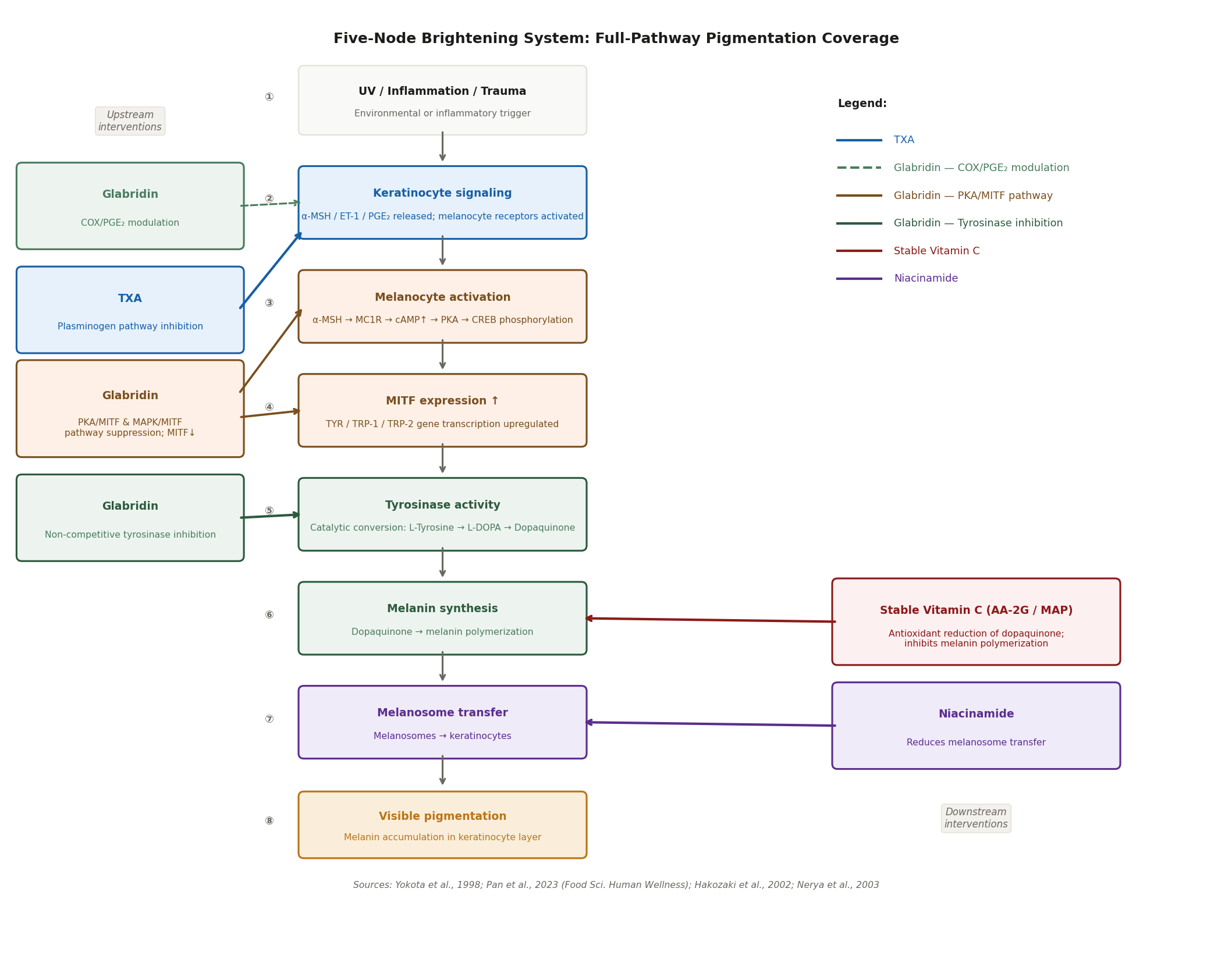
This inflammatory cascade is directly connected to melanogenesis. Through the prostaglandin E₂ (PGE₂) pathway and keratinocyte–melanocyte signaling, inflammation can promote melanocyte activation and increase pigmentation-related signaling. The result: reactive skin develops post-inflammatory hyperpigmentation (PIH) more easily, and once PIH is established, any further skin stress may contribute to persistence or recurrence of pigmentation.
The critical insight: applying aggressive brightening actives to reactive skin may add inflammatory stress at a point where skin is more vulnerable to inflammation-triggered PIH. The brightening treatment may unintentionally contribute to the same inflammatory environment it is designed to improve.
Where Conventional Brighteners Fall Short
| Approach | Problem on Sensitive Skin |
|---|---|
| High-dose L-ascorbic acid | Low pH (typically 2.5–3.5) may increase irritation potential; oxidative degradation products may further challenge reactive skin |
| AHA exfoliants | Barrier disruption → increased risk of PIH development; inflammation from exfoliation may worsen pigmentation |
| Kojic acid at effective concentrations | Documented sensitization potential; contact dermatitis risk |
| Hydroquinone (where permitted) | Irritation risk; improper or prolonged use may contribute to pigmentation rebound or ochronosis risk |
| Retinoids | Initial retinization-related irritation may increase PIH risk, particularly in Fitzpatrick III–VI skin types |
Each of these may induce inflammatory stress that can contribute to pigmentation in sensitized skin. Repeated irritation may maintain a cycle of inflammation and pigmentation.
The Anti-Inflammatory Brightening Framework
Anti-inflammatory brightening operates on a different principle: reduce inflammatory signals that contribute to melanogenesis while simultaneously inhibiting the enzymatic synthesis of melanin. The goal is not just to slow melanin production, but to reduce upstream stimuli that promote melanogenic activity.
This requires actives that operate at two levels:
- Upstream: Suppress the inflammatory melanogenic signal
- Downstream: Inhibit tyrosinase enzymatically
An ingredient that addresses both within a single molecule provides a more streamlined formulation architecture for sensitive skin.
Glabridin: The Dual-Mechanism Anchor
Glabridin addresses both levels simultaneously:
Anti-inflammatory (upstream): Modulation of prostaglandin-mediated inflammatory signaling associated with melanogenesis — regulating the prostaglandin-driven inflammatory signal that is associated with melanocyte activation and increased pigmentation. This is a pathway involved in inflammation-associated pigmentation such as PIH in sensitive skin (Yokota et al., 1998).
Tyrosinase inhibition (downstream): Non-competitive inhibition of tyrosinase — reducing enzymatic activity independently of substrate concentration, and maintaining inhibitory effect even under inflammation-stimulated melanogenic conditions.
Safety: Human closed patch test (30 subjects, Guangdong Weipu Testing Technology Co., Ltd., CMA accredited, Report No. GZA01-23080632-JC-01) — zero adverse reactions at all observation timepoints (0.5h, 24h, 48h post-removal).
Efficacy: Human clinical study (35 subjects, 0.03% glabridin in leave-on skincare water, same report) — 16.8% Melanin Index reduction over 4 weeks, statistically significant from Week 1 (P<0.05). The efficacy at 0.03% active concentration demonstrates that meaningful brightening may be achievable with improved tolerability compared to higher-dose approaches.
| Timepoint | Test Product ITA° | Control ITA° | Test Product MI | Control MI |
|---|---|---|---|---|
| Baseline | 25.73 | 24.31 | 183.10 | 186.61 |
| Week 1 | 26.10 | 24.21 | 177.90 | 189.94 |
| Week 2 | 27.14 | 24.78 | 165.05 | 186.70 |
| Week 3 | 28.40 | 25.51 | 157.46 | 182.85 |
| Week 4 | 29.34 | 25.84 | 152.35 | 175.98 |
Source: Report No. GZA01-23080632-JC-01, Guangdong Weipu Testing Technology Co., Ltd. (CMA accredited). 0.03% glabridin in leave-on skincare water, 35 subjects, 4 weeks.
Formulation Architecture: Three Layers
A sensitive brightening system should be built in three layers, each serving a distinct function.
Layer 1 — Inflammation Control
Before brightening, the formulation must create the conditions under which brightening can succeed. This means actively reducing the inflammatory background, not just avoiding known irritants.
| Active | Mechanism | Role in Sensitive Brightening |
|---|---|---|
| Glabridin | COX/PGE₂ modulation | Modulates prostaglandin-mediated melanogenic signaling |
| Ectoin (extremophile-derived amino acid derivative) | Cell membrane stabilization; stress protection | Reduces environmental triggers that initiate PIH in sensitized skin |
| Dipotassium Glycyrrhizate (DPG) | Surface anti-inflammatory; pH buffering | Aqueous-phase soothing; complements glabridin's oil-phase activity; both licorice-derived |
| Tranexamic Acid (TXA) | Keratinocyte–melanocyte signaling inhibition | Modulates keratinocyte–melanocyte signaling via the plasminogen pathway |
Formulation note: DPG and TXA are water-soluble and belong in the aqueous phase. Glabridin (standard grades) is dissolved in the polyol or oil phase. Ectoin is added to the water phase. No phase conflicts.
Layer 2 — Melanogenesis Inhibition
Once the inflammatory signal is suppressed, enzymatic inhibition operates with reduced upstream pressure.
| Active | Mechanism | Role |
|---|---|---|
| Glabridin (primary) | Non-competitive tyrosinase inhibition | IC₅₀ = 0.09 μmol/L; inhibitory activity less affected by substrate concentration |
| Niacinamide | Melanosome transfer inhibition | Reduces transfer of produced melanosomes to keratinocytes; barrier function support |
| Stable Vitamin C derivative (AA-2G or MAP) | Melanin reduction (redox modulation of dopaquinone) | Reduces melanin-related intermediates and provides antioxidant ROS protection |
Grade recommendation: For water-based serums or toners, use the 10% water-soluble glabridin grade (HP-β-CD encapsulated, COSMOS-certified). For emulsions, use 40% white or 90% in the polyol or oil phase.
Layer 3 — Barrier Protection and pH Management
A disrupted barrier is both a sensitization risk factor and a contributor to PIH development. Layer 3 ensures the formulation actively supports barrier recovery.
- Ceramide precursors or plant-derived ceramides: Restore intercellular lipid matrix
- Oat beta-glucan: Anti-inflammatory, barrier-supporting, well-tolerated in sensitive skin
- Purslane extract: Antioxidant; anti-inflammatory; supports barrier function
- pH target: 4.5–5.5 — aligns with both glabridin stability requirements and physiological skin surface pH, supporting microbiome balance
- Buffer system: Citric acid/sodium citrate; avoid phosphate buffers (metal contamination risk)
Complete Sensitive Brightening Serum — Formulation Blueprint
The following is a structural overview for a water-based sensitive brightening serum. Use levels are indicative; final levels depend on system design and stability testing.
| Phase | Ingredient | Function | Notes |
|---|---|---|---|
| Water phase | Purified water | Carrier | Buffered with citric acid/sodium citrate |
| Water phase | Citric acid / Sodium citrate | Buffer | Target pH 4.8–5.2 before actives |
| Water phase | Disodium EDTA | Metal chelation | 0.05–0.1%; prevents oxidation cascade |
| Water phase | Dipotassium Glycyrrhizate (DPG) | Soothing | Water-phase anti-inflammatory |
| Water phase | Tranexamic Acid | Keratinocyte–melanocyte signaling modulation | 2–5% |
| Water phase | Niacinamide | Melanosome transfer inhibition | 2–5% |
| Water phase | Ascorbyl Glucoside (AA-2G) | Melanin reduction (redox modulation) | 1–3% |
| Water phase | Ectoin | Membrane stabilization | 0.5–2% |
| Water phase | Oat Beta-Glucan | Barrier support | 0.5–2% |
| Cool-down | Glabridin (10% water-soluble, or pre-dissolved 40%/90% in polyol) | Primary brightening anchor | 0.1–0.3% active |
| Cool-down | Mixed Tocopherol | Antioxidant | 0.2–0.5%; add in polyol or oil phase |
| Cool-down | Preservative system | Preservation | pH-appropriate system for the final formulation |
| Final | pH verification | Quality control | Measure after ALL cool-down additions; adjust to 4.5–5.5 |
Packaging: Airless pump with opaque or UV-protective container, recommended to ensure stability of glabridin-containing systems.
What to Avoid in Sensitive Brightening Formulations
| Ingredient / Approach | Reason to Avoid |
|---|---|
| Raw L-ascorbic acid | pH conflict with glabridin; low pH is a potential barrier irritant for sensitive skin |
| AHA at exfoliating concentrations | Barrier disruption → increased risk of PIH development |
| Kojic acid | Sensitization risk; may be less suitable for sensitive skin formulations |
| Fragrance | Common sensitizer; no functional role in brightening |
| Ethanol at high concentration | Barrier disruption in sensitive skin |
| Retinoids | Retinization phase may increase risk of PIH in Fitzpatrick III–VI skin types; pH conflict with glabridin |
| Preservatives with high sensitization potential | Review PCPC/CTFA allergen data for sensitive skin suitability |
Packaging and Stability Protocol
Sensitive skin brightening formulations typically include multiple actives, any of which can degrade and compromise both efficacy and tolerance if stability is not managed.
- Accelerated stability: 40°C / 75% RH, 12 weeks (ICH Q1A(R2) conditions)
- Photostability: D65 + UV, 6 weeks (ICH Q1B)
- Freeze-thaw: 5 cycles (PCPC/CTFA guideline)
- Tracking parameters: pH (flag >0.3 unit shift), Δb* (yellowing index; flag Δb* > 3.0, commonly used industry threshold for perceptible yellowing), HPLC assay for glabridin, organoleptic assessment
Every batch ships with COA, TDS, and SDS/MSDS. Additional testing available upon request.
References
- Yokota T, Nishio H, Kubota Y, Mizoguchi M. The inhibitory effect of glabridin from licorice extracts on melanogenesis and inflammation. Pigment Cell Research, 11(6), 355–361, 1998. DOI: 10.1111/j.1600-0749.1998.tb00494.x.
- Maeda K, Nishino H. Mechanism of the inhibitory effect of tranexamic acid on melanogenesis in cultured human melanocytes in the presence of keratinocyte-conditioned medium. Journal of Health Science, 53(4), 389–396, 2007. DOI: 10.1248/jhs.53.389.
- Hakozaki T, Minwalla L, Zhuang J, et al. The effect of niacinamide on reducing cutaneous pigmentation and suppression of melanosome transfer. British Journal of Dermatology, 147(1), 20–31, 2002. DOI: 10.1046/j.1365-2133.2002.04834.x.
- Pan C, Liu X, Zheng Y, et al. The mechanisms of melanogenesis inhibition by glabridin: molecular docking, PKA/MITF and MAPK/MITF pathways. Food Science and Human Wellness, 12(1), 212–222, 2023. DOI: 10.1016/j.fshw.2022.07.011.
- Guangdong Weipu Testing Technology Co., Ltd. (CMA No. 202119135666). Report No. GZA01-23080632-JC-01. Human skin patch test + 4-week brightening efficacy study, 0.03% Glabridin. Commissioned by Huatai Bio-Fine Chemical.
- ICH Q1A(R2): Stability Testing of New Drug Substances and Products. International Council for Harmonisation, 2003.
-300x300.jpg)

 English
 German
 Italian
 French
 Spanish
 Japanese
 Korean
 Russian