
Dark circles are among the most common aesthetic concerns in skincare — and among the most frequently misformulated. The error most commonly made is applying a general brightening approach to a problem that, in most cases, is not solely driven by melanin production. Effective eye-area brightening requires identifying which of the three primary causes is dominant — vascular, structural, or pigmentary — and selecting actives that address the underlying mechanism.
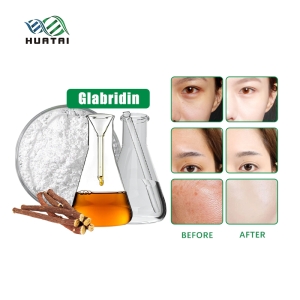
Glabridin is relevant across all three dark circle pathways — but with different levels of contribution. Understanding the distinction determines whether glabridin should be the primary active, a co-active, or a supporting ingredient in a given eye formulation.
The Three Causes of Dark Circles
The periorbital skin is exceptionally thin — among the thinnest on the face. Underlying superficial blood vessels become visible through the skin, presenting as blue, red, or purplish discoloration. This appearance is primarily associated with vascular visibility, often influenced by microcirculatory slowdown and vessel dilation.
Vascular dark circles are typically more prominent after poor sleep, dehydration, or fatigue, and they have a blue-red hue rather than a brown tone.
Brightening actives are not the primary intervention here. Caffeine (vasoconstrictive and helps reduce puffiness), dipeptide-2 (supports fluid balance), and vitamin K derivatives (support recovery of blood-related discoloration) are more relevant for addressing vascular concerns.
Volume loss in the periorbital area — fat pad atrophy, tear trough deepening — creates a shadow effect that reads as darkness. This is a three-dimensional structural issue, not a pigmentation issue.
Topical brightening actives cannot directly address structural causes. Peptides supporting collagen and elastin (acetyl tetrapeptide-5, palmitoyl tripeptide-1) and film-forming actives that improve the appearance of contour irregularities can reduce the appearance of under-eye shadowing.
True periorbital hyperpigmentation — brown melanin-related discoloration in the epidermis and dermis — is the primary target for brightening actives. It is most common in:
- Fitzpatrick III–VI skin types, where melanogenesis is more prone to pigmentation
- Post-inflammatory cases (allergic contact dermatitis from eye products, chronic rubbing)
- UV-exposed periorbital area in individuals with a tendency toward hyperpigmentation
Brown-toned dark circles that persist regardless of sleep or hydration status, and that worsen with sun exposure, are predominantly pigmentation-driven.
Why Glabridin Is Well-Suited for Periorbital Pigmentation
Anti-Inflammatory Mechanism Addresses the Primary PIH Pathway
Periorbital PIH — from allergens, friction, or repeated minor trauma from eye rubbing — follows inflammatory melanogenesis pathways involving COX/PGE₂ signaling, similar to PIH elsewhere on the face. Glabridin's COX inhibitory activity helps modulate this mechanism, not just the symptom.
For individuals with a history of allergic periorbital reactions (cosmetic contact dermatitis, eye-drop sensitivity), the inflammatory origin of their dark circles is closely associated with the mechanisms that glabridin helps modulate.
Safety Profile — Critical for the Periorbital Zone
The periorbital area is the most sensitive zone on the face. The thinner, more permeable skin means that irritant or sensitizing actives can generate more pronounced adverse reactions in some individuals. The same third-party human closed patch test that supported glabridin's dermal safety (30 subjects, zero observed adverse reactions, Report No. GZA01-23080632-JC-01) is supportive of its tolerability under tested conditions. Glabridin at recommended concentrations is generally well tolerated under standardized use conditions.
By contrast, actives such as kojic acid (reported sensitization potential), high-dose L-ascorbic acid (low pH and potential irritation in compromised barrier conditions), or retinoids (irritation potential in sensitive periorbital skin) carry elevated risk considerations in the eye area.
Efficacy at Low Concentration
The human clinical study demonstrating 16.8% MI reduction at 0.03% active concentration provides a relevant reference for topical pigmentation control, including considerations for eye-area formulation. Effective brightening may be achievable at concentrations that do not place excessive stress on thin, sensitive periorbital skin. A target use level of 0.1–0.2% active provides a practical margin above the studied concentration, without requiring higher doses that may increase tolerability considerations.
Recommended Use Level
0.1–0.2% active in the finished formulation.
This range provides potential tyrosinase inhibition and anti-inflammatory activity while remaining consistent with tolerability observations from patch testing. At 0.03%, clinical brightening was statistically significant from Week 1 — 0.1–0.2% active may provide enhanced efficacy potential within a comparable timeframe.
Complementary Active System for the Eye Area
For Pigmentation-Primary Dark Circles
| Active | Mechanism | Eye Area Rationale |
|---|---|---|
| Glabridin (primary) | Tyrosinase inhibition + COX anti-inflammatory | Contributes to both melanin production regulation and inflammatory PIH-related pathways |
| Niacinamide | Melanosome transfer inhibition | Downstream modulation; well-tolerated in periorbital zone |
| Caffeine | Vasoconstrictive; helps reduce puffiness | Co-addresses vascular component that often accompanies pigmentation dark circles |
| Dipeptide-2 | Lymphatic support; anti-edema effect | Reduces puffiness that contributes to shadow appearance |
For Mixed Etiology Dark Circles (Pigmentation + Vascular)
| Active | Mechanism |
|---|---|
| Glabridin (0.1–0.2% active) | Pigmentation: tyrosinase inhibition + COX anti-inflammatory |
| Caffeine (1–3%) | Vascular: vasoconstrictive; reduces microcirculatory pooling appearance |
| Dipeptide-2 (2–4 ppm typical) | Vascular/structural: lymphatic support; anti-edema effect |
| Niacinamide (2–3%) | Pigmentation: melanosome transfer modulation |
| Acetyl tetrapeptide-5 | Structural: lymphatic support; anti-edema activity |
Formulation Considerations for the Eye Area
Texture
Eye creams and eye serums require specific texture adjustments compared to standard facial formulations:
- Very light emulsion or gel-cream for the under-eye area — avoid heavy occlusive textures that can cause milia in the thin periorbital skin
- Low oil content (≤15% in O/W emulsion) — higher oil fractions increase milia risk
- Non-comedogenic emollients — dimethicone, cyclopentasiloxane, light esters (caprylic/capric triglyceride)
Grade Selection for Eye Formulations
| Format | Recommended Grade | Notes |
|---|---|---|
| Water-based eye serum | 10% water-soluble glabridin (HP-β-CD) | Direct aqueous dispersion; co-solvent may not be required depending on system design |
| Light O/W eye cream | 40% white powder (pre-dissolved in PG or BG at cool-down) | Polyol concentration may support dissolution depending on formulation conditions |
| Oil-serum eye treatment | 90% oil-soluble glabridin | 0.2% in oil fraction; designed to minimize sedimentation risk under proper formulation conditions |
pH Target
pH 4.5–5.5 — generally compatible with glabridin stability range and physiological periorbital skin pH. Critically, this range also supports barrier function in thin, more permeable periorbital skin, where pH imbalance may affect tolerance more noticeably.
Buffer with citric acid/sodium citrate or lactic acid/sodium lactate. Lactic acid is a good choice for eye area products — it is naturally present in skin NMF, supports hydration, and is generally well-tolerated in low concentrations in periorbital formulations.
Preservative Considerations
The periorbital area's thin, permeable skin may increase local sensitivity and permeation potential for ingredients in the formulation. Select preservatives with well-established use history in ophthalmic or eye-area formulations. Parabens have a long history of safe use in eye products. Phenoxyethanol at typical concentrations (≤1%) is widely accepted. Isothiazolinone-family preservatives are generally avoided in eye-area formulations due to sensitization concerns.
Packaging
Airless pump or glass dropper with tight seal. Open jar formats are generally not preferred for eye-area products — repeated finger contact may increase the risk of contamination, and preservative system requirements are particularly important for periorbital formulations due to increased sensitivity and frequent use near the eye area.
Eye Area Brightening Formulation — Structural Blueprint
| Phase | Ingredient | Target % | Function |
|---|---|---|---|
| Water phase | Purified water | q.s. | Carrier |
| Water phase | Lactic acid / Sodium lactate | Buffer | pH 4.8–5.2 before actives |
| Water phase | Disodium EDTA | 0.05% | Metal chelation |
| Water phase | Niacinamide | 2–3% | Melanosome transfer modulation |
| Water phase | Caffeine | 1–2% | Vascular component; puffiness reduction |
| Water phase | Dipeptide-2 | Per supplier recommendation | Lymphatic support; anti-edema activity |
| Water phase | Acetyl tetrapeptide-5 | Per supplier recommendation | Lymphatic support; anti-edema activity |
| Water phase | Hyaluronic acid (low MW) | 0.1–0.5% | Periorbital hydration |
| Oil phase | Caprylic/capric triglyceride | 5–10% | Light, non-comedogenic emollient |
| Oil phase | Dimethicone | 1–3% | Sensory; non-comedogenic |
| Emulsifier | PEG-free emulsifier system | As required | Light O/W emulsion |
| Cool-down | Glabridin (10% water-soluble or 40% pre-dissolved) | 0.1–0.2% active | Primary brightening anchor |
| Cool-down | Mixed Tocopherols | 0.2% | Antioxidant |
| Cool-down | Preservative | As required | Periorbital-appropriate system |
| Final | pH check | Target 4.5–5.5 | After all additions |
Every batch ships with COA, TDS, and SDS/MSDS. Additional testing available upon request.
References
- Yokota T, Nishio H, Kubota Y, Mizoguchi M. The inhibitory effect of glabridin from licorice extracts on melanogenesis and inflammation. Pigment Cell Research, 11(6), 355–361, 1998. DOI: 10.1111/j.1600-0749.1998.tb00494.x.
- Hakozaki T, Minwalla L, Zhuang J, et al. The effect of niacinamide on reducing cutaneous pigmentation and suppression of melanosome transfer. British Journal of Dermatology, 147(1), 20–31, 2002. DOI: 10.1046/j.1365-2133.2002.04834.x.
- Guangdong Weipu Testing Technology Co., Ltd. (CMA No. 202119135666). Report No. GZA01-23080632-JC-01. Human skin brightening efficacy study + patch test, 0.03% Glabridin. Commissioned by Huatai Bio-Fine Chemical.


 English
 German
 Italian
 French
 Spanish
 Japanese
 Korean
 Russian