
Glabridin is not a single ingredient with variable purity — it is a family of grades, each engineered for a specific formulation system. Selecting the wrong grade is the most common source of incorporation failures, stability problems, and unexpected color development in glabridin-containing products.
This article explains how each grade dimension differs and how to select the right one at the formulation brief stage.
The Four Grade Dimensions
Every glabridin grade is defined by four parameters: active content, physical form, solubility system, and color. Each dimension is independent — a grade with the same active content can exist in multiple solubility systems and colors.
Dimension 1 — Active Content
| Active Content | Grade Family | Primary Use Context |
|---|---|---|
| 1%–5% | Liquid (pre-dissolved) | Convenient concentrates; direct addition to system |
| 10% | Water-soluble powder | Aqueous systems; HP-β-CD encapsulated |
| 40% | Powder | Standard brightening applications; most common commercial grade |
| 90% | Powder (alcohol or oil) | High-purity; premium serums; oil-phase systems |
| 98% | Powder | Clinical, luxury, efficacy-claim applications |
| 99% | Powder | Ultra-premium; analytical reference |
| Custom | — | Any content level available on request |
Higher active content means a lower use level is needed to achieve the same final active concentration in the finished product. The 98% grade requires significantly less material to deliver the same active dose as a 40% grade — relevant for cost-of-goods and handling precision.
Dimension 2 — Solubility System
This is the most critical dimension for formulation compatibility. Glabridin grades fall into three distinct solubility categories — and grades from different categories cannot be substituted for each other.
| Solubility | Grades Available | Formulation System |
|---|---|---|
| Alcohol-soluble | 1–5% liquid · 40% white · 40% reddish-brown · 90% · 98% · 99% | Polyol systems, hydroalcoholic toners, O/W emulsions (dissolved in polyol phase) |
| Water-soluble | 1–5% liquid · 10% powder | Water phase, aqueous serums, toners, hydrogels, sheet masks |
| Oil-soluble | 90% oil-soluble powder | Face oils, lip oils, anhydrous serums, O/W emulsion oil phase |
What goes wrong when the wrong grade is selected:
— Alcohol-soluble grade added to water phase: precipitation, clumping, uneven active distribution
— Water-soluble grade used in oil-phase system: phase incompatibility, emulsion destabilization
— Standard powder grade added to face oil: visible sedimentation within days
Dimension 3 — Color
Color variation exists only within specific grade families and is not a quality indicator.
| Grade | Color Options | Cause of Color | Quality Implication |
|---|---|---|---|
| 1%–5% liquid | Colorless to pale yellow or reddish-brown to dark brown | Botanical matrix concentration | None — both are within specification |
| 40% powder | White or reddish-brown | Purification depth | None — identical active content by HPLC |
| 90% powder | White only | High purification | — |
| 98% powder | White only | High purification | — |
| 10% water-soluble | White only | HP-β-CD encapsulation | — |
The most common diagnostic error: Receiving a reddish-brown 40% grade and concluding the material has degraded. Brown color in this grade is inherent to the botanical extraction matrix. Confirm with HPLC if uncertain — active content will be within specification. Formulation yellowing during storage is a separate oxidative stability issue and is unrelated to the raw material's natural color.
When to specify white: Select the white 40%, 90%, or 98% grade when formula base color is critical — light-colored emulsions, tinted products, or formulations where any warm color shift in the base is unacceptable.
Dimension 4 — Physical Form (Liquid vs Powder)
| Form | Grades | Shelf Life | Preservative | Best For |
|---|---|---|---|---|
| Liquid | 1%–5% (all four variants) | 12 months | Present (water-soluble) / absent (alcohol-soluble) | Convenient addition; brands without powder-weighing infrastructure |
| Powder | 10% · 40% · 90% · 98% · 99% | 24 months | None | Most manufacturing operations; better shelf life; no preservative burden |
For most manufacturing contexts, powder grades are preferred: longer shelf life, no preservative considerations, and higher active concentration per unit weight.
Grade Selection Quick Reference
| Formulation System | Correct Grade |
|---|---|
| Water-based toner / essence / hydrogel | 10% water-soluble powder or 1–5% water-soluble liquid |
| Hydroalcoholic toner / mist | 1–5% alcohol-soluble liquid or 40%/90%/98% alcohol-soluble powder (pre-dissolved in polyol) |
| O/W emulsion — active in polyol phase | 40% white or reddish-brown or 90%/98% alcohol-soluble |
| O/W emulsion — active in oil phase | 90% oil-soluble only |
| Face oil / lip oil / anhydrous serum | 90% oil-soluble only |
| Formula where color is critical | 40% white · 90% · 98% · 99% (avoid reddish-brown grades) |
| Cost-sensitive mass-market emulsion | 40% reddish-brown (where base color allows) |
| Clinical / luxury / efficacy-claim product | 98% or 99% |
| Non-standard concentration required | Custom grade — contact Huatai |
The Two Most Common Grade Selection Errors
The 40% white and 40% reddish-brown are separate SKUs. They have identical purity but different purification depth and different visual impact on the formulation. Switching from white to reddish-brown mid-development will alter the base color of a light-colored emulsion.
Without adequate polyol or ethanol concentration, alcohol-soluble glabridin will not stay in solution in a water-dominant phase. The result is precipitation that may not be visible at time of manufacture but becomes apparent after a freeze-thaw cycle or temperature excursion.
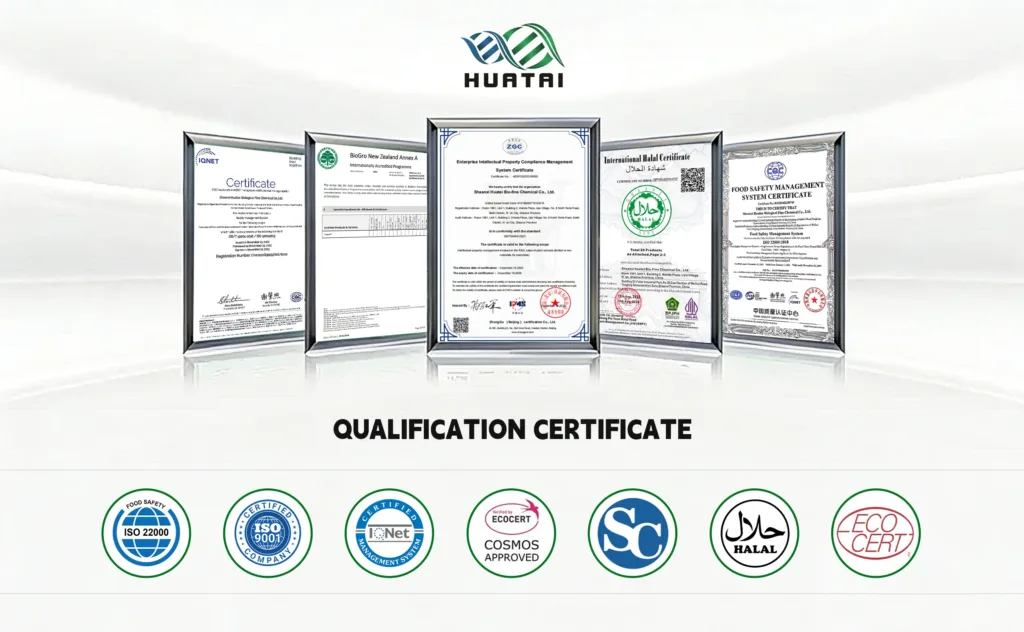
Every batch ships with COA, TDS, and SDS/MSDS. Additional testing available upon request.

 English
 German
 Italian
 French
 Spanish
 Japanese
 Korean
 Russian