
The Three Degradation Mechanisms Behind Discoloration
1Metal Ion-Catalyzed Oxidation — The Most Common Cause
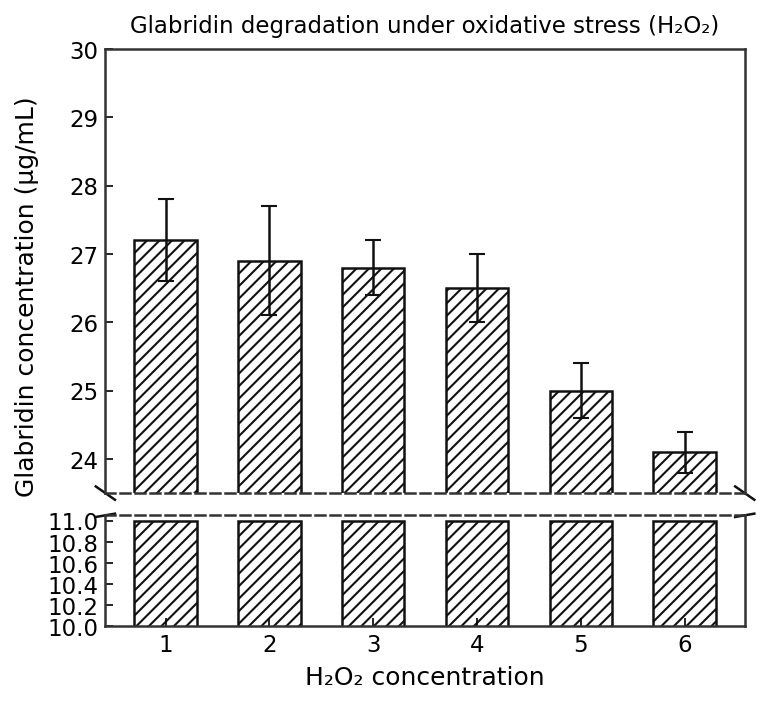
Glabridin's isoflavane structure contains two phenolic hydroxyl groups that are highly susceptible to metal-catalyzed oxidative chain reactions. Trace Fe²⁺ and Cu²⁺ can catalyze the oxidation of glabridin, accelerating the formation of chromophoric by-products that progressively shift formula color from white or cream toward yellow, amber, and eventually brown.
Sources of trace metal contamination in emulsion production are often overlooked:
- Municipal or deionized water with residual mineral content
- Plant-derived co-ingredients (botanical extracts, plant oils) that carry natural metal content
- Stainless steel processing equipment that releases trace iron under mild acidic conditions
- Titanium dioxide or iron oxide pigments used in tinted formulations
In accelerated stability testing (per ICH Q1A(R2) accelerated conditions: 40°C / 75% RH), emulsions without a chelating agent show color development (measurable Δb* shift) within 2–4 weeks, even when pH and antioxidants are well-controlled. Metal chelation is not optional — it is the primary chemical defense against oxidative discoloration.
2UV and Light Photodegradation
Ao et al. (Natural Product Communications, 2010) identified illumination as the primary factor affecting glabridin stability, with both natural light and UV light causing measurable degradation within hours under controlled conditions:
| Light Condition | Exposure | Degradation |
|---|---|---|
| Dark storage | 24 hours | No significant change |
| Natural light | 8 hours | Measurable degradation |
| UV light | 8 hours | Greater degradation than natural light |
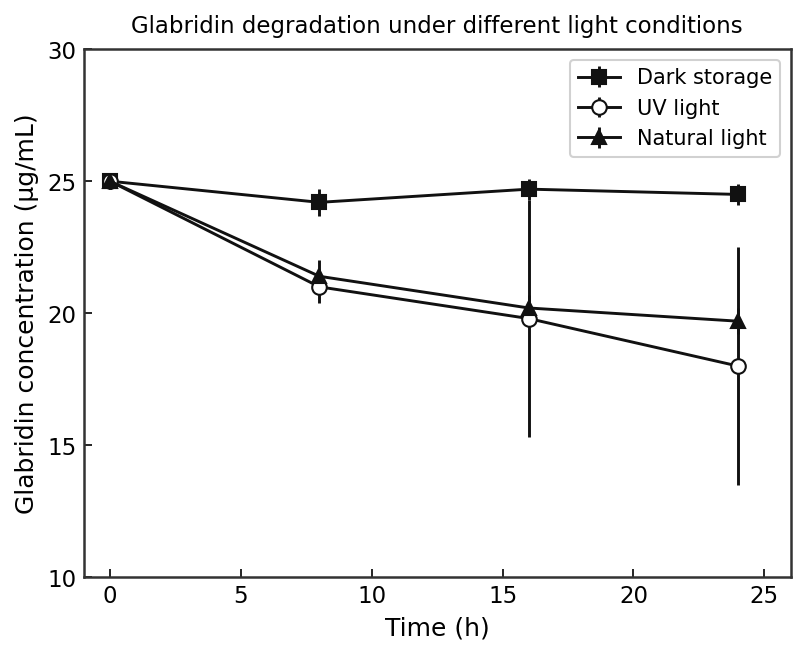
Prolonged exposure to natural or UV light may cause glabridin degradation; oxidative by-products formed in this process may contribute to color deepening in the formulation. Light-blocking packaging is therefore an important consideration for finished products containing glabridin.
3Alkaline-Induced Oxidative Degradation — A pH Management Problem
Above pH 7.0, glabridin's phenolic hydroxyl groups deprotonate more readily to form phenoxide anions, significantly increasing oxidative sensitivity and accelerating radical-mediated oxidative degradation. This process generates conjugated oxidation products, manifesting as progressive color deepening accompanied by active content loss.
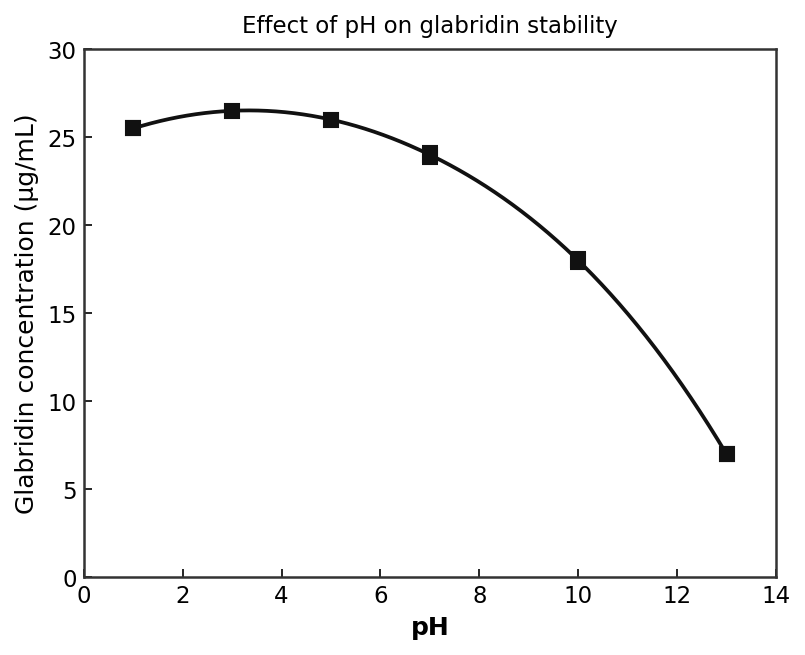
This degradation is non-linear: a formulation at pH 7.5 degrades measurably faster than one at pH 5.5 in accelerated testing. For formulators, the critical error is failing to measure pH after all cool-down additions are complete. Glabridin itself, along with co-actives added in the same phase, can shift a pH 6.0 base formula above 7.0 — triggering the very degradation the base pH was designed to prevent.
Critical formulation note: Always measure final pH after all cool-down additions are complete. A single pH check before the active addition phase is insufficient.
How to Fix It: A Three-Layer Stabilization Protocol
| Antioxidant | Use Level | Notes |
|---|---|---|
| Tocopherol (mixed) | 0.2%–0.5% | Primary lipid-phase antioxidant; incorporate in oil phase |
| BHT | 0.02%–0.1% | Highly effective; evaluate against clean-label positioning |
| Rosemary extract | 0.05%–0.2% | COSMOS-compatible natural alternative |
| Ascorbyl palmitate | 0.05%–0.1% | Oil-soluble Vitamin C derivative; synergizes with tocopherol |
The tocopherol + BHT combination provides the most robust protection in accelerated stability testing. For certified natural formulations, replace BHT with rosemary extract.
| Chelator | Use Level | Notes |
|---|---|---|
| Disodium EDTA | 0.05%–0.1% | Standard; highly effective across water types |
| Sodium phytate | 0.1%–0.5% | Natural, COSMOS-compatible; also beneficial for skin |
| Sodium gluconate | 0.1%–0.3% | Mild; for minimal-additive formulations |
Metal chelation is non-negotiable even in natural formulations. Trace transition metal ions exhibit significant catalytic activity in polyphenolic systems; their impact is closely related to concentration and formulation environment.
| pH Range | Stability | Recommendation |
|---|---|---|
| 4.0–5.5 | Optimal | Target range |
| 5.5–6.5 | Good | Acceptable |
| 6.5–7.0 | Marginal | Increase antioxidant protection |
| >7.0 | Poor | Avoid — significant alkaline decomposition |
Use a buffered aqueous phase — citric acid/sodium citrate or lactic acid/sodium lactate are both effective and cosmetically appropriate.
Packaging Considerations
Separating Raw Material Color from Formulation Degradation
A common diagnostic error: attributing formulation yellowing to the brown color of the raw material.
Formulation yellowing during storage is a distinct phenomenon caused by oxidative breakdown of glabridin in the finished product. The two are unrelated. Troubleshoot formulation color by addressing antioxidant, chelation, pH, and packaging — not by switching to a white-powder grade as the first step.
If formula color is a concern from the outset, select the white 40%, 90%, or 98% grades at the brief stage — these undergo additional purification to remove chromogenic botanical matrix components.
Every batch ships with COA, TDS, and SDS/MSDS. Additional testing available upon request.
References
- Ao M, Shi Y, Cui Y, Guo W, Wang J, Yu L. Factors influencing glabridin stability. Natural Product Communications, Vol. 5(12), 1907–1912, 2010. DOI: 10.1177/1934578X1000501214. PMID: 21299118.
- Yokota T, Nishio H, Kubota Y, Mizoguchi M. The inhibitory effect of glabridin from licorice extracts on melanogenesis and inflammation. Pigment Cell Research, 11(6), 355–361, 1998. DOI: 10.1111/j.1600-0749.1998.tb00494.x.
- ICH Q1A(R2): Stability Testing of New Drug Substances and Products. International Council for Harmonisation, 2003.
-300x300.jpg)


 English
 German
 Italian
 French
 Spanish
 Japanese
 Korean
 Russian