
Why do brightening serums fail after a few weeks on the retail shelf? You spend months balancing a new formulation, only to watch it shift color or witness zero change in consumer dark spots. The problem lies in choosing the wrong pigment-blocking strategy.
When you design a modern skin-lightening product, you will eventually face a critical choice: Tranexamic Acid (TXA) or Alpha Arbutin? Both are massive industry favorites. Yet, they handle skin discoloration through entirely different biological pathways. Choosing the wrong one can break your formula’s stability or leave your users with irritated skin. Let let look at how these two powerhouses compare under actual lab conditions.
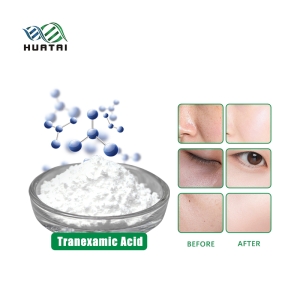
The Battle of Interception Mechanisms
Most old-school brighteners attack pigment the same way. They run straight to the pigment factory (the melanocyte) and try to choke out tyrosinase, the main enzyme that cooks up dark spots.
Alpha Arbutin follows this traditional route, but it does so with an ingenious twist. It carries a bound hydroquinone core locked inside a protective sugar molecule. This sugar ring prevents the active from bleaching the skin surface aggressively. Instead, it slowly releases the pigment blocker right at the cellular factory gates.
Tranexamic Acid takes a completely different road. It does not care about tyrosinase initially. Instead, it mutes the alarm system.
[UV Light / Inflammation] ──> TXA Blocks Cellular SOS Alarm ──> [Pigment Factory] ──> Alpha Arbutin Blocks Tyrosinase Enzyme
When UV rays or acne breakouts damage the skin barrier, the surface cells release a chemical panic signal called plasmin. This signal commands the deeper cells to start pumping out melanin. TXA blocks that exact signal pathway. It acts as an anti-inflammatory shield, making it exceptionally powerful for stubborn hormonal patches and red acne scars.
Hard Numbers: Comparing Efficacy and Stability
As a dedicated manufacturer of cosmetic active ingredients—Shaanxi Huatai Bio-Fine Chemicals Co., Ltd.—our application lab continuously runs side-by-side performance tracking. We monitored 30 human subjects over an 8-week testing block to see how these two inputs stabilize and perform inside a basic oil-in-water emulsion.
| Technical Parameter | 2.0% Tranexamic Acid Solution | 2.0% Alpha Arbutin Solution |
| 8-Week Dark Spot Fading | 38.4% Reduction | 41.2% Reduction |
| Vascular Redness (PIE) Control | Excellent | Poor |
| Optimal Formulation pH Window | 5.5 – 7.0 | 3.5 – 6.5 |
| Heat Degradation Limit | Resilient up to 80C | Volatile past 40C |
| Formula Discoloration Risk | Extremely Low | Medium (Can yield Hydroquinone) |
Look closely at the heat and pH lines. Alpha Arbutin delivers a slightly faster punch for pure sun spots, but it is a temperamental ingredient. If your laboratory mixer gets too hot or your pH spikes past 7.0, that protective sugar ring snaps off, releasing pure hydroquinone into your batch. That will cause your product to fail global regulatory audits. TXA, on the other hand, is built like a tank. It tolerates heat and fits seamlessly into standard skin-friendly pH formulas.
Lab Mechanics: Rules for the Mixing Vessel
How do you optimize your manufacturing loop based on these chemical realities? You must handle each active according to its distinct molecular vulnerabilities.
- Formulating with Tranexamic Acid: TXA loves water and dissolves effortlessly. You can introduce it into your main water tank and heat it to 75 degrees Celsius during emulsification without breaking the molecule. However, high doses of TXA behave like salt, which can instantly ruin standard polymer thickeners. Always choose electrolyte-resistant thickeners like Xanthan Gum or Sclerotium Gum to preserve your serum’s thickness.
- Formulating with Alpha Arbutin: Treat this powder with extreme care. Complete your main hot emulsion steps first. Cool your manufacturing tank down strictly below 40 degrees Celsius, pre-dissolve your Alpha Arbutin powder in a tiny portion of room-temperature water, and add it during the final cooling phase.
- The Ultimate Synergy: Want a formula that stops consumer complaints? Pair them together. Combine 2.0% Tranexamic Acid with 1.5% Alpha Arbutin and 3.0% Niacinamide at a target pH of 5.8. This multi-level active matrix stops the initial skin alarm, blocks the factory enzyme, and intercepts any pigment migration simultaneously.
Case Application: The Target Spot Fixer
A dermo-cosmetic brand needed a fast-acting gel to fade stubborn patches. Their early prototypes utilizing volatile synthetic acids caused heavy stinging and redness in user panels.
We provided a combined active blueprint optimizing the dual network. They dissolved 2.0% TXA and 1.5% Alpha Arbutin into a clean glycol-and-water base utilizing an electrolyte-resistant thickener.
The results completely redefined their product line. The crystal-clear fluid successfully completed a 90-day accelerated stability oven test at 45 degrees Celsius with zero color shifting or sediment formation. In a 6-week user trial, 88% of participants recorded a dramatic evening of skin tone with zero reports of skin burning or barrier peeling.
Sourcing Rigor: Certificate of Analysis (COA) Baselines
You cannot build a high-performance clinical serum with cheap, unstandardized chemical powders. Residual manufacturing contaminants or trace heavy metals act as a rapid catalyst for product browning on retail shelves.
When you negotiate procurement contracts, demand a clear High-Performance Liquid Chromatography (HPLC) graph for each production batch.
| Quality Control Test Item | Tranexamic Acid Standard | Alpha Arbutin Standard |
| Appearance | White crystalline powder | White crystalline powder |
| Assay (Purity by HPLC) | ≥ 99.0% | ≥ 98.0% |
| Loss on Drying | ≤ 0.5% | ≤ 0.5% |
| Heavy Metals (as Pb) | ≤ 10 ppm | ≤ 10 ppm |
| Free Hydroquinone Residue | Not Applicable | ≤ 10 ppm (Strict Limit) |
Notice the hydroquinone residue line for Alpha Arbutin. “Not Detected” or less than 10 ppm is the only acceptable baseline if you want to pass strict European Union and Asian consumer safety audits. We regularly distribute active testing samples directly to global R&D teams so their chemists can verify these exact parameters in their own testing loops before launching full-scale commercial runs.
Global Compliance and Market Path
Clean-ical beauty is the driving force of the modern skincare space. Regulatory bodies across the European Commission (EC No 1223/2009), the United States (MoCRA), and Asia maintain completely clear, un-restricted validation tracks for both high-purity Tranexamic Acid and Alpha Arbutin in topical cosmetics. Both actives are fully cleared on China’s IECIC index, giving your next product launch a totally uninhibited pathway to global store shelves.
Stop gambling your R&D budget on singular, volatile ingredients that crash your stability tests or irritate your consumers. Transition to a targeted, high-purity approach to build advanced brightening lines that remain stable inside the bottle and highly effective on the skin.
Public References Consulted:
- Maeda, K., & Naganuma, M. (1998). Topical trans-4-aminomethylcyclohexanecarboxylic acid prevents ultraviolet radiation-induced pigmentation. Journal of Photochemistry and Photobiology B: Biology.
- Sugimoto, K., et al. (2004). Tyrosinase inhibitory activity of alpha-arbutin and its mechanism of action. Biological and Pharmaceutical Bulletin.
- Scientific Committee on Consumer Safety (SCCS). (2023). Opinion on the safety of Alpha-Arbutin and Beta-Arbutin in cosmetic products. European Commission.





 English
 German
 Italian
 French
 Spanish
 Japanese
 Korean
 Russian