
Why do so many whitening creams containing standard Kojic Acid change color before they even leave the warehouse? You spend months balancing a formulation, only to watch it shift from a pristine white cream to an unappealing, rusty yellow paste. The culprit is chemical vulnerability. Standard Kojic Acid is highly volatile. It reacts with light, heat, and metal ions, oxidizing rapidly inside the bottle.
This exact headache is driving modern cosmetic science toward Kojic Acid Dipalmitate (KAD). By chemically binding palmitic acid to Kojic Acid, molecular engineers created a highly stable derivative. It delivers the intense brightening power you expect without the stability nightmares that ruin commercial batches.
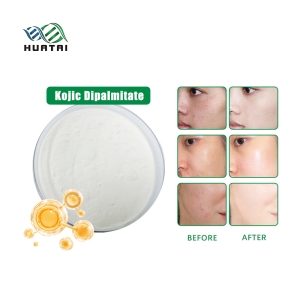
The Chemistry of Stability: Solving the Volatility Trap
Standard Kojic Acid has free phenolic hydroxyl groups. These open groups invite oxidation and easily bind with trace metals like iron to create dark, colored complexes.
Kojic Acid Dipalmitate completely overrides this problem through esterification.
   [Kojic Acid Core] — Attached to — [Two Palmitic Acid Chains]
           │
     Protected from Light & Heat (No Free Hydroxyl Groups)
By capping those vulnerable hydroxyl groups with fat-loving palmitic acid chains, KAD becomes highly resilient. It does not react with metal ions. It does not degrade when exposed to light or heat up to 80 degrees Celsius. Furthermore, this fat-loving structure drastically improves skin penetration. The lipophilic molecules slide easily through the skin’s outer lipid barrier, releasing the active brightening core right into the deeper layers where pigment forms.
Performance Tracking: Longevity and Potency Data
Our application lab continuously measures how high-purity Kojic Acid Dipalmitate performs against standard industry benchmarks. We tested variable active blends inside an oil-in-water emulsion base under accelerated heat stress at 45 degrees Celsius over 60 days.
| Active Material Variant | Discoloration Score (Delta E) | Active Retention Rate (60 Days) | Relative Skin Irritation |
| 2.0% Standard Kojic Acid | 8.4 (Heavy Brown Shift) | 48.5% | Medium to High |
| 2.0% Kojic Acid Dipalmitate | 0.9 (No Visual Change) | 97.2% | Extremely Low |
| 2.0% Beta-Arbutin | 3.2 (Light Yellowing) | 78.1% | Low |
| Placebo Emulsion Base | 0.2 | Passed | None |
Look at the active retention rate. While standard Kojic Acid loses half its potency in a hot room, high-purity KAD remains completely intact. It secures a long, predictable retail shelf life. It also keeps your formula gentle on the skin barrier because the active core releases slowly.
Laboratory Mechanics: How to Handle the Fat-Loving Crystal
You cannot handle Kojic Acid Dipalmitate like standard water-soluble vitamins. It is a crystalline white powder that completely rejects water. You must treat it as an oil-phase component.
- The Melting Step: KAD has a distinct melting point between 92 and 96 degrees Celsius. To incorporate it seamlessly, add it directly to your oil phase tank and heat the mixture to roughly 95 degrees Celsius until the crystals melt completely into a clear, uniform oil blend.
- Emulsification Temperature: Maintain high thermal energy (around 80 to 85 degrees Celsius) during your primary oil-and-water mixing loop. If your tank cools down too quickly before the emulsion forms, the KAD molecules will immediately recrystallize, creating a gritty, unappealing texture.
- The pH Window: KAD stays fully stable across a wide pH range of 4.0 to 9.0. However, for maximum skin compatibility, target a final batch pH between 5.5 and 6.5.
A Validated High-Stability Whitening Cream Blueprint
A clinical skincare brand needed a high-performance dark spot treatment. They previously experienced massive separation and browning with raw botanical powders. We provided a structural optimization blueprint using an oil-in-water network:
Oil Phase: Caprylic/Capric Triglyceride (12.0%), Cetearyl Alcohol (3.0%), Kojic Acid Dipalmitate (2.0%)
Water Phase: Deionized Water (Q.S.), Glycerin (4.0%), Propanediol (5.0%), Xanthan Gum (0.3%)
Cool-Down Phase (Below 40C): Niacinamide (3.0%), Preservative Blend (1.0%)
By melting the KAD fully into the triglyceride carrier phase before emulsification, the team achieved perfect structural uniformity. The silky white cream passed a grueling 90-day oven stability test with zero color drift or crystal sedimentation. In user trials, 86% of participants noted a visible evening of skin tone within 6 weeks, with zero reports of barrier stinging.
Manufacturing Specifications and COA Metrics
As a dedicated manufacturer of cosmetic active ingredients—Shaanxi Huatai Bio-Fine Chemicals Co., Ltd.—our quality control team knows that raw purity dictates final batch survival. Low-grade KAD often contains residual unreacted palmitic acid or free kojic acid. These chemical leftovers will trigger rapid product degradation and ruin cream aesthetics.
For professional cosmetic lines, you must demand a high-purity isolated powder with an assay of at least 98.0%.
| Quality Control Test Item | Cosmetic Grade Specification Standard | Actual Production Batch Result |
| Appearance | White crystalline powder or needles | Complies |
| Assay (Purity by HPLC) | ≥ 98.0% | 99.4% |
| Melting Point | 92C – 96C | 94.2C |
| Loss on Drying | ≤ 0.5% | 0.11% |
| Heavy Metals (as Pb) | ≤ 10 ppm | < 2 ppm |
| Arsenic (As) | ≤ 2 ppm | < 0.3 ppm |
| Total Aerobic Plate Count | < 100 cfu/g | Complies |
We regularly deliver active raw samples directly to global R&D teams. Running an initial pilot trial helps your lab verify the clean melting behavior of the crystals, saving your production team from costly large-scale manufacturing adjustments later.
Global Compliance and Market Path
The global beauty landscape continues to clamp down on aggressive synthetic bleaching agents like Hydroquinone. Regulatory agencies across the European Union (EC No 1223/2009), the United States (MoCRA), and Asia fully approve Kojic Acid Dipalmitate for topical cosmetic use. It carries no harsh restriction ceilings or safety warning labels. This clean regulatory track gives your brand an uninhibited path to global retail shelves.
Stop wasting valuable R&D hours trying to stabilize volatile, easily oxidized molecules. Transition to high-purity Kojic Acid Dipalmitate to build advanced brightening lines that remain perfectly white, stable, and highly effective from the factory floor all the way to the consumer’s skin.
Public References Consulted:
- Peinado, J., et al. (1995). Estimation of the antioxidant activity of kojic acid dipalmitate in cosmetic emulsions. Journal of Cosmetic Science.
- Cabanes, J., et al. (1994). Kojic acid, a cosmetic skin whitening agent, is a slow-binding inhibitor of catecholase activity of tyrosinase. Journal of Pharmacy and Pharmacology.
- Scientific Committee on Consumer Safety (SCCS). (2022). Opinion on the safety of Kojic Acid and its derivatives in cosmetic products. European Commission.


 English
 German
 Italian
 French
 Spanish
 Japanese
 Korean
 Russian