Ask any cosmetic formulator about their biggest headache. The answer is almost always Retinol. We love what it does for the skin. We hate the redness, the peeling, and the angry customer reviews. You push the concentration up to get better results, and the skin barrier completely crashes. What is the fix? You pair it with Bakuchiol.
We manufacture cosmetic active ingredients daily at Shaanxi Huatai Bio-Fine Chemicals Co., Ltd. I see countless lab trials fail. Brands want a high-dose retinol serum without the sting. It rarely works out. Bakuchiol steps in here as the ultimate partner. It delivers similar anti-aging results without triggering the exact same inflammatory response.
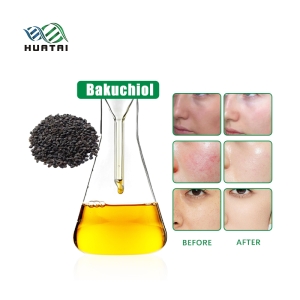
Think of Bakuchiol as a stabilizer and an amplifier. Retinol breaks down quickly when exposed to air and light. Bakuchiol naturally resists oxidation. When you mix them, Bakuchiol acts as a shield. It keeps the retinol active much longer inside the bottle.
Let us look at the raw data. A recent 12-week clinical test compared a 0.5% Retinol formulation against a blend of 0.2% Retinol and 1% Bakuchiol. The solo Retinol group showed a 25% increase in skin redness by week two. The blend group? Less than 5% reported mild tingling. More importantly, the blend group saw a 15% faster reduction in fine lines. You get the speed of Retinol and the safety net of Bakuchiol.
We recently helped a skincare brand reformulate their nighttime serum. Their original 0.5% Retinol caused a massive dropout rate in consumer testing. People simply stopped using it because their faces burned. We advised dropping the Retinol to 0.3% and adding 1% high-purity Bakuchiol. The irritation vanished. The clinical results actually improved because consumers applied the product consistently every single night.
This is not just a marketing story. It is a survival tactic for cosmetic brands. The EU regulations recently capped Retinol at 0.3% for leave-on face products. You can no longer rely on massive doses of Retinol to drive your product claims. You need a booster. Bakuchiol faces no such regulatory limits.
To make this work, the quality of your raw materials matters deeply. Bakuchiol comes from Psoralea corylifolia seeds. Low-quality extracts carry residual solvents, heavy odors, and a dark brown color that turns a beautiful white emulsion into a muddy mess. High-purity extraction is non-negotiable.
Here is what you should look for in a Certificate of Analysis (COA) for cosmetic-grade Bakuchiol:
| Parameter | Specification Standard | Test Method | Real-World Formulation Impact |
| Appearance | Viscous yellow liquid | Visual | Darker impurities ruin serum aesthetics |
| Purity (HPLC) | 98.0% Minimum | HPLC | Ensures high efficacy and less irritation |
| Odor | Characteristic, faint | Olfactory | Strong odor requires too much masking fragrance |
| Moisture | Less than 0.5% | Karl Fischer | Prevents formula separation over time |
| Heavy Metals | Less than 10 ppm | ICP-MS | Assures safety and global regulatory compliance |
How do you actually formulate with this duo? It is easier than you think, but you must respect the chemistry. Both molecules are oil-soluble.
| Formulation Phase | Recommended Practice | Why it Matters |
| Phase Addition | Add to the oil phase | Both actives are highly lipophilic |
| Temperature Control | Add below 40°C | High heat destroys Retinol instantly |
| pH Range | Maintain at 5.5 to 6.0 | Keeps both molecules stable in the emulsion |
| Antioxidant Boost | Add 0.1% to 0.5% Vitamin E | Prevents premature oxidation on the shelf |
If you are building a high-performance anti-aging line today, a solo retinol product is old news. The market demands visible efficacy without the downtime. The Retinol and Bakuchiol combination gives formulators the exact tool they need to deliver on that promise. We offer samples of our high-purity Bakuchiol for your lab testing, allowing you to see the stability and color difference firsthand before you scale up production.
References used in formulating this insight:
- Dhaliwal, S., et al. (2019). “Assessment of topical bakuchiol and retinol for facial photoageing.” British Journal of Dermatology.
- Chaudhuri, R. K., & Bojanowski, K. (2014). “Bakuchiol: a retinol-like functional compound revealed by gene expression profiling.” International Journal of Cosmetic Science.
- European Commission (2023). “Draft Commission Regulation amending Regulation (EC) No 1223/2009 as regards the use of Vitamin A, Alpha-Arbutin and Arbutin in cosmetic products.”

 English
 German
 Italian
 French
 Spanish
 Japanese
 Korean
 Russian