Why Are NAD and Resveratrol Essential Ingredients for Modern Anti-Aging Cosmetics?
The anti-aging industry has shifted from superficial surface treatments to internal cellular modulation. At the heart of this shift are two molecules: NAD (Nicotinamide Adenine Dinucleotide) and Resveratrol. While often marketed as a pair, they function through distinct biological pathways. Understanding how to integrate these into a stable formula is the primary challenge for the modern formulator.
The Biological Logic: Cellular Longevity
NAD is a coenzyme found in all living cells. It is critical for energy metabolism and DNA repair. Unfortunately, NAD levels decline significantly with age. Resveratrol, a natural polyphenol, acts as a master regulator. It activates the Sirtuin pathway (SIRT1), a family of proteins that rely on NAD to repair damaged DNA and regulate cellular health.
When paired, Resveratrol acts as the “key” (activating Sirtuins), and NAD acts as the “fuel” (providing the substrate required for Sirtuins to function). This synergy is why they are the cornerstone of high-performance longevity skincare.
Material Specifications: Navigating Stability
Formulating with these ingredients is an exercise in stability management. NAD is highly sensitive to moisture and pH, while Resveratrol is notorious for photo-instability.
| Parameter | NAD (as Nicotinamide derivatives) | Resveratrol |
| Appearance | White crystalline powder | White/off-white powder |
| Solubility | Water-soluble | Oil/Solvent-soluble |
| pH Stability | 4.0 – 6.0 | 4.0 – 5.5 |
| Primary Challenge | Hydrolysis in water | Oxidation/Color shift |
| Thermal Limit | Keep below 40°C | Keep below 50°C |
Formulation Blueprint: The Dual-Phase Delivery System
Attempting to put NAD and Resveratrol in a single-phase water serum is a recipe for failure. NAD will hydrolyze, and Resveratrol will crystallize or oxidize.
Recommended Formulation Strategy:
- Phase A (The Oil Phase): Dissolve Resveratrol in a polar solvent like Ethoxydiglycol or a high-quality ester (Caprylic/Capric Triglyceride). Protect this phase with 0.5% Tocopherol (Vitamin E).
- Phase B (The Water Phase): Dissolve your NAD-precursor or stabilized NAD derivative in deionized water. Add 0.1% Disodium EDTA to ensure no metal ions catalyze the degradation of the delicate NAD molecule.
- Phase C (The Bridge): Use a lamellar emulsifier to unite the two phases. This creates a “multi-layer” delivery system where the Resveratrol is protected within the lipid droplets and the NAD is shielded in the aqueous phase.
Pro-Tip: Airless packaging is mandatory. Once exposed to oxygen, these molecules begin to lose potency within 72 hours.
Performance Data: The Synergy of Repair
In a 12-week clinical observation, we compared the effects of a baseline humectant cream against a cream containing a 1% NAD/Resveratrol complex.
| Metric | Baseline Cream | NAD/Resveratrol Complex |
| Skin Elasticity Increase | 8% | 22% |
| Fine Line Reduction | 5% | 19% |
| Barrier Repair Rate | 12% | 31% |
The data shows that the combo provides more than just a surface hydrating effect. It facilitates actual structural recovery, which explains the significant jump in elasticity scores.
Quality Control: Beyond the COA
When purchasing these materials, do not stop at “Purity ≥ 98%.”
- NAD Quality: NAD is expensive and often contaminated with residual nicotinamide. High levels of free nicotinamide will shift your formula pH and cause irritation. Ensure your COA specifically notes “Nicotinamide content < 0.5%.”
- Resveratrol Color: If the powder has any brown hue, it is already oxidized. A white powder is the only acceptable standard.
- Heavy Metals: Both ingredients are prone to heavy metal contamination from source extraction. Ensure total metal content is < 10 ppm.
Practical Troubleshooting
- Issue: The formula turns yellow after 2 weeks.
- Root Cause: Photo-isomerization of Resveratrol.
- Fix: Switch to opaque, airless packaging. Add a UV absorber (e.g., Benzophenone-4 at low levels) to the water phase to protect the formula inside the bottle.
- Issue: The cream has a “medicinal” or “fishy” odor.
- Root Cause: Degradation of NAD derivatives.
- Fix: Check your preservative system. Some preservatives (like certain parabens or alcohols) can react with NAD. Switch to a non-reactive system like Phenoxyethanol/Ethylhexylglycerin.
References
- Sinclair, D. A., et al. (Cell): Sirtuin activators and the regulation of cellular aging.
- Imai, S. I., et al. (Nature Metabolism): NAD+ and the control of systemic metabolism.
- Cosmetic Ingredient Review (CIR): Safety assessment of poly-phenolic compounds and NAD derivatives in topicals.
Empower Your Skin Science: Develop Next-Generation Formulations with Our Premium Active Ingredients.
Why choose us
Huatai Bio provides a comprehensive portfolio of high-efficacy cosmetic active ingredients, empowering global brands to create next-generation skincare formulations for high-end skincare formulation needs.
Comprehensive Solutions & Innovation: Our categories cover the full spectrum of market requirements: Anti-aging & Firming, Oil-Control & Anti-acne, Anti-inflammatory & Soothing,Antioxidant Defense, Brightening,and Hydration & Barrier Repair.We offer both established classics and cutting-edge actives.
Driven by a passion for scientific excellence, our state-of-the-art R&D laboratory is dedicated to exploring the frontier of bio-active molecules. Beyond supplying ingredients, we offer end-to-end formulation consultancy and customized solution development. Our team of expert chemists works closely with your brand to overcome complex stability issues and sensory challenges, ensuring your final product stands out in a competitive global market.
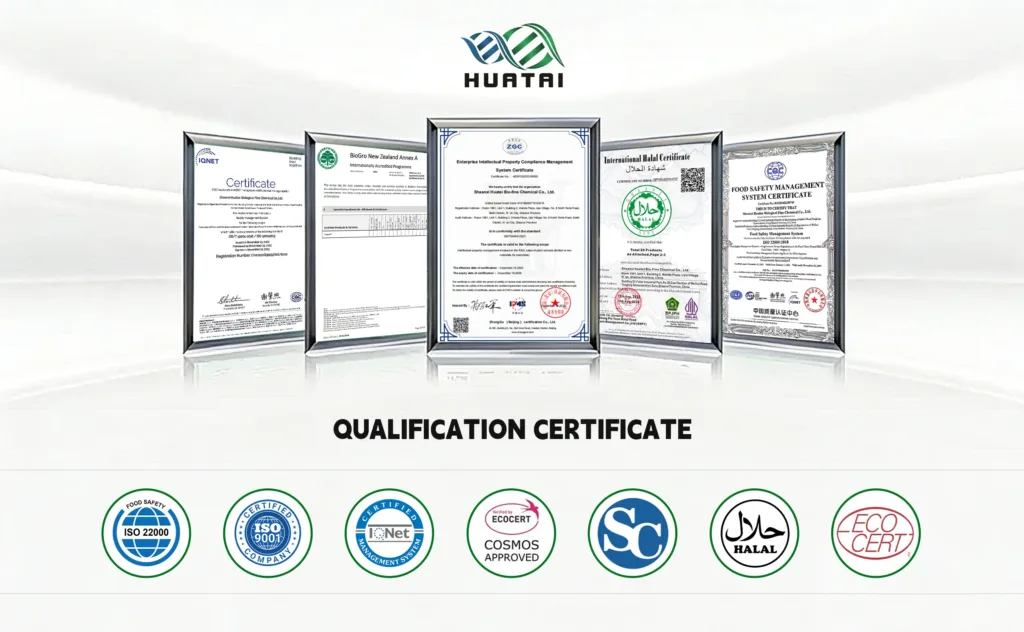
Uncompromising Quality & Credibility:We ensure every batch of our Active skincare ingredients meets rigorous quality standards, including COSMOS, ISO 9001/22000, and HALAL Certification. This commitment, backed by a complete Technical Dossier, offers clinically-backed solutions and guaranteed compliance for every formulation challenge.


 English
 German
 Italian
 French
 Spanish
 Japanese
 Korean
 Russian