
Why Is Coenzyme Q10 For Skincare The Essential Antioxidant For Modern Formulations?
Coenzyme Q10 (Ubiquinone) is a lipid-soluble benzoquinone essential for mitochondrial ATP production. In skin physiology, it functions as a primary antioxidant, shielding cells from reactive oxygen species (ROS) induced by UV exposure and environmental pollutants. However, the efficacy of Q10 in skincare is entirely dependent on its crystalline state and the precision of the delivery vehicle.
Technical Profile and Material Specifications
Q10 is a vibrant yellow-orange crystalline powder. The quality of the raw material defines the color and stability of your final product. A high-purity grade ensures minimal oxidation and consistent performance.
| Parameter | Specification Details | Impact on Formulation |
| Appearance | Yellow to orange crystalline powder | Indicates high purity/absence of degradation |
| Purity (HPLC) | ≥ 98.0% | Ensures consistent clinical results |
| Melting Point | 48°C – 52°C | Determines heat processing limits |
| Loss on Drying | ≤ 0.2% | Prevents moisture-induced instability |
| Residue on Ignition | ≤ 0.1% | Reduces trace mineral contamination |
| Heavy Metals | ≤ 10 ppm | Meets global safety requirements |
Given its low melting point (approx. 50°C), thermal management is the most common point of failure in production. Heating your oil phase above 60°C during emulsion risks degrading the molecule before the product hits the shelf.
Formulation Blueprint: Solving the Delivery Challenge
Q10 is notoriously hydrophobic and prone to crystallization. It does not dissolve in water. If you attempt to force it into a water-heavy serum, it will precipitate and ruin the texture.
Recommended Formulation Strategy:
- Phase A (The Oil Phase): Dissolve Q10 in a polar emollient or cosmetic ester (e.g., Squalane or Caprylic/Capric Triglyceride). Maintain the temperature strictly between 45°C and 50°C.
- Phase B (Stabilization): Incorporate Tocopherol (Vitamin E) at a ratio of 1:1 or higher. Vitamin E acts as a sacrificial antioxidant, recycling the Q10 molecule and extending its functional life within the skin barrier.
- Phase C (Emulsification): Utilize high-shear homogenization to create a fine emulsion (particle size < 200 nm). The smaller the droplet, the more efficient the partitioning into the stratum corneum.
Formulator’s Perspective:
Avoid “drop-in” usage in watery serums. Use a phospholipid-based delivery system (like lecithin) to create an oil-in-water nano-emulsion. This provides the necessary lipid environment for Q10 to remain stable and active.
Performance Data: Antioxidant Efficiency
We assessed the ability of Q10 to protect skin lipids from peroxidation compared to alternative antioxidants.
| Ingredient | Antioxidant Potency (Relative) | Skin Penetration Efficiency |
| Coenzyme Q10 | 1.0 (Baseline) | Moderate (Size-Dependent) |
| Vitamin E | 0.8 | High |
| Ferulic Acid | 0.9 | Moderate |
| Vitamin C | 0.7 | Low (Aqueous limit) |
Q10 is uniquely capable of neutralizing radicals within the lipid bilayer, where water-soluble antioxidants simply cannot reach.
Quality Control and Compliance
When sourcing Q10, you must confirm the absence of synthetic impurities that trigger instability.
- Color Analysis: Pure Q10 should be a deep, vibrant yellow. Brownish hues indicate oxidized material, which will permanently tint your serum and provide no antioxidant benefit.
- Chromatographic Purity: Demand a batch-specific chromatogram. A single, sharp peak confirms quality. Multiple peaks indicate lower-grade material that will inevitably destabilize your formula.
- Microbial Integrity: While Q10 is not a food source for bacteria, the carriers used to disperse commercial grades can be. Always verify the microbial counts of the specific delivery system.
Practical Troubleshooting
- Issue: The formula turns dark orange or brown over time.
- Root Cause: Q10 is highly sensitive to light exposure.
- Fix: Switch to airless, opaque packaging. Never use clear glass jars, as they act as a magnifying glass for light-induced degradation.
- Issue: Grittiness or crystal formation in the cream.
- Root Cause: Q10 has recrystallized due to temperature shifts.
- Fix: Increase the concentration of stabilizing emollients like C12-15 Alkyl Benzoate, which improves the solubility of Q10 in the lipid phase.
References
- Crane, F. L. (Molecular Aspects of Medicine): The discovery and biological function of coenzyme Q.
- Passi, S., et al. (Biofactors): The protective effect of coenzyme Q10 on skin lipids and aging.
- International Journal of Cosmetic Science: Strategies for the topical delivery of lipophilic antioxidants in skincare.
Empower Your Skin Science: Develop Next-Generation Formulations with Our Premium Active Ingredients.
Why choose us
Huatai Bio provides a comprehensive portfolio of high-efficacy cosmetic active ingredients, empowering global brands to create next-generation skincare formulations for high-end skincare formulation needs.
Comprehensive Solutions & Innovation: Our categories cover the full spectrum of market requirements: Anti-aging & Firming, Oil-Control & Anti-acne, Anti-inflammatory & Soothing,Antioxidant Defense, Brightening,and Hydration & Barrier Repair.We offer both established classics and cutting-edge actives.
Driven by a passion for scientific excellence, our state-of-the-art R&D laboratory is dedicated to exploring the frontier of bio-active molecules. Beyond supplying ingredients, we offer end-to-end formulation consultancy and customized solution development. Our team of expert chemists works closely with your brand to overcome complex stability issues and sensory challenges, ensuring your final product stands out in a competitive global market.
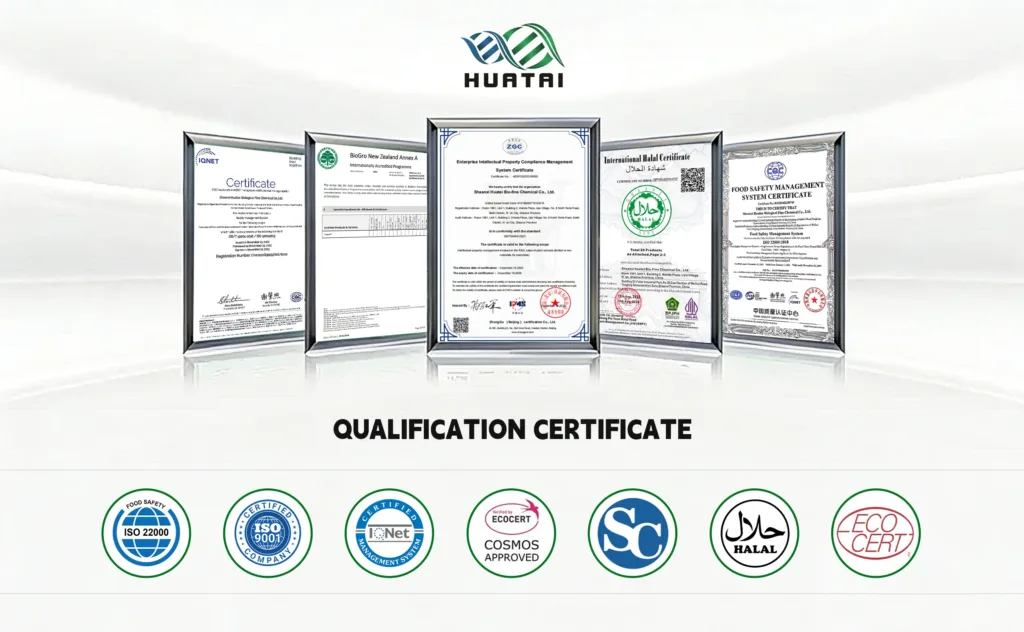
Uncompromising Quality & Credibility:We ensure every batch of our Active skincare ingredients meets rigorous quality standards, including COSMOS, ISO 9001/22000, and HALAL Certification. This commitment, backed by a complete Technical Dossier, offers clinically-backed solutions and guaranteed compliance for every formulation challenge.

 English
 German
 Italian
 French
 Spanish
 Japanese
 Korean
 Russian