
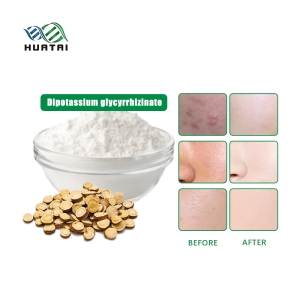
Dipotassium Glycyrrhizinate (DG) is often pigeonholed as a simple “soothing agent.” If you only see it as a way to reduce redness after a harsh chemical peel, you are missing its potential as a multifunctional structural component. It is a salt derived from licorice root, offering both amphiphilic properties and deep biological activity.
The Molecule: Why Solubility Matters
Unlike pure glycyrrhizic acid, which is hydrophobic and difficult to incorporate into water-based serums, the dipotassium salt is highly water-soluble. This makes it an ideal candidate for high-load aqueous systems where you need to deliver active ingredients without disrupting the emulsion stability.
| Property | Specification Value | Significance |
| Appearance | White to off-white powder | Easy to blend without aesthetic impact |
| Solubility (Water) | > 50 mg/mL | Ideal for toners and clear serums |
| Purity (HPLC) | ≥ 98.0% | Ensures consistent clinical results |
| Loss on Drying | ≤ 8.0% | Prevents clumping during storage |
| pH (1% Aqueous) | 5.0 – 6.0 | Excellent compatibility with human skin pH |
Biological Mechanisms: Beyond Redness Reduction
DG does more than just mask irritation. It interferes with the inflammatory cascade at multiple levels.
First, it inhibits the enzyme 11β-hydroxysteroid dehydrogenase. By slowing down this enzyme, it effectively extends the half-life of endogenous cortisol in the skin. This natural, localized anti-inflammatory response is significantly more sustainable for the skin barrier than adding synthetic cortisone.
Second, it modulates the arachidonic acid cascade. By preventing the release of inflammatory mediators, it essentially stops the “fire” before the skin shows physical signs of heat or erythema.
Formulation Blueprint: Integrating DG for Stability
I often see formulators add DG at the wrong phase of production. Because it is heat stable, you can add it to the water phase, but pay attention to the electrolyte balance.
Pro-tip for stability: DG is a salt. If your formula contains high levels of ionic emulsifiers or other metallic salts, you may see a drop in viscosity. I recommend adding it in the pre-solubilization phase of the water cycle, ensuring you have a strong chelating agent like EDTA in the system to prevent any interaction with trace minerals in your water supply.
Application Example: The Repair Serum
In a 0.5% concentration, DG acts as a synergistic booster. When paired with high-molecular-weight Hyaluronic Acid, it reduces the “sticky” feel often associated with high-polymer concentrations. It functions as a mild surfactant, helping to stabilize the film-forming properties of the hyaluronic acid on the skin surface.
Comparative Performance: DG vs. Alternatives
When building a product profile, you must choose between various soothing agents. Here is how DG stacks up against common industry choices in terms of cost-to-performance efficiency.
| Ingredient | Primary Action | Ideal pH Range | Stability Challenge |
| Dipotassium Glycyrrhizinate | Anti-inflammatory | 4.5 – 7.5 | Low; highly compatible |
| Allantoin | Keratolytic/Soothing | 4.0 – 8.0 | Moderate solubility issues |
| Bisabolol | Anti-irritant | 3.0 – 9.0 | Oil-soluble only |
| Aloe Vera Extract | Humectant/Soothing | 4.0 – 6.0 | Microbial degradation risk |
Quality Control: What the COA Doesn’t Tell You
Purity of 98% is the industry baseline. However, the origin of the licorice root determines the impurity profile. Look specifically at the Heavy Metal content (keep this below 10ppm) and Ash content. High ash content often indicates poor extraction techniques that leave behind trace salts, which can trigger sensitivity in ultra-sensitive skin types—defeating the entire purpose of using the ingredient.
Always request a batch-specific chromatogram. If the peak for glycyrrhizic acid isn’t sharp and isolated, you are dealing with a crude extract that will vary from lot to lot. Consistency is your best friend when scaling up production.
Practical Troubleshooting
- Issue: Precipitation in low-temperature storage.
- Root Cause: Excessive electrolyte load from other ingredients.
- Fix: Check your ingredient list for other ionic salts. You may need to introduce a solvent like Butylene Glycol at a 3-5% concentration to keep the DG in solution.
- Issue: Unexpected foaming.
- Root Cause: DG is a saponin derivative and acts as a natural foaming agent.
- Fix: If your formula is a clear serum, reduce the agitation speed during the mixing phase to minimize bubble entrapment.
References
- Fenwick, G. R., et al. (Journal of the Science of Food and Agriculture): Chemistry and biological activities of licorice.
- Saeedi, M., et al. (Journal of Cosmetic Dermatology): Licorice root and its effects on skin inflammation and hyperpigmentation.
- European Commission Cosmetic Ingredient Database (CosIng): Safety and function documentation for Dipotassium Glycyrrhizinate.




 English
 German
 Italian
 French
 Spanish
 Japanese
 Korean
 Russian