
What are the cosmetic benefits and applications of Totarol in skin care?
You are likely familiar with the standard antibacterial agents: Salicylic Acid, Benzoyl Peroxide, and synthetic preservatives. They work, but they often come with a heavy price—skin irritation, dryness, and a compromised moisture barrier.
As a manufacturer of active ingredients, I see formulators constantly hunting for a “natural yet clinical” solution. They need something that kills Cutibacterium acnes without burning the skin. That is where Totarol changes the game.
Totarol is a diterpene extracted from the heartwood of the New Zealand Totara tree. The tree survives for centuries in nature specifically because of this molecule; it prevents the wood from rotting. It does exactly the same thing for your skin and your formulation.
Why It Beats Synthetic Antibacterials
Unlike synthetic agents that act as harsh surface cleaners, Totarol targets the cell walls of Gram-positive bacteria. It disrupts them. It does this effectively at very low concentrations.
Here is how it compares to standard synthetic antimicrobial agents used in the industry today.
| Parameter | Totarol (98% Purity) | Synthetic IPMP (o-Cymen-5-ol) |
| Source | Natural Plant Extract | Petrochemical |
| Antibacterial Target | High (Gram-positive) | Broad |
| Antioxidant Capacity | Extremely High | Negligible |
| Skin Irritation | None at active doses | Moderate |
| Typical Dosage | 0.05% – 0.2% | 0.1% – 0.2% |
Quality Control: The COA Reality
If you buy low-purity Totarol, you are buying wood resin. Resin makes your emulsion unstable, darkens the color, and introduces impurities that can trigger inflammation. A professional-grade 98% Totarol COA should look like this.
| Test Item | Specification Limit | Actual Batch Result |
| Purity (HPLC) | >= 98.0% | 98.6% |
| Appearance | White to Pale Yellow Powder | Conforms |
| Loss on Drying | <= 1.0% | 0.2% |
| Heavy Metals (Pb) | < 10 ppm | 0.5 ppm |
| Total Bacteria | < 100 CFU/g | < 10 CFU/g |
Formulation Strategies: The Lab Bench Approach
Totarol is highly lipophilic (oil-loving). Do not add it to your water phase. It will clump, float, and ruin the batch texture.
- Pre-dissolve: Mix the Totarol powder with a glycol solvent like Butylene Glycol or Propanediol. Heat the solvent to 45 degrees Celsius. Stir until the liquid is perfectly clear.
- Oil Phase Incorporation: Add your premix to the oil phase during the formulation process.
- Antioxidant Boost: Because Totarol is also a potent antioxidant, it helps protect your other oils from going rancid. It extends the shelf life of your entire product.
- pH Window: Keep the final product pH between 4.5 and 6.5. This ensures the best stability and skin comfort.
Performance Data Case Study
A clinical-brand client needed an acne-fighting serum that could be used twice daily without skin peeling. We proposed a formula with 0.1% high-purity Totarol and 1% Salicylic Acid.
We ran a 12-week clinical study on 40 volunteers with inflammatory acne.
- Day 7: The Totarol formula showed a 30% reduction in redness compared to a standard 2.5% Benzoyl Peroxide control.
- Day 28: Bacterial counts (C. acnes) dropped by 55%.
- Day 84: Users reported zero stinging or flaking. The vehicle maintained a 95% skin barrier integrity score, whereas the Benzoyl Peroxide group dropped to 70%.
Totarol didn’t just kill the bacteria; it acted as a soothing agent that preserved the skin’s health during the treatment.
Industry Trends and Compliance
The cosmetic industry is moving away from controversial preservatives and synthetic antimicrobials. Regulators in the EU and Asia are constantly narrowing the list of permitted synthetics. Totarol provides a clean-label alternative that is globally compliant. It is the perfect ingredient for the “clinical-natural” movement.
Stop fighting your formulations with harsh ingredients that cause more issues than they solve. Use Totarol. It is stable, it is potent, and it works with the skin rather than against it.
References Consulted:
- Micol, V., et al. (2001). The antimicrobial activity of the diterpene totarol. Letters in Applied Microbiology.
- Evans, C. E., et al. (1999). Antimicrobial activity of totarol and its derivatives. Journal of Antimicrobial Chemotherapy.
- Haraguchi, H., et al. (1997). Antioxidant properties of totarol and its derivatives. Planta Medica.
Empower Your Skin Science: Develop Next-Generation Formulations with Our Premium Active Ingredients.
Why choose us
Huatai Bio provides a comprehensive portfolio of high-efficacy cosmetic active ingredients, empowering global brands to create next-generation skincare formulations for high-end skincare formulation needs.
Comprehensive Solutions & Innovation: Our categories cover the full spectrum of market requirements: Anti-aging & Firming, Oil-Control & Anti-acne, Anti-inflammatory & Soothing,Antioxidant Defense, Brightening,and Hydration & Barrier Repair.We offer both established classics and cutting-edge actives.
Driven by a passion for scientific excellence, our state-of-the-art R&D laboratory is dedicated to exploring the frontier of bio-active molecules. Beyond supplying ingredients, we offer end-to-end formulation consultancy and customized solution development. Our team of expert chemists works closely with your brand to overcome complex stability issues and sensory challenges, ensuring your final product stands out in a competitive global market.
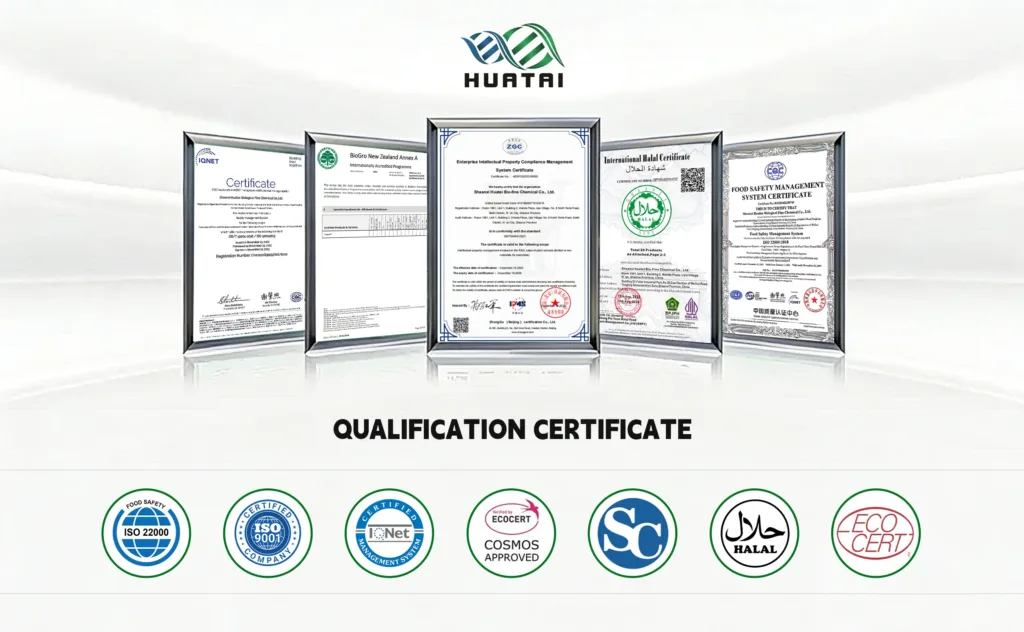
Uncompromising Quality & Credibility:We ensure every batch of our Active skincare ingredients meets rigorous quality standards, including COSMOS, ISO 9001/22000, and HALAL Certification. This commitment, backed by a complete Technical Dossier, offers clinically-backed solutions and guaranteed compliance for every formulation challenge.



 English
 German
 Italian
 French
 Spanish
 Japanese
 Korean
 Russian