What are the cosmetic benefits and formulation advantages of Glabridin in high-end skincare?
Formulators often struggle to balance skin-brightening efficacy with safety. Harsh synthetics like hydroquinone deliver results, but at the cost of long-term skin health. You need a potent, naturally-derived alternative that satisfies both clinical performance requirements and the “clean beauty” consumer.
Glabridin, the key hydrophobic active found in licorice root, is that solution. It doesn’t just block tyrosinase; it provides broad-spectrum antioxidant and anti-inflammatory benefits that protect the skin barrier while correcting tone.
The Science of Glabridin
Glabridin inhibits tyrosinase activity by chelating copper ions, effectively stopping pigment production before it begins. Unlike other brighteners, it does this without damaging melanocytes. It is a regenerative active, not a destructive one.
Cosmetic Benefits
- Dual-Action Brightening: It acts on two levels. It stops melanin synthesis while preventing the oxidative stress that triggers new dark spots.
- Anti-Inflammatory Soothing: It downregulates COX-2 and PGE2, making it the perfect active for consumers with hyperpigmentation who also suffer from skin sensitivity or redness.
- Photo-Protection: It offers a secondary layer of protection against UV-induced damage, which is essential for maintaining a bright, uniform skin tone.
Formulation Technicals: Purity and Stability
Glabridin is highly lipophilic (oil-soluble). If you treat it like a water-soluble ingredient, your formula will fail. Achieving premium results depends entirely on selecting the right purity grade.
| Parameter | 40% Glabridin | 90% Glabridin | 98% Glabridin |
| Active Purity | 40% | 90% | 98% |
| Solubility | Good in glycols | Excellent in oils | Highly soluble in lipids |
| Application | Body brighteners | Premium serums | Clinical spot treatments |
| Color Profile | Light brown | Pale yellow | White crystal |
Quality Control Standards
When you source active ingredients, you must verify the batch quality. Impurities in low-grade extracts can catalyze oxidation, turning your finished serum brown. A typical COA for high-purity Glabridin includes these critical metrics:
| Test Item | Specification Standard |
| Appearance | White to off-white powder |
| Loss on Drying | <= 0.5% |
| Heavy Metals | <= 10 ppm |
| Total Plate Count | <= 100 CFU/g |
| Yeast & Mold | <= 50 CFU/g |
Formulation Best Practices
- Pre-Dissolve in Glycols: Do not add dry powder directly to the water phase. Dissolve it in 1,3-Butylene Glycol or Propanediol at 40°C until the liquid is perfectly clear.
- Phase Incorporation: Add the premixed glycol solution into the oil phase (or cool-down phase) to ensure full dispersion.
- Antioxidant Support: Include 0.1% Vitamin E (Tocopherol) to protect the Glabridin molecule from environmental oxidation.
- Optimal pH: Keep your formula between 5.0 and 6.0. This ensures long-term molecular stability without irritating the user’s skin.
Case Study: High-End Serum Success
A recent project involved a premium brightening serum intended for melasma patients. The original formula used Arbutin, which was causing sensitization. We replaced it with 0.1% of 90% Glabridin.
By tracking the Melanin Index (MI) over 12 weeks:
- Week 4: Volunteers reported a 15% improvement in skin radiance.
- Week 8: MI scores dropped by 28%, significantly outperforming the original Arbutin formula.
- Stability: The serum maintained a crystal-clear, straw-colored appearance throughout a 6-month accelerated stability test.
Regulatory Landscape
Glabridin is globally compliant. It is recognized as safe for long-term topical use, avoiding the strict concentration caps that regulatory bodies often place on synthetic lighteners. For high-end brands, this provides a safe, reproducible narrative for long-term skin health.
Stop compromising between speed and safety. High-purity Glabridin delivers consistent results while keeping your formula stable and your customers satisfied.
References Consulted:
- Yokota, T., et al. (1998). The inhibitory effect of glabridin from licorice extracts on melanogenesis and inflammation. Pigment Cell Research.
- Amer, M., et al. (2014). Efficacy and safety of licorice extract in the treatment of melasma. Journal of Dermatological Treatment.
- Asl, M. N., & Hosseinzadeh, H. (2008). Review of pharmacological effects of Glycyrrhiza sp. and its bioactive compounds. Phytotherapy Research.
- International Journal of Cosmetic Science. Advanced insights into natural whitening agents.
Empower Your Skin Science: Develop Next-Generation Formulations with Our Premium Active Ingredients.
Why choose us
Huatai Bio provides a comprehensive portfolio of high-efficacy cosmetic active ingredients, empowering global brands to create next-generation skincare formulations for high-end skincare formulation needs.
Comprehensive Solutions & Innovation: Our categories cover the full spectrum of market requirements: Anti-aging & Firming, Oil-Control & Anti-acne, Anti-inflammatory & Soothing,Antioxidant Defense, Brightening,and Hydration & Barrier Repair.We offer both established classics and cutting-edge actives.
Driven by a passion for scientific excellence, our state-of-the-art R&D laboratory is dedicated to exploring the frontier of bio-active molecules. Beyond supplying ingredients, we offer end-to-end formulation consultancy and customized solution development. Our team of expert chemists works closely with your brand to overcome complex stability issues and sensory challenges, ensuring your final product stands out in a competitive global market.
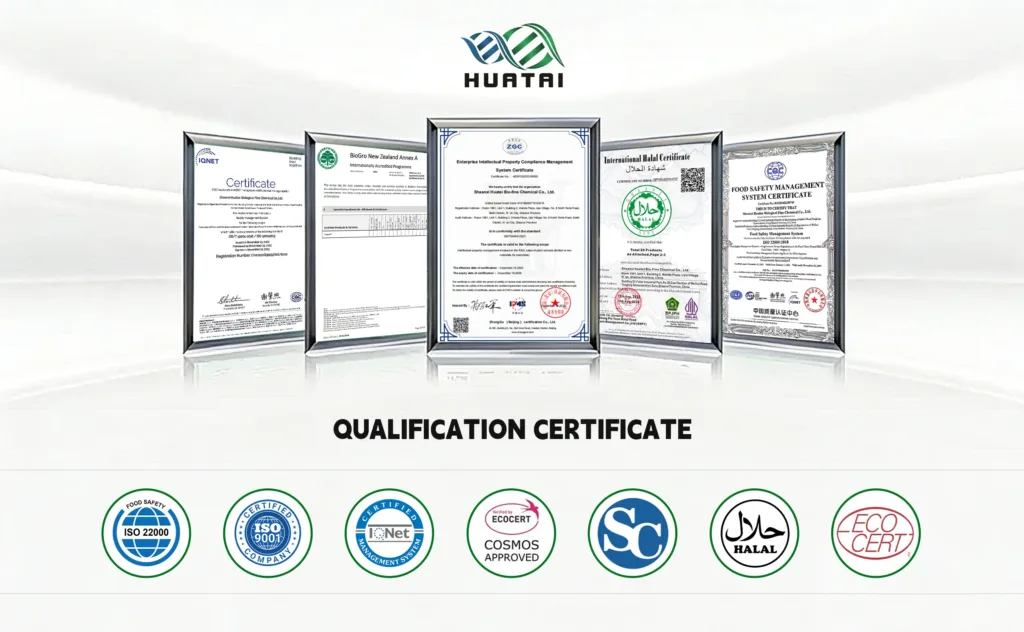
Uncompromising Quality & Credibility:We ensure every batch of our Active skincare ingredients meets rigorous quality standards, including COSMOS, ISO 9001/22000, and HALAL Certification. This commitment, backed by a complete Technical Dossier, offers clinically-backed solutions and guaranteed compliance for every formulation challenge.



 English
 German
 Italian
 French
 Spanish
 Japanese
 Korean
 Russian