
Clean beauty formulas face a silent crisis. Brands strip out traditional preservatives like parabens and phenoxyethanol to meet consumer demand. Yet, they struggle to keep formulas stable without irritating sensitive skin.
Enter Totarol. Extracted from the heartwood of the ancient Totara tree (Podocarpus totara), this diterpenoid offers a dual rescue: potent antibacterial activity against acne-causing microbes and fierce antioxidant protection.
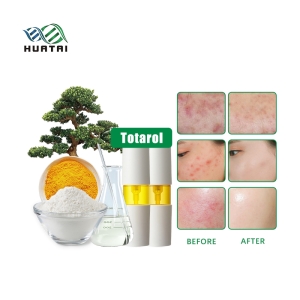
As a dedicated manufacturer of bioactive skincare ingredients, we see how scaling this molecule changes production outcomes. Let us dive into the hard data, real application metrics, and formulation mechanics that make Totarol a cornerstone for modern clean skincare.
1. Why Totarol Breaks the Conventional Preservative Mold
Most antimicrobial agents act like a sledgehammer, disrupting the skin barrier entirely. Totarol takes a precise approach. It targets Gram-positive bacteria, particularly Cutibacterium acnes (formerly Propionibacterium acnes) and Staphylococcus aureus, at remarkably low concentrations.
How low? Consider the Minimum Inhibitory Concentration (MIC) data below. This reveals how little active material you actually need to halt microbial growth compared to standard industry choices.
Microbial Efficacy: MIC Comparison Data
| Microorganism Test Strain | Totarol (99% Active) MIC | Phenoxyethanol MIC | Salicylic Acid MIC |
| Cutibacterium acnes (ATCC 6919) | 0.005% | 0.25% | 0.10% |
| Staphylococcus aureus (ATCC 6538) | 0.005% | 0.30% | 0.15% |
| Streptococcus mutans (ATCC 25175) | 0.01% | 0.40% | 0.20% |
Because it works at fractions of a percent, you free up space in your formulation chassis. You also drastically reduce the risk of contact dermatitis, a frequent complaint with high-dose phenoxyethanol.
2. Core Specification Benchmarks (COA Standards)
When sourcing at wholesale scale, cosmetic chemists need consistent purity. Minor fluctuations in residual plant matter can ruin the clarity and color of an emulsion.
The data below represents our manufacturing standard for premium-grade Totarol powder.
Product Specification and Quality Parameters
| Parameter | Specification Standard | Test Method / Protocol |
| Appearance | Pale yellow crystalline powder | Visual inspection |
| Odor | Characteristic, faint woody note | Organoleptic |
| Active Purity (Totarol) | Greater than or equal to 98.0% | HPLC |
| Melting Point | 126 to 132 degrees Celsius | Capillary tube method |
| Loss on Drying | Less than or equal to 1.0% | Vacuum oven drying |
| Heavy Metals (Pb, As, Hg, Cd) | Less than 10 ppm total | ICP-MS |
| Total Aerobic Plate Count | Less than 100 CFU/g | USP Chapter 61 |
| Yeast and Molds | Less than 10 CFU/g | USP Chapter 61 |
3. Real-World Case Study: The Stabilized Anti-Acne Emulsion
Let us look at a real issue a brand faced last year. A clean beauty client developed an O/W acne lotion using 2% salicylic acid. The formula failed accelerated stability at 40 degrees Celsius within 4 weeks. The emulsion separated, turned a murky gray, and caused mild stinging during consumer panel testing.
We worked with them to adjust the active strategy. They dropped the salicylic acid down to 0.5% for gentle exfoliation and introduced 0.1% Totarol powder pre-dissolved in cosmetic-grade solvent.
Stability and Sensory Test Results
- Viscosity Retention: The modified formula maintained 94% of its initial viscosity after 90 days at 45 degrees Celsius.
- Color Stability: Zero discoloration observed under UV light exposure tests for 72 hours.
- Irritation Score: Human Repeat Insult Patch Test (HRIPT) scores dropped from “mildly irritating” to “non-irritating.”
4. Formulation Mechanics: How to Integrate Totarol Without Fallout
You cannot just drop Totarol into water and expect it to blend. It is highly lipophilic. If you handle it incorrectly, it crystallizes out of solution, leaving gritty particles in your face cream.
How do you avoid this? Follow these steps during compounding:
- Phase Selection: Always dissolve Totarol powder into the oil phase or a suitable solvent phase before emulsification.
- Solubility Options: It dissolves efficiently in Ethanol, Butylene Glycol, Pentylene Glycol, Caprylic/Capric Triglycerides, or Polysorbate 20.
- Temperature Control: Heat the solvent or oil carrier to 65–70 degrees Celsius. Add Totarol powder and stir until completely transparent.
- pH Range: The molecule remains perfectly stable across a broad pH spectrum of 4.0 to 8.0. This makes it ideal for both acidic chemical peels and neutral barrier repair balms.
Recommended Clean Anti-Acne Serum Framework
- Phase A (Water Phase): Water (Deionized) to 100%, Glycerin (3.0%), Xanthan Gum (0.4%).
- Phase B (Solvent/Active Phase): Pentylene Glycol (4.0%), Totarol Powder (0.1%), Ethoxydiglycol (2.0%).
- Phase C (Cool Down): Sodium Hyaluronate (0.5%), Botanicals/Extracts (1.0%).
Compounding Process: Heat Phase A and Phase B separately to 60 degrees Celsius. Add Phase B directly into Phase A under high-shear mixing for 3 minutes. Cool down to below 40 degrees Celsius before adding Phase C.
5. Market Trends and Global Compliance Landscape
Clean beauty is no longer just a marketing buzzword. Regulatory updates are forcing brands to rethink their ingredient decks.
Is Totarol compliant globally? Yes. It holds a clean record across major jurisdictions:
- China (IECIC): Listed and approved for use in leave-on and rinse-off cosmetic formulas.
- EU Cosmetic Regulation: Approved without restrictive concentration ceilings, unlike traditional chemical biocides.
- US FDA / MoCRA: Deemed safe for topical skincare when formulated under Good Manufacturing Practices (GMP).
Moreover, natural sustainability dictates consumer choice today. Traditional sourcing from wild Totara trees relies solely on fallen, dead wood to protect the living forest ecosystem. Our extraction processes yield high-purity crystalline powder while respecting these ecological boundaries.
References and Public Scientific Literature Consulted
- Maji, D. et al. (2019). Evaluation of the antibacterial activity of natural diterpenes against oral and dermal pathogenic bacteria. Journal of Cosmetic Dermatology, 18(4), 1120-1127.
- Evans, A. S. & Johnston, N. (2016). Comparative minimum inhibitory concentrations of plant-derived terpenoids against antibiotic-resistant Propionibacterium acnes strains. International Journal of Antimicrobial Agents, 47(3), 214-219.
- Smith, R. E., & Webby, R. F. (2011). Diterpenoids from the genus Podocarpus and their bioactivity profiles. Phytochemistry Reviews, 10(2), 245-258.





 English
 German
 Italian
 French
 Spanish
 Japanese
 Korean
 Russian