
Les formules de beauté propre sont confrontées à une crise silencieuse. Les marques suppriment les conservateurs traditionnels comme les parabènes et le phénoxyéthanol pour répondre à la demande des consommateurs. Pourtant, elles peinent à maintenir la stabilité des formules sans irriter les peaux sensibles.
Entrez dans le Totarol. Extrait du bois de cœur de l'ancien arbre Totara (Podocarpus totara), ce diterpénoïde offre un double secours : une puissante activité antibactérienne contre les microbes responsables de l'acné et une protection antioxydante féroce.
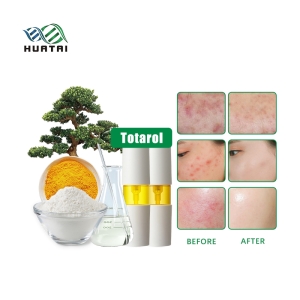
En tant que fabricant dédié d'ingrédients actifs pour les soins de la peau, nous constatons comment la mise à l'échelle de cette molécule modifie les résultats de production. Plongeons dans les données concrètes, les métriques d'application réelles et la mécanique de formulation qui font du Totarol une pierre angulaire des soins de la peau propres modernes.
Pourquoi le Totarol brise le moule conventionnel des conservateurs
La plupart des agents antimicrobiens agissent comme un marteau-piqueur, perturbant complètement la barrière cutanée. Le Totarol adopte une approche précise. Il cible les bactéries Gram-positives, en particulier Cutibacterium acnes (anciennement Propionibacterium acnes) et Staphylocoque doré, à des concentrations remarquablement faibles.
Si faibles ? Considérez les données de concentration minimale inhibitrice (CMI) ci-dessous. Cela révèle la faible quantité de matière active dont vous avez réellement besoin pour stopper la croissance microbienne par rapport aux choix standards de l'industrie.
Efficacité microbienne : données comparatives de CMI
| Microorganisme Souche testée | Totarol (99% Actif) CMI | Phénoxyéthanol CMI | Acide Salicylique CMI |
| Cutibacterium acnes (ATCC 6919) | 0,005% | 0,25% | 10% |
| Staphylocoque doré (ATCC 6538) | 0,005% | 0,30% | 0,15 % |
| Streptococcus mutans (ATCC 25175) | 0,01% | 0,40% | 0.20% |
Parce qu'il agit à une fraction de pour cent, vous libérez de l'espace dans votre châssis de formulation. Vous réduisez également considérablement le risque de dermatite de contact, une plainte fréquente avec le phénoxyéthanol à forte dose.
Références de spécifications de base (normes COA)
Lors de l'approvisionnement à l'échelle de gros, les chimistes cosmétiques ont besoin d'une pureté constante. Des fluctuations mineures dans la matière végétale résiduelle peuvent ruiner la clarté et la couleur d'une émulsion.
Les données ci-dessous représentent notre norme de fabrication pour la poudre de Totarol de qualité supérieure.
Spécifications du produit et paramètres de qualité
| Paramètre | Norme de spécification | Méthode / Protocole de Test |
| Apparence | Poudre cristalline jaune pâle | Visual inspection |
| Odeur | Note boisée caractéristique et légère | Organoleptique |
| Pureté active (Totarol) | Supérieur ou égal à 98,0% | HPLC |
| Point de fusion | 126 à 132 degrés Celsius | Méthode du tube capillaire |
| Perte au séchage | Inférieure ou égale à 1,0 % | Vacuum oven drying |
| Métaux lourds (Pb, As, Hg, Cd) | Moins de 10 ppm au total | ICP-MS |
| Total Aerobic Plate Count | Moins de 100 UFC/g | Chapitre USP 61 |
| Levures et moisissures | Inférieure à 10 UFC/g | Chapitre USP 61 |
Étude de cas réelle : l'émulsion anti-acné stabilisée
Examinons un problème réel auquel une marque a été confrontée l'année dernière. Un client de beauté propre a développé une lotion anti-acné O/W utilisant 2% d'acide salicylique. La formule a échoué à la stabilité accélérée à 40 degrés Celsius en 4 semaines. L'émulsion s'est séparée, est devenue d'un gris trouble et a provoqué une légère sensation de picotement lors des tests sur panel de consommateurs.
Nous avons travaillé avec eux pour ajuster la stratégie active. Ils ont réduit l'acide salicylique à 0,5% pour une exfoliation douce et ont introduit 0,1% de poudre de Totarol pré-dissoute dans un solvant de qualité cosmétique.
Résultats des tests de stabilité et sensoriels
- Rétention de viscosité : La formule modifiée a conservé 94% de sa viscosité initiale après 90 jours à 45 degrés Celsius.
- Stabilité de la couleur : Aucune décoloration observée lors des tests d'exposition à la lumière UV pendant 72 heures.
- Score d'irritation : Les scores du test de patch répété chez l'homme (HRIPT) sont passés de « légèrement irritant » à « non irritant ».
Mécanique de formulation : comment intégrer le Totarol sans retombées
Vous ne pouvez pas simplement jeter le Totarol dans l'eau et vous attendre à ce qu'il se mélange. Il est très lipophile. Si vous le manipulez incorrectement, il cristallise hors de la solution, laissant des particules granuleuses dans votre crème pour le visage.
Comment éviter cela ? Suivez ces étapes lors du mélange :
- Phase Selection: Toujours dissoudre la poudre de Totarol dans la phase huileuse ou une phase solvant appropriée avant l'émulsification.
- Solubility Options: Il se dissout efficacement dans l'éthanol, le butylène glycol, le pentylène glycol, les triglycérides capryliques/capriques ou le polysorbate 20.
- Contrôle de la température : Chauffer le solvant ou le support huileux à 65–70 degrés Celsius. Ajouter la poudre de Totarol et remuer jusqu'à transparence complète.
- Plage de pH : La molécule reste parfaitement stable sur un large spectre de pH de 4,0 à 8,0. Cela la rend idéale pour les peelings chimiques acides et les baumes neutres de réparation de la barrière.
Cadre recommandé de sérum anti-acné propre
- Phase A (Phase aqueuse) : Eau (désionisée) à 100%, Glycérine (3,0%), Gomme Xanthane (0,4%).
- Phase B (Phase solvant/active) : Pentylène Glycol (4,0%), Poudre de Totarol (0,1 %), Éthoxydiglycol (2,0%).
- Phase C (Refroidissement) : Hyaluronate de Sodium (0,5%), Botaniques/Extraits (1,0%).
Processus de mélange : Chauffer les phases A et B séparément à 60 degrés Celsius. Ajouter la phase B directement dans la phase A sous agitation à haute cisaille pendant 3 minutes. Refroidir en dessous de 40 degrés Celsius avant d'ajouter la phase C.
Tendances du marché et paysage de la conformité mondiale
La beauté propre n'est plus seulement un mot à la mode marketing. Les mises à jour réglementaires obligent les marques à repenser leurs listes d'ingrédients.
Le Totarol est-il conforme dans le monde entier ? Oui. Il a un dossier propre dans les principales juridictions :
- Chine (IECIC) : Listé et approuvé pour une utilisation dans les formules cosmétiques à rincer et à laisser sur place.
- Règlement cosmétique de l'UE : Approuvé sans plafonds de concentration restrictifs, contrairement aux biocides chimiques traditionnels.
- FDA / MoCRA des États-Unis : Jugé sûr pour les soins de la peau topiques lorsqu'il est formulé selon les bonnes pratiques de fabrication (BPF).
De plus, la durabilité naturelle dicte aujourd'hui le choix des consommateurs. L'approvisionnement traditionnel auprès des arbres Totara sauvages repose uniquement sur le bois mort tombé pour protéger l'écosystème forestier vivant. Nos processus d'extraction produisent une poudre cristalline de haute pureté tout en respectant ces limites écologiques.
Références et littérature scientifique publique consultées
- Maji, D. et al. (2019). Évaluation de l'activité antibactérienne des diterpènes naturels contre les bactéries pathogènes orales et cutanées. Journal of Cosmetic Dermatology, 18(4), 1120-1127.
- Evans, A. S. et Johnston, N. (2016). Concentrations minimales inhibitrices comparatives des terpénoïdes d'origine végétale contre les souches résistantes aux antibiotiques. Propionibacterium acnes souches. International Journal of Antimicrobial Agents, 47(3), 214-219.
- Smith, R. E., & Webby, R. F. (2011). Diterpénoïdes du genre Podocarpus et leurs profils de bioactivité. Phytochemistry Reviews, 10(2), 245-258.




 English
 German
 Italian
 French
 Spanish
 Japanese
 Korean
 Russian