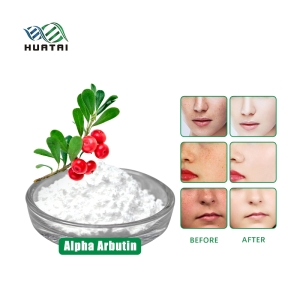
Walk into any cosmetics manufacturing lab and ask the head chemist to mix Alpha Arbutin with Kojic Acid. Watch their face drop.
Brands love this combination on paper. Both ingredients target hyperpigmentation aggressively. Formulators usually hate working with them together. I watched a client dump an entire production run of premium brightening serum last month. The liquid turned the color of an old, oxidized penny after just three weeks in a warm warehouse.
Worse than the color change? The serum became technically illegal. You cannot simply mix two powerful active ingredients in a water base and hope for the best. Let us look at the actual chemical battlefield inside the mixing tank.
The Mechanical Conflict
Alpha Arbutin and Kojic Acid attack melanin production at the same site: the tyrosinase enzyme. Kojic Acid acts like a claw. It chelates the copper ions that the enzyme needs to function, effectively breaking the machine. Alpha Arbutin acts as a decoy. It mimics the natural building blocks of melanin, jamming the enzyme’s gears through competitive inhibition.
The synergy is massive. The stability profile is a nightmare.
Kojic Acid is highly reactive. It oxidizes rapidly upon exposure to air and UV light, forming dark brown polymeric compounds. It also binds violently with trace iron (Fe3+) in your water, turning the solution blood-red or dark brown almost instantly.
The pH Threat & Hydroquinone Risk
But the biggest threat is the pH conflict. Kojic Acid is inherently acidic. When added to water, it drives the pH down. Alpha Arbutin is a glycoside. It requires a stable pH environment between 4.5 and 6.5.
If the Kojic Acid drags the formula pH below 4.0, the glycosidic bonds in Alpha Arbutin begin to break. This hydrolysis reaction releases hydroquinone into your serum. Hydroquinone is strictly banned in cosmetics across most global markets. A poorly buffered Kojic Acid and Alpha Arbutin serum does not just turn brown. It degrades into a toxic, non-compliant hazard.
Raw Material Quality Specifications (COA Benchmark)
As a manufacturer producing these raw materials by the ton, we run exhaustive analytical tests. We see brands fail repeatedly because they purchase unpurified, cheap powders. You must demand strict specifications from your supplier. Here is the benchmark we enforce:
*Pay close attention to the Specific Optical Rotation for Alpha Arbutin. This proves you are getting the highly effective “Alpha” isomer, not the cheaper, less stable “Beta” isomer. Look at the Iron limit for Kojic Acid. If your Kojic Acid contains elevated iron, your formulation will discolor before it even reaches the filling line.
Stabilizing the Duo: 45-Day Accelerated Assay (45°C + UV)
We tracked the degradation of a standard 2% Alpha Arbutin and 1% Kojic Acid aqueous base. We monitored color shift, active retention, and most importantly, hydroquinone generation.
| Protocol | Buffer / Protective System | pH Drift (Day 0 ➔ 45) | Kojic Acid Retention | Hydroquinone Detected |
|---|---|---|---|---|
| Control | None | 4.8 ➔ 3.6 | 31% (Dark Brown) | 145 ppm (Fail) |
| Protocol A | 0.1% EDTA | 4.8 ➔ 4.1 | 68% (Yellow) | 35 ppm (Fail) |
| Protocol B | 0.1% EDTA + 0.2% Sodium Metabisulfite | 4.8 ➔ 4.3 | 89% (Light Yellow) | 12 ppm (Borderline) |
| Optimized Protocol | EDTA + Metabisulfite + Citric Acid/Sodium Citrate Buffer | 5.2 ➔ 5.1 | 97% (Clear) | Undetected (Pass) |
The raw data exposes the reality of formulation. Adding a chelator (EDTA) is not enough. Adding an antioxidant (Sodium Metabisulfite) is not enough. You must lock the pH in place. The Optimized Protocol prevents the Kojic Acid from acidifying the water, which in turn saves the Alpha Arbutin from hydrolyzing.
3 Absolute Compounding Rules
- Lock the pH. Create a buffer system before adding your actives. Target a strict pH of 5.0 to 5.5.
- Cage the metals. Use 0.1% Disodium EDTA in the heated water phase. You must scavenge every trace metal before introducing Kojic Acid.
- Use an oxygen scavenger. Add Sodium Metabisulfite (0.1% – 0.2%). It takes the oxidative damage so your Kojic Acid does not have to. (Note: Mask the slight sulfur odor intelligently, or your product will fail aesthetically.)
- Cold processing only. Both ingredients are highly thermolabile. Never expose them to temperatures above 40°C. Pre-dissolve them in room-temperature water and add them during the final cool-down phase.
The Regulatory Landscape
The regulatory landscape is tightening globally. The European SCCS (Scientific Committee on Consumer Safety) finalized its safety margins:
- Kojic Acid: Strictly capped at 1% for face and hand products.
- Alpha Arbutin: Permitted up to 2% in facial creams.
You can no longer brute-force skin brightening with 4% Kojic Acid. The law prohibits it. You must rely on the precise, calculated synergy of 2% Alpha Arbutin and 1% Kojic Acid. This means your delivery systems, buffer protocols, and raw material purity must be flawless. High-performance skincare starts with uncompromising raw materials. Do not let cheap, unstable powders ruin a chemically brilliant formula.
- SCCS (Scientific Committee on Consumer Safety), Opinion on the safety of Kojic Acid (SCCS/1637/21). Final version adopted March 2022.
- SCCS, Opinion on the safety of alpha-arbutin (SCCS/1642/22). Final version adopted March 2023.
- Burnett, C. L., et al. “Final report of the safety assessment of Kojic acid as used in cosmetics.” International Journal of Toxicology 29.6 (2010): 244S-273S.
- Smit, N., Vicanova, J., & Pavel, S. “The hunt for natural skin whitening agents.” International Journal of Molecular Sciences 10.12 (2009): 5326-5349.

 English
 German
 Italian
 French
 Spanish
 Japanese
 Korean
 Russian