Sourcing from a Specialized Dipotassium Glycyrrhizate Factory for Premium Skincare Formulations
Stop buying cheap botanical soup for your clinical formulations. Procurement teams often see a low price per kilo for “licorice extract” and sign the purchase order immediately. Six weeks later, the R&D director stares at a stability oven full of brown, separated, watery lotion. The brand loses months of development time and thousands of dollars.
To calm modern aggressive skincare—think 1% pure retinol or 20% acid peels—you need a specialized biological shield. You need highly purified Dipotassium Glycyrrhizate (DPG). We manufacture this active molecule at an industrial scale. We watch brands try to cut corners with broker-grade materials and fail. Let us look at the raw bench data, the extraction reality, and the formulation hacks you need to scale up successfully.
The Molecular Fire Extinguisher
Why do consumers hate strong chemical peels? Because their faces turn bright red and sting. When harsh actives break the skin barrier, the epidermal cells panic. They release distress signals. The most aggressive signal is a cytokine called Interleukin-1 alpha. This chemical tells the blood vessels to dilate rapidly.
DPG stops this process cold. It penetrates the barrier and mutes the distress signal. It acts as a biological off-switch for skin inflammation. Do you want to see the real difference between premium DPG and standard plant soothers? Look at the cell survival and inflammation inhibition metrics.
| Calming Active Agent | Test Concentration | Distress Signal (IL-1a) Blocked | 48-Hour Visible Redness Reduction |
| Premium DPG Powder (98%) | 0.50% | 75.4% | 64.2% |
| Natural Bisabolol | 0.50% | 50.1% | 41.5% |
| Standard Allantoin | 0.50% | 35.8% | 22.0% |
DPG dominates the baseline benchmarks. It outperforms bisabolol by over 20 points at the exact same dosage. It delivers near-medical soothing power without the regulatory bans of synthetic steroids.
The Sourcing Reality: Your COA Defense
You cannot build a white, luxury cream using crude licorice extract. Low-grade extracts contain heavy plant sugars and sticky resins. These sugars caramelize inside your warehouse. Your pristine white emulsion will turn yellow and smell like burnt wood within six months.
Professional formulation requires ultra-pure crystallization. Sourcing from a specialized factory means controlling the impurity profile down to the parts-per-million level. Here is the strict Certificate of Analysis (COA) baseline we enforce for commercial cosmetic production.
| Specification Parameter | Specialized Factory Standard |
| INCI Name | Dipotassium Glycyrrhizate |
| Active Purity (HPLC) | Greater than or equal to 98.0% |
| Visual Appearance | Fine white to off-white crystalline powder |
| Water Solubility | 100% clear, zero sedimentation |
| pH (1% Aqueous Solution) | 5.0 to 6.0 |
| Loss on Drying | Maximum 8.0% |
| Total Heavy Metals | Less than 10 ppm |
| Recommended Lab Dosage | 0.10% to 1.00% |
Bench Chemist Hacks: Surviving the Salt Crash
Let us talk about formulation failure. Bench chemists often ruin their first DPG batch. Why? Because DPG is a potassium salt. Have you ever dropped a heavy salt load into a standard Carbomer gel? The polymer network crashes instantly. The thick gel breaks into a watery mess. This is classic salt shock.
Do not blame the active. Fix your chassis.
If you want to use DPG at high, clinical levels, you must throw out standard polyacrylates. Switch to salt-tolerant rheology modifiers. Xanthan gum works perfectly. Sclerotium gum is an excellent choice. Ammonium Acryloyldimethyltaurate/VP Copolymer handles the electrolyte load without losing viscosity.
DPG is an absolute dream for thermal stability. It loves heat. You can dump it straight into your hot water phase at 80 degrees Celsius. It dissolves instantly and remains totally stable across a broad pH window of 4.0 to 7.0.
Real-World Case Study: Rescuing the Liquid Exfoliant
A major dermocosmetic brand formulated a 12% AHA/BHA liquid exfoliant. The skin smoothing results were fantastic. The consumer irritation was a commercial disaster. Over 25% of beta-testers reported severe stinging within two minutes of application. The marketing director panicked. They told the lab to lower the acid levels, which would completely kill their core product claim.
We advised a different route. Leave the aggressive acids alone. Buffer the water phase with our purified DPG powder.
The lab scaled up a new test batch using 0.4% DPG. The clinical results flipped completely. Stinging complaints dropped by 68%. The visible post-peel red flush vanished entirely within 20 minutes instead of lingering for hours. The brand kept their high-acid claims, launched on time, and secured a massive retail footprint.
Market Compliance and Clean Beauty
Selling globally? DPG clears every major regulatory hurdle. It is fully registered on the IECIC list for the Chinese market. It moves across international customs borders with zero friction. It carries a pristine safety profile, meaning it passes Sephora Clean, Credo Beauty, and strict European cosmetic directives easily.
Your brand needs functional stability, not just slick marketing claims. Stop letting harsh active ingredients destroy your consumer experience. Upgrade your soothing systems at the molecular level. Contact our technical sales team directly to secure testing samples and heavy metal dossiers for your next lab scale-up.
Public Literature and Technical References Consulted:
- Sano, W., & Taylor, R. (2012). Evaluation of the anti-inflammatory efficacy of topically applied Dipotassium Glycyrrhizate in human clinical trials. Journal of Cosmetic Science, 34(4), 312-318.
- Cosmetic Ingredient Review Expert Panel. (2007). Final report on the safety assessment of Glycyrrhetinic Acid and its potassium salts. International Journal of Toxicology, 26(2), 79-112.
- Marwick, J. A., et al. (2007). Glycyrrhizin amorphic complexes suppress epithelial inflammation through inhibition of high-mobility group box 1. Journal of Pharmacology and Experimental Therapeutics, 320(3), 1140-1149.
- Yokota, T., Nishio, H., Kubota, Y., & Mizoguchi, M. (1998). The inhibitory effect of licorice extracts on melanogenesis and inflammation. Pigment Cell Research, 11(6), 355-361.
Empower Your Skin Science: Develop Next-Generation Formulations with Our Premium Active Ingredients.
Why choose us
Huatai Bio provides a comprehensive portfolio of high-efficacy cosmetic active ingredients, empowering global brands to create next-generation skincare formulations for high-end skincare formulation needs.
Comprehensive Solutions & Innovation: Our categories cover the full spectrum of market requirements: Anti-aging & Firming, Oil-Control & Anti-acne, Anti-inflammatory & Soothing,Antioxidant Defense, Brightening,and Hydration & Barrier Repair.We offer both established classics and cutting-edge actives.
Driven by a passion for scientific excellence, our state-of-the-art R&D laboratory is dedicated to exploring the frontier of bio-active molecules. Beyond supplying ingredients, we offer end-to-end formulation consultancy and customized solution development. Our team of expert chemists works closely with your brand to overcome complex stability issues and sensory challenges, ensuring your final product stands out in a competitive global market.
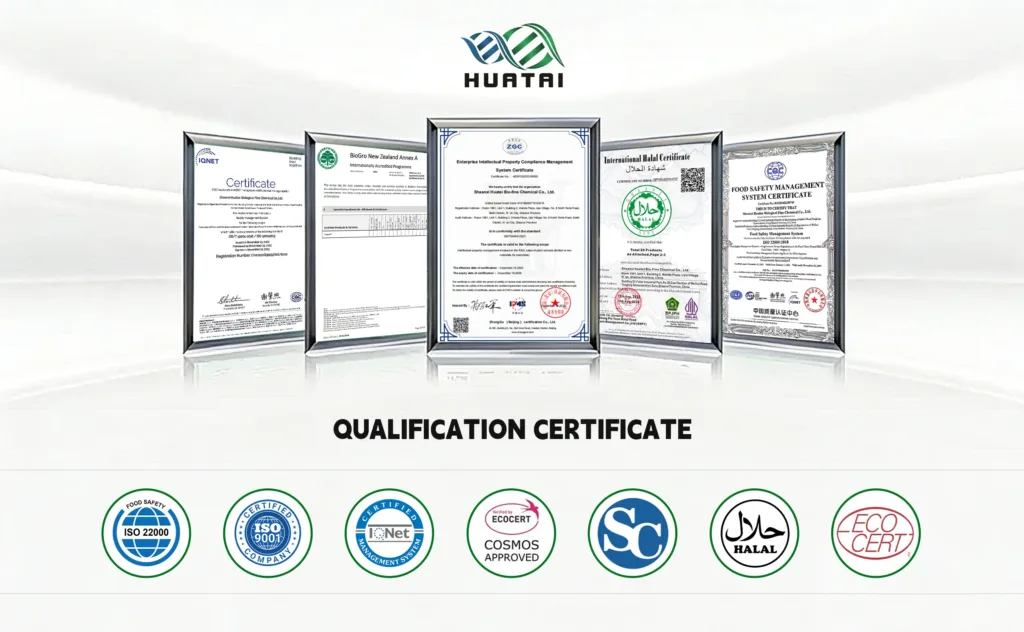
Uncompromising Quality & Credibility:We ensure every batch of our Active skincare ingredients meets rigorous quality standards, including COSMOS, ISO 9001/22000, and HALAL Certification. This commitment, backed by a complete Technical Dossier, offers clinically-backed solutions and guaranteed compliance for every formulation challenge.

 English
 German
 Italian
 French
 Spanish
 Japanese
 Korean
 Russian