Oat Beta Glucan Powder: Formulation Specifications, Mechanism of Action, and Sourcing Guide
Let us correct the scientific misconceptions up front. Many suppliers falsely market high-molecular-weight polysaccharides as direct free-radical scavengers. This is chemically inaccurate. Pure oat beta-glucan does not act like Vitamin C. Its primary mechanism is receptor-mediated cellular communication and macro-molecular film forming.
Linear β-(1,3) and β-(1,4) glycosidic bonds create a permeable moisture-retaining matrix on the stratum corneum. It penetrates the epidermis through the intercellular lipid matrix to interact with specific receptors. It works through biological pathways, not just simple occlusion.
1. Core Physicochemical Specifications
Accurate physicochemical data is the foundation of formulation stability. Below is our standard specification table for Oat Beta Glucan Powder.
| Parameter | Specification Standard | Test Method |
|---|---|---|
| Product Name | Oat Beta Glucan Powder | / |
| INCI Name | BETA-GLUCAN | / |
| CAS Number | 9051-97-2 | / |
| Appearance | Off-white to light yellow powder | Visual |
| Assay (Purity) | ≥ 70.0% / ≥ 80.0% | Enzymatic (Megazyme) / HPLC |
| Molecular Weight | 1.0 × 10^5 to 2.0 × 10^6 Da | GPC |
| Solubility | Soluble in hot water (forms viscous liquid) | 80°C Water |
| pH (1% aqueous) | 5.0 – 7.0 | pH Meter |
2. Corrected Efficacy Data and Biological Mechanisms
We must separate direct chemical reactions from biological responses. High molecular weight oat beta-glucan is a poor direct antioxidant. Its true value lies in cellular modulation and barrier repair.
Receptor-Mediated Skin Repair
Oat beta-glucan binds to Dectin-1 receptors on macrophages and keratinocytes. This binding triggers an immune cascade. It stimulates fibroblasts to synthesize collagen and promotes the natural production of hyaluronic acid within the skin. In vitro tests on UV-irradiated keratinocytes show that a 0.5% beta-glucan solution significantly reduces the release of pro-inflammatory cytokines, specifically Interleukin-1 alpha (IL-1a).
Skin Hydration and TEWL Reduction
Its film-forming capacity is measurable. In vivo tape-stripping models using a 1.0% oat beta-glucan emulsion demonstrate a rapid restoration of the disrupted barrier. Transdermal water loss (TEWL) is typically reduced by 12% to 15% within 7 days of application on Sodium Lauryl Sulfate (SLS) irritated skin. It outperforms standard glycerin in long-term moisture retention because the polymer network slows water evaporation without feeling tacky.
3. The Reality of Color and Agglomeration
Suppliers frequently avoid discussing powder color variations and formulation agglomeration. We rely on transparency.
Color Reality: Pure oat beta-glucan powder is off-white to light yellow. Non-chemical, enzymatic extraction preserves trace proteins, lipids, and natural oat polyphenols (avenanthramides). Over-bleaching the powder to a stark white destroys these beneficial trace compounds and degrades the polymer chain, lowering the molecular weight. A slight yellow tint in the raw powder will not impact the color of a final emulsion formulated at the standard 0.1% to 1.0% dosage.
Solubility and Agglomeration Prevention
Oat beta-glucan is a hydrocolloid. If you add it rapidly to cold water, the outside of the powder particles hydrates instantly. This forms a gel layer that prevents water from reaching the inside. You get clumps or “fish eyes”. To ensure a smooth, transparent matrix:
- Pre-disperse the powder in a liquid humectant (glycerin, propylene glycol, or butylene glycol) at a 1:3 ratio before adding water.
- Add the slurry to the water phase at 75°C-85°C while using a high-shear homogenizer.
Once properly hydrated, it forms a stable liquid. It will not recrystallize.
4. Oat vs. Yeast Beta-Glucan: Structural Differences
Both are excellent ingredients, but they serve different functions.
- Structure: Yeast beta-glucan features a β-(1,3) backbone with β-(1,6) branches. Oat beta-glucan is a linear chain with β-(1,3) and β-(1,4) linkages.
- Formulation Impact: The branched structure of yeast beta-glucan makes it highly insoluble in water without chemical modification (carboxymethylation). Oat beta-glucan is naturally water-soluble when heated.
- Sensory Feel: The linear structure of oat glucan provides superior rheological properties, creating a silky, non-sticky glide that yeast glucans cannot match.
5. Formulation Synergies and Guidelines
Oat beta-glucan acts as an active ingredient and a sensory modifier.
- Recommended Dosage: 0.1% to 1.0% (Solid powder basis).
- Synergy: Combine it with Ceramide NP, Panthenol (Vitamin B5), and Allantoin. Panthenol accelerates re-epithelialization. Beta-glucan provides the occlusive scaffold.
- Stability: Highly heat stable. It withstands standard emulsion heating cycles up to 90°C without polymer degradation.
6. Top 8 B2B Buyer FAQs
We analyzed the top questions formulation chemists ask regarding procurement and technical application.
We use the industry-standard Megazyme enzymatic assay method. This specifically measures the β-glucan content, avoiding false positives from other starches or dextrins that can skew generic total polysaccharide tests.
Oat beta-glucan does penetrate the stratum corneum. Research indicates that the polymer matrix moves through the intercellular lipid pathways rather than passing directly through the corneocytes, allowing it to reach the deeper epidermis to interact with receptors.
No. The powder requires heat (75°C-85°C) to fully hydrate and unfold the polymer chains. If you need a cold-process ingredient, you must source a pre-solubilized liquid beta-glucan solution.
No. The trace color originates from natural oat compounds. It is stable under normal cosmetic shelf-life conditions. Protect the final formulation from prolonged direct UV exposure, as you would with any botanical extract.
Yes. Oat beta-glucan is a non-ionic polysaccharide. It demonstrates excellent compatibility with cationic conditioning agents, anionic emulsifiers, and high-electrolyte environments.
The ingredient is stable in a pH range of 4.0 to 7.0. Extreme acidic environments (pH < 3.0) can cause gradual hydrolysis of the glycosidic bonds over time, reducing viscosity.
No. The raw powder has a loss on drying specification of less than 5.0%. This low water activity prevents microbial growth. You only need to preserve the final aqueous formulation.
Yes. Every batch is accompanied by a Certificate of Analysis (COA), MSDS, and statements regarding non-GMO status and cruelty-free testing.
References
- Mechanism of Beta-Glucan in Skin Repair: Review of Dectin-1 receptor activation by beta-glucans in human dermal fibroblasts.
- Rheological and Hydration Properties of Avena sativa (Oat) Beta-Glucan: Clinical evaluation of transdermal water loss (TEWL) reduction and stratum corneum barrier restoration.
- Linear vs. Branched Polysaccharides in Cosmetic Delivery Systems: Comparative analysis of water solubility and film-forming capabilities of oat versus yeast-derived glucans.
Empower Your Skin Science: Develop Next-Generation Formulations with Our Premium Active Ingredients.
Why choose us
Huatai Bio provides a comprehensive portfolio of high-efficacy cosmetic active ingredients, empowering global brands to create next-generation skincare formulations for high-end skincare formulation needs.
Comprehensive Solutions & Innovation: Our categories cover the full spectrum of market requirements: Anti-aging & Firming, Oil-Control & Anti-acne, Anti-inflammatory & Soothing,Antioxidant Defense, Brightening,and Hydration & Barrier Repair.We offer both established classics and cutting-edge actives.
Driven by a passion for scientific excellence, our state-of-the-art R&D laboratory is dedicated to exploring the frontier of bio-active molecules. Beyond supplying ingredients, we offer end-to-end formulation consultancy and customized solution development. Our team of expert chemists works closely with your brand to overcome complex stability issues and sensory challenges, ensuring your final product stands out in a competitive global market.
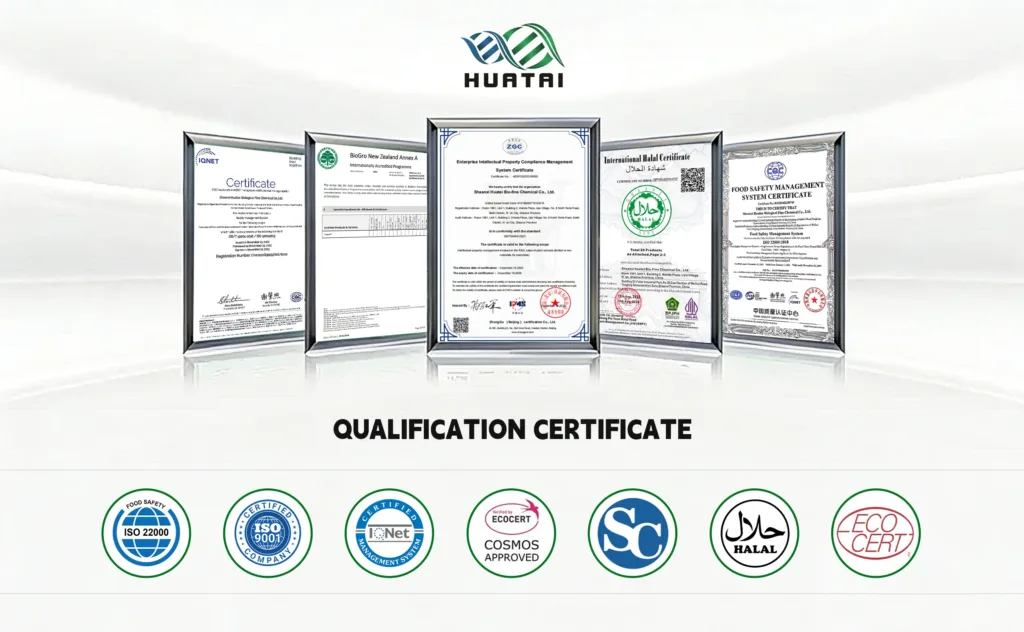
Uncompromising Quality & Credibility:We ensure every batch of our Active skincare ingredients meets rigorous quality standards, including COSMOS, ISO 9001/22000, and HALAL Certification. This commitment, backed by a complete Technical Dossier, offers clinically-backed solutions and guaranteed compliance for every formulation challenge.



 English
 German
 Italian
 French
 Spanish
 Japanese
 Korean
 Russian