How to Choose Licochalcone A Suppliers: Real Data, Formulation Realities, and Quality Metrics
Formulators hate surprises. When a new batch of active ingredients ruins an emulsion, money burns. Licochalcone A is a powerful molecule for calming inflamed skin and regulating sebum. But sourcing it requires looking past shiny brochures.
You face a specific choice in the supply chain. You either buy a highly pure powder that is stubborn to dissolve. Or you buy a pre-dissolved liquid matrix that eats into your profit margins. We need to look at the actual physical-chemical realities of this extract. No fluff. Just hard data.
The Visual Reality: Color and Crystallization
Let us address the physical traits first. Licochalcone A is inherently yellow. If a supplier hands you a bright white powder claiming high purity, question their testing methods. The closer you get to 90% purity, the more distinct the yellow hue becomes. This pigment will tint your final cosmetic emulsion. Do not fight it. A pale yellow cream tells your educated consumer that the active botanical is actually present.
Crystallization is another hurdle. Pure Licochalcone A has extremely poor water solubility. If you dump it directly into an aqueous phase, it crashes out. It requires a precise solvent system.
| Solvent | Solubility Limit | Formulation Notes |
|---|---|---|
| Water | < 0.01% | Insoluble. Do not add directly to the water phase. |
| Ethanol | > 10.0% | Excellent solvent. Useful for spot treatments or tinctures. |
| Propylene Glycol | 3.0% – 5.0% | Good baseline solvent. Requires heating to 60°C. |
| Butylene Glycol | 2.5% – 4.0% | Preferred for skin feel. Disperse with moderate shear. |
| PEG-400 | > 10.0% | Excellent primary solvent for high-concentration masterbatches. |
Hard Efficacy Data: Targeting Inflammation
Why go through the trouble of mastering its solubility? The biological pathways are undeniable. We test this ingredient specifically against pathways relevant to acne-prone and highly reactive skin.
A previous error in industry literature often conflates it with other root fractions regarding tyrosinase inhibition. While it has minor brightening effects, its primary value is strictly anti-inflammatory and antibacterial. We must look at the correct markers.
| Test Target | Metric | Data Value | Implication for Skincare |
|---|---|---|---|
| Cutibacterium acnes | MIC | 12.5 – 25.0 μg/mL | Directly inhibits acne-causing bacteria growth. |
| PGE2 Production | IC50 | 1.8 μM | Blocks primary inflammatory pathways. Reduces visible redness. |
| Nitric Oxide (NO) Release | IC50 | 2.3 μM | Downregulates macrophage activation during inflammatory responses. |
Quality Metrics: Reading the COA
As a manufacturer, we track every batch. You need total transparency on what goes into your vats. High-performance liquid chromatography (HPLC) is the only reliable way to verify the assay. UV-Vis spectrophotometry will capture other random flavonoids and give you a falsely high reading.
| Parameter | Specification | Testing Method |
|---|---|---|
| Appearance | Yellow to dark yellow fine powder | Visual |
| Assay | ≥ 20.0% or ≥ 90.0% options | HPLC |
| Loss on Drying | ≤ 5.0% | 105°C, 2 hours |
| Heavy Metals (Pb, As, Hg, Cd) | ≤ 10 ppm total | ICP-MS |
Commercial Reality: Patents and Hidden Costs
Many suppliers push encapsulated or chemically modified variants. Do you actually need it? Run the math. Encapsulated liquids drastically increase your cost per active kilo. They sell you convenience.
If your R&D team understands basic solvent dynamics, buying standard raw powder is massively more cost-effective. Do not pay a premium for a proprietary delivery system if a simple glycol blend works perfectly for your formula. We provide the raw powder because we trust formulators to do their jobs. We give you the exact physical parameters. You maintain control over your formulation costs.
Real-World Formulation Application
How do you use it without ruining the batch? Let us look at a standard 0.5% Anti-Redness Serum protocol.
- Create your active premix. Disperse the powder in a mixture of PEG-400 and Butylene Glycol. Heat this gently to 60°C until the liquid is entirely transparent.
- Proceed with your standard main phase emulsification.
- Cool the main tank below 40°C.
- Introduce the active premix slowly under high shear.
Crucial Check: Keep your final pH between 5.5 and 7.0. If the pH drops too low, licorice extracts risk precipitation over a three-month stability test.
Top 8 FAQ When Sourcing Licochalcone A
1. Where to buy bulk raw powder for cosmetic manufacturing?
Buy directly from botanical extract manufacturers who provide batch-specific HPLC chromatograms. Avoid trading companies that rely on generic spec sheets.
2. What is the standard MOQ for wholesale supply?
We supply testing samples to verify formulation compatibility before you commit to standard commercial drums.
3. Does high purity extract stain the skin?
No. While the raw powder is intensely yellow, the typical application dosage (0.1% to 1.0%) will not stain human skin upon absorption.
4. How to dissolve the powder in cosmetic formulations?
Avoid water. Use glycols like Propylene Glycol, PEG-400, or Ethanol with gentle heat.
5. Licochalcone A vs Glabridin: Which is better?
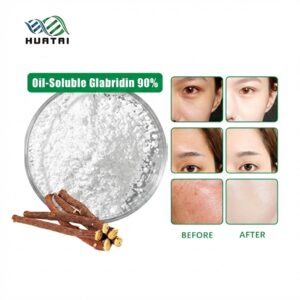
They serve entirely different functions. Glabridin (from Glycyrrhiza glabra) is the gold standard for tyrosinase inhibition and skin brightening. This molecule (from Glycyrrhiza inflata) dominates in anti-inflammatory and acne-control applications.
6. Can I request a COA and MSDS before purchasing?
Yes. Never buy active ingredients without reviewing the exact batch COA and the safety data sheet first.
7. Is synthetic powder available?
The cosmetic industry relies on natural extract from Glycyrrhiza inflata roots. Synthetic pathways exist in academia but are not commercially viable or regulatory-friendly for skincare yet.
8. What is the current market price for high-purity grades?
Prices fluctuate based on raw licorice root harvest yields. Powder formats remain significantly more economical than pre-dissolved proprietary blends.
References:
- Kolbe, L., et al. (2006). “Anti-inflammatory efficacy of Licochalcone A: correlation of clinical potency and in vitro effects.” Archives of Dermatological Research.
- Shibata, S. (2000). “A drug over the millennia: pharmacognosy, chemistry, and pharmacology of licorice.” Yakugaku Zasshi.
- Furusawa, J., et al. (2009). “Licochalcone A significantly suppresses LPS signaling pathway through the inhibition of NF-κB p65.” International Immunopharmacology.
Empower Your Skin Science: Develop Next-Generation Formulations with Our Premium Active Ingredients.
Why choose us
Huatai Bio provides a comprehensive portfolio of high-efficacy cosmetic active ingredients, empowering global brands to create next-generation skincare formulations for high-end skincare formulation needs.
Comprehensive Solutions & Innovation: Our categories cover the full spectrum of market requirements: Anti-aging & Firming, Oil-Control & Anti-acne, Anti-inflammatory & Soothing,Antioxidant Defense, Brightening,and Hydration & Barrier Repair.We offer both established classics and cutting-edge actives.
Driven by a passion for scientific excellence, our state-of-the-art R&D laboratory is dedicated to exploring the frontier of bio-active molecules. Beyond supplying ingredients, we offer end-to-end formulation consultancy and customized solution development. Our team of expert chemists works closely with your brand to overcome complex stability issues and sensory challenges, ensuring your final product stands out in a competitive global market.
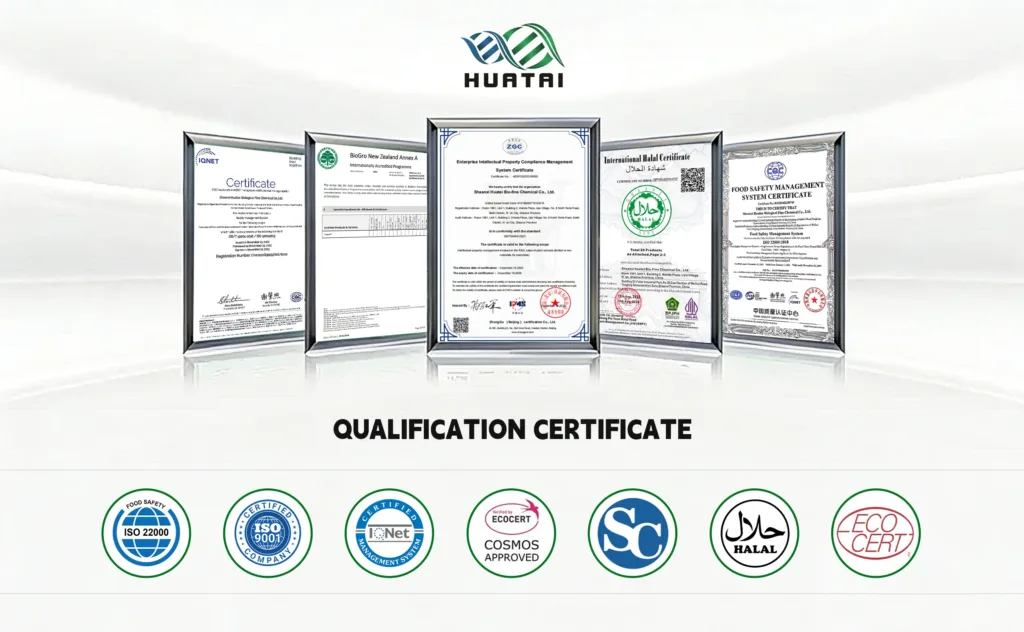
Uncompromising Quality & Credibility:We ensure every batch of our Active skincare ingredients meets rigorous quality standards, including COSMOS, ISO 9001/22000, and HALAL Certification. This commitment, backed by a complete Technical Dossier, offers clinically-backed solutions and guaranteed compliance for every formulation challenge.



 English
 German
 Italian
 French
 Spanish
 Japanese
 Korean
 Russian