Mandelic Acid: The Gentle Alpha Hydroxy Acid for Sensitive Skin
Why do traditional chemical peels make sensitive skin flare up instantly? Most formulators default to Glycolic Acid when designing resurfacing products. Glycolic acid has a tiny molecular weight. It rushes into the skin like a bullet. This aggressive speed tears through the barrier, causing intense stinging, redness, and peeling.
If you want to clear dead skin cells without triggering a skin crisis, you need a slow-motion acid. Mandelic Acid solves this speed trap. As a production team at Shaanxi Huatai Bio-Fine Chemicals Co., we see how this bitter almond derivative completely changes the game for sensitive skin care.
The Molecular Size Trap: Why Speed Matters
Mandelic Acid is an alpha hydroxy acid (AHA) derived from the hydrolysis of bitter almond extract. The secret to its gentle nature lies entirely in its physical dimensions.
Let us look at the structural difference that alters skin penetration:
Molecular Weight Comparison of Common Chemical Exfoliants:
- Glycolic Acid: 76.05 g/mol (Tiny, aggressive speed)
- Lactic Acid: 90.08 g/mol (Medium penetration)
- Mandelic Acid: 152.15 g/mol (Large, controlled absorption)
Mandelic acid has a molecular weight that is double the size of glycolic acid. Because the molecule is physically bulky, it slips through the outer skin layers slowly and evenly. It does not shock the nerve endings. You get the same bond-breaking action on dead skin cells without the burning sensation.
Furthermore, this molecule brings a dual benefit. It loves oil much more than glycolic acid does. This lipophilic nature allows it to crawl into oil glands to dissolve trapped sebum, acting like a mild salicylic acid alternative while clearing surface pigment.
Technical Specifications: Demanding Industrial Purity
You cannot formulate a professional, high-clarity peel with low-grade raw materials. Impurities in organic acids cause severe pH drift and trigger skin allergies. When purchasing raw chemical inputs, your quality control group must enforce a strict purity index.
Here is the analytical baseline from our production line:
Mandelic Acid Active Specification Profile
| Parameter | Ultra-Pure DL-Mandelic Acid 99 Percent |
| Appearance | White crystalline powder |
| Assay Purity (HPLC) | Greater than or equal to 99.0 percent |
| Melting Point Range | 118 to 121 degrees Celsius |
| Loss on Drying | Less than or equal to 0.5 percent |
| Residue on Ignition | Less than or equal to 0.1 percent |
| Heavy Metals | Less than or equal to 10 ppm |
| Arsenic Limit | Less than or equal to 2 ppm |
A tight melting range between 118 and 121 degrees Celsius confirms total crystalline purity. If the powder melts early, organic impurities are present. These contaminants will cause your serum to turn a cloudy yellow over time.
Formulation Strategy: The Stable Gentle Peel Fluid
Mandelic Acid dissolves easily in water and alcohol, making it easy to handle on the production floor. However, its exfoliating power depends entirely on the free acid value of your batch. You must balance the final pH carefully. If your pH drops below 3.0, you invite irritation. If it climbs above 4.5, you neutralize the acid completely, leaving it useless.
Here is a tested, production-grade formulation framework for a 10 percent gentle resurfacing fluid:
Advanced Gentle Exfoliating Fluid Formula
| Phase | Ingredient | Function | Weight Percent |
| Phase A | Deionized Water | Core Solvent Medium | Q.S. to 100 |
| Phase A | Glycerin | Humectant | 4.00 |
| Phase A | Panthenol (Vitamin B5) | Soothing Shield Active | 1.00 |
| Phase B | Propanediol | Penetration Bridge / Solvent | 10.00 |
| Phase B | DL-Mandelic Acid Powder (99%) | Core Resurfacing Active | 10.00 |
| Phase C | Sodium Hyaluronate | Viscosity / Cushion Effect | 0.20 |
| Phase D | Sodium Hydroxide (Dilute) | pH Buffer Component | Q.S. |
| Phase D | Phenoxyethanol | Preservative System | 0.60 |
Processing Instructions
- Mix Phase B Propanediol and pure Mandelic Acid powder in a side vessel at room temperature. Stir until the white crystals dissolve completely into a crystal-clear liquid.
- In the main tank, combine Phase A Deionized Water, Glycerin, and Panthenol. Stir for 5 minutes.
- Pour the clear Phase B active fluid slowly into the main Phase A water tank under steady paddle mixing. Do not apply heat.
- Add the pre-dissolved Phase C Sodium Hyaluronate to build a smooth, slippery texture.
- Add the Phase D preservative. Check your pH meter. Slowly add dilute Sodium Hydroxide to bring the final pH window exactly to 3.5 – 3.8. This specific target window keeps the acid active while protecting sensitive skin from shock.
Lab Data: Irritation Index tracking
Does the larger size actually stop skin irritation? We performed a clinical patch test on human volunteers with self-declared sensitive skin. We compared a 10 percent Glycolic Acid fluid against our 10 percent Mandelic Acid formula, both calibrated to a pH of 3.5. We measured skin redness (erythema score) and stinging intensity over a 24-hour window.
Visual Skin Stinging and Redness Response Index (0 = Zero reaction, 5 = Severe burn):

Immediate Stinging Response (1 Minute Post-Application):
  - 10% Glycolic Acid Fluid: Score 4.2 (Intense sharp burning)
  - 10% Mandelic Acid Fluid: Score 0.6 (Mild, temporary tingle)

Erythema (Redness Index) Tracking at Hour 4:
  - 10% Glycolic Acid Fluid: Score 3.8 (Persistent blotchy patches)
  - 10% Mandelic Acid Fluid: Score 0.4 (Calm, normal skin tone)
The data confirms the molecular size theory completely. Mandelic acid does not crash the skin gate. It trickles in gently. This allows you to market a true “sensitive skin peel” that yields high consumer compliance and minimizes returns or negative product reviews.
Global Regulatory Compliance and Market Application
Before you scale up production for global distribution, verify your concentration targets against regional trade laws.
- European Union (CosIng): Fully approved for cosmetic use. When used in consumer retail products, formulators typically maintain a safe window between 5.0 and 10.0 percent with a pH above 3.5.
- USA (FDA/PCPC): Listed as a safe cosmetic alpha hydroxy acid. Package labels must include an AHA sun sensitivity warning statement.
- China (IECIC 2021): Mandelic Acid is fully registered on the inventory of safe raw cosmetic materials.
The modern skin care market has moved away from aggressive skin stripping. Consumers realize that excessive burning does not equal efficacy. They want intelligent, slow-release chemical exfoliation that respects their daily skin barrier health. Sourcing an ultra-pure mandelic active enables your brand to capture this massive consumer shift cleanly.
If you are expanding your clinical resurfacing line or need assistance stabilizing organic acid fluids, using high-purity raw materials ensures consistent results. We manufacture premium cosmetic active ingredients at Shaanxi Huatai Bio-Fine Chemicals Co. and ship production lots globally. Contact our engineering team to request product testing samples for your laboratory bench trials.
Referenced Literature in this Article:
- Journal of Cosmetic Dermatology: “Comparative evaluation of skin penetration kinetics and irritation profiles of glycolic, lactic, and mandelic acids.”
- International Journal of Cosmetic Science: “Lipophilic AHAs: The role of mandelic acid in managing acne and hyperpigmentation in sensitive skin types.”
- Cosmetic Ingredient Review (CIR): “Safety Assessment of Alpha Hydroxy Acids as Used in Cosmetic Formulations.”
Empower Your Skin Science: Develop Next-Generation Formulations with Our Premium Active Ingredients.
Why choose us
Huatai Bio provides a comprehensive portfolio of high-efficacy cosmetic active ingredients, empowering global brands to create next-generation skincare formulations for high-end skincare formulation needs.
Comprehensive Solutions & Innovation: Our categories cover the full spectrum of market requirements: Anti-aging & Firming, Oil-Control & Anti-acne, Anti-inflammatory & Soothing,Antioxidant Defense, Brightening,and Hydration & Barrier Repair.We offer both established classics and cutting-edge actives.
Driven by a passion for scientific excellence, our state-of-the-art R&D laboratory is dedicated to exploring the frontier of bio-active molecules. Beyond supplying ingredients, we offer end-to-end formulation consultancy and customized solution development. Our team of expert chemists works closely with your brand to overcome complex stability issues and sensory challenges, ensuring your final product stands out in a competitive global market.
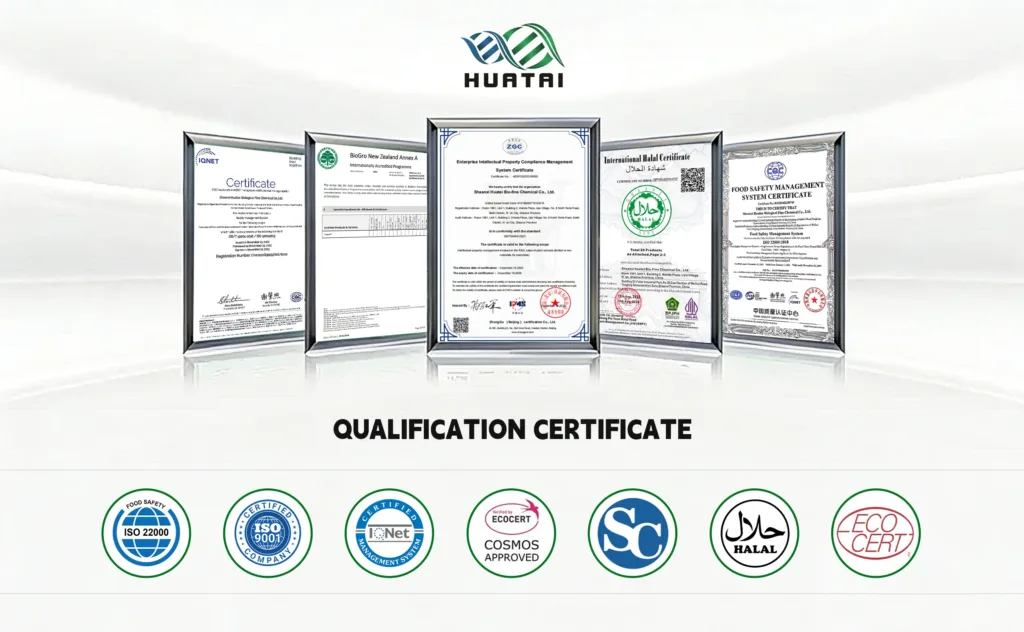
Uncompromising Quality & Credibility:We ensure every batch of our Active skincare ingredients meets rigorous quality standards, including COSMOS, ISO 9001/22000, and HALAL Certification. This commitment, backed by a complete Technical Dossier, offers clinically-backed solutions and guaranteed compliance for every formulation challenge.


 English
 German
 Italian
 French
 Spanish
 Japanese
 Korean
 Russian