Kojic Acid: The Fungal-Derived Agent for Pigment Control
Why do many brightening serums turn yellow-brown before they even hit retail shelves? The answer lies in the unstable nature of traditional skin-lightening chemicals. Formulators want intense pigment control. Yet, they often end up with a degraded product that stains the skin.
If you want to clear dark spots effectively, you must understand the chemistry of enzymatic blockades. Kojic acid, a natural byproduct of fungal fermentation, represents a gold standard in clinical hyperpigmentation care. As a manufacturing team at Shaanxi Huatai Bio-Fine Chemicals Co., we see how raw material purity determines whether this molecule succeeds or fails in production. Let us dive into the data.
The Molecular Action: How Kojic Acid Chelation Works
Kojic acid is a hydrophilic hydrophilic compound produced during the fermentation of malted rice by Aspergillus fungi. Unlike surface-level peeling agents, it targets the root assembly line of dark spots.
The skin builds pigment using an enzyme called tyrosinase. This enzyme requires copper ions to activate its core structure. Kojic acid acts as a molecular magnet. It binds to the copper ions, starving the enzyme of its vital power source.
- Direct Tyrosinase Inactivation: By capturing copper, it turns off the pigment assembly line.
- Melanin Reduction: It stops pre-existing dark spots from becoming darker when exposed to sunlight.
- Synergistic Affinity: It blends perfectly with other water-soluble actives to create targeted dark spot systems.
Technical Specifications: The Reality of Purity
You cannot build a high-performance clinical serum with low-grade cosmetic ingredients. Impurities cause rapid discoloration, strange odors, and skin irritation. When sourcing raw materials, your quality control group must enforce strict limits on heavy metals and ash.
Here is the analytical specification baseline from our production floor:
Kojic Acid Active Specification Profile
| Parameter | Ultra-Pure Kojic Acid 99 Percent |
| Appearance | White to off-white crystalline powder |
| Assay Purity (HPLC) | Greater than or equal to 99.0 percent |
| Melting Point Range | 152 to 156 degrees Celsius |
| Loss on Drying | Less than or equal to 0.5 percent |
| Residue on Ignition | Less than or equal to 0.1 percent |
| Heavy Metals | Less than or equal to 10 ppm |
| Arsenic Limit | Less than or equal to 2 ppm |
A tight melting point window between 152 and 156 degrees Celsius confirms high crystalline purity. If the powder melts early, unreacted fermentation residues are present. These residues cause your serum to turn brown within weeks.
Formulation Strategy: The High-Stability Clear Essence
Kojic acid dissolves easily in water, but it hates light and high temperatures. If you heat this molecule above 50 degrees Celsius for an extended time, you break its structural ring.
Furthermore, you must include a chelating agent like Disodium EDTA. Why? Because trace iron ions in your formulation water will bind with the Kojic acid, turning your clear liquid into an unusable red-purple hue.
Here is a stable, production-grade formulation framework for a targeted brightening essence:
Advanced Copper-Block Dark Spot Essence Formula
| Phase | Ingredient | Function | Weight Percent |
| Phase A | Deionized Water | Solvent Medium | Q.S. to 100 |
| Phase A | Glycerin | Humectant | 4.00 |
| Phase A | Disodium EDTA | Ion Sequestrant (Critical) | 0.10 |
| Phase B | Butylene Glycol | Texture Enhancer | 5.00 |
| Phase B | Kojic Acid Powder (99%) | Core Pigment Controller | 1.00 to 2.00 |
| Phase C | Niacinamide | Vitamin B3 / Co-Active | 2.00 |
| Phase C | Sodium Hyaluronate | Viscosity / Moisture Film | 0.30 |
| Phase D | Phenoxyethanol | Preservative System | 0.60 |
Processing Instructions
- Charge the main vessel with Phase A Deionized Water at room temperature. Add Glycerin and Disodium EDTA. Mix until completely clear.
- Pour the Phase B Butylene Glycol into a side vessel. Add the pure Kojic acid powder. Mix at room temperature until the crystals dissolve fully into a clear fluid.
- Pour the Phase B active fluid slowly into the Phase A tank under steady paddle mixing. Do not apply heat.
- Add the Phase C Niacinamide and pre-dissolved Sodium Hyaluronate. Stir for 15 minutes.
- Add the Phase D preservative. Check the final pH. Maintain a strict target window between 4.0 and 5.0. If your pH climbs above 5.5, the active molecule will degrade rapidly.
Lab Data: Stability Trends Over Time
Does adding a chelating agent really stop the color shift? We ran an accelerated stability test over a 12-week period at 40 degrees Celsius. We compared the color shift and active active retention of Kojic acid under different processing conditions.
Active Kojic Acid Retention Rate (%) over 12 Weeks at 40°C:

Week 0: All formulas start at 100% active compound concentration

Week 4:
  - Aqueous Solution (No EDTA, pH 6.0): 78% remaining (Dark yellow tint)
  - Stabilized Formula (With EDTA, pH 4.5): 97% remaining (Clear transparent)

Week 8:
  - Aqueous Solution (No EDTA, pH 6.0): 52% remaining (Brown coloration)
  - Stabilized Formula (With EDTA, pH 4.5): 94% remaining (Clear transparent)

Week 12:
  - Aqueous Solution (No EDTA, pH 6.0): 31% remaining (Muddy brown sludge)
  - Stabilized Formula (With EDTA, pH 4.5): 89% remaining (Slight cream tint)
The data shows why pH control and metal isolation are vital. Keeping the pH under 5.0 preserves nearly 90 percent of the active molecule through its commercial shelf life. Your user gets the exact pigment-clearing power promised on the carton.
Global Regulatory Compliance and Market Application
Before you push a new pigment control gel to production, make sure your active loading meets regional cosmetic safety thresholds.
- European Union (SCCS): Regulated strictly. The Scientific Committee on Consumer Safety limits Kojic acid to a maximum concentration of 1.0 percent in leave-on face creams.
- United States (CIR): Reviewed and approved for cosmetic applications. Formulators typically use it between 1.0 and 2.0 percent for targeted clinical spot corrections.
- China (IECIC 2021): Listed on the safe inventory of approved raw materials.
Modern skin care consumers want hyper-targeted routines that solve discoloration without causing permanent barrier damage. Sourcing an ultra-pure fungal active lets your brand deliver on this exact consumer trend.
If you are currently developing an active brightening serum or need technical support to stabilize sensitive skin-lightening powders, raw material purity determines your batch success. We manufacture premium cosmetic active ingredients at Shaanxi Huatai Bio-Fine Chemicals Co. and supply R&D labs globally. Contact our engineering team to request product testing samples for your laboratory bench trials.
Referenced Literature in this Article:
- Journal of Cosmetic Science: “Inhibitory mechanisms of kojic acid and its derivatives on copper-dependent tyrosinase models.”
- International Journal of Molecular Sciences: “Fermentation kinetics of Aspergillus species and the purification of high-stability skin-lightening compounds.”
- Scientific Committee on Consumer Safety (SCCS): “Opinion on the safety of Kojic acid in cosmetic products.”
Empower Your Skin Science: Develop Next-Generation Formulations with Our Premium Active Ingredients.
Why choose us
Huatai Bio provides a comprehensive portfolio of high-efficacy cosmetic active ingredients, empowering global brands to create next-generation skincare formulations for high-end skincare formulation needs.
Comprehensive Solutions & Innovation: Our categories cover the full spectrum of market requirements: Anti-aging & Firming, Oil-Control & Anti-acne, Anti-inflammatory & Soothing,Antioxidant Defense, Brightening,and Hydration & Barrier Repair.We offer both established classics and cutting-edge actives.
Driven by a passion for scientific excellence, our state-of-the-art R&D laboratory is dedicated to exploring the frontier of bio-active molecules. Beyond supplying ingredients, we offer end-to-end formulation consultancy and customized solution development. Our team of expert chemists works closely with your brand to overcome complex stability issues and sensory challenges, ensuring your final product stands out in a competitive global market.
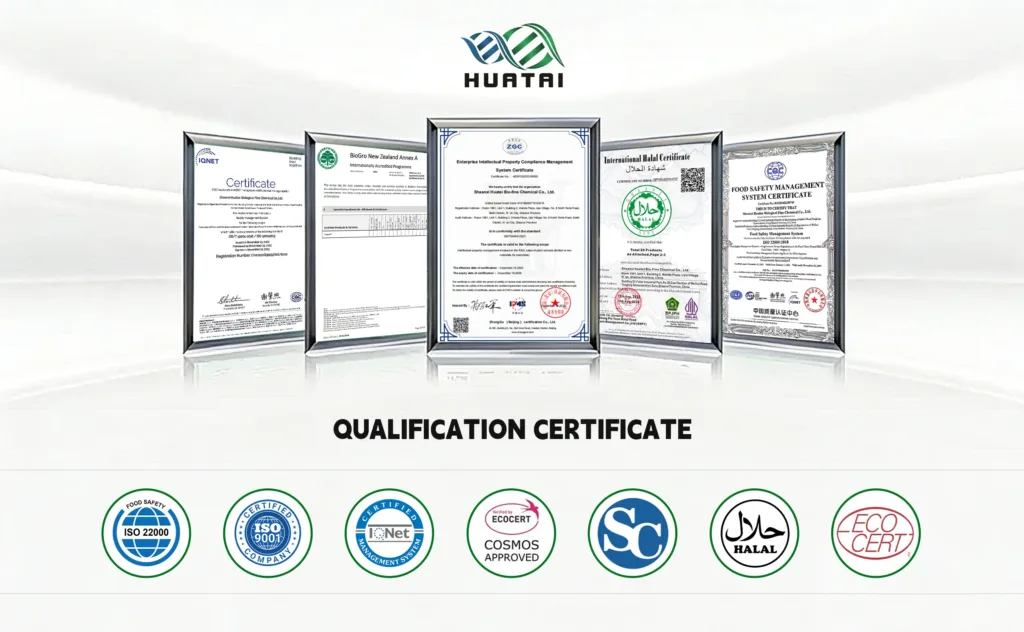
Uncompromising Quality & Credibility:We ensure every batch of our Active skincare ingredients meets rigorous quality standards, including COSMOS, ISO 9001/22000, and HALAL Certification. This commitment, backed by a complete Technical Dossier, offers clinically-backed solutions and guaranteed compliance for every formulation challenge.

 English
 German
 Italian
 French
 Spanish
 Japanese
 Korean
 Russian