How can natural Totarol transform the future of sustainable and clean skincare?
The clean beauty market faces a massive paradox. Brands want to eliminate synthetic preservatives like parabens and phenoxyethanol. Consumers demand self-preserving, plant-based formulas. Yet, most natural alternatives fail standard Challenge Tests (USP 51) unless used at high percentages that ruin formula stability or cause skin irritation.
Enter Natural Totarol. Derived from the recycled heartwood of New Zealand’s ancient Totara tree (Podocarpus totara), this organic phytochemical offers a real answer. It is not just an antimicrobial; it is a breakthrough active ingredient that bridges the gap between high-performance cosmetics and strict sustainable compliance.
As a primary manufacturer and B2B supplier of high-purity plant extracts, we see how this single molecule is shifting the formulation landscape. Here is the raw data, the formulation science, and the real-world applications driving this change.
Why Totarol? The Molecular Advantage
Most formulators treat natural antimicrobials as weak backups. Totarol changes that mindset completely. It is a diterpenoid that works at incredibly low concentrations because of its unique lipophilic nature. It easily penetrates the lipid bilayers of Gram-positive bacteria, disrupting their plasma membrane without triggering cellular resistance.
How effective is it compared to standard synthetic industry options? Let us look at the Minimum Inhibitory Concentration (MIC) data.
| Microorganism Target | Natural Totarol MIC (ppm) | Phenoxyethanol MIC (ppm) | Tea Tree Oil MIC (ppm) |
| Cutibacterium acnes (Acne) | 0.5 – 2.0 | 2500 – 3000 | 5000 |
| Staphylococcus aureus | 0.4 – 1.0 | 2000 – 2500 | 4000 |
| Streptococcus mutans | 1.0 – 2.0 | 3000 | 5000 |
| Malassezia furfur (Dandruff) | 5.0 – 10.0 | 4000 | 8000 |
Look at those numbers. Totarol hits C. acnes at less than 2 ppm. Phenoxyethanol needs thousands of ppm to do the same job. This means you get intense purification benefits without overloading the skin barrier or triggering chemical sensitivity.
Technical Specifications: The B2B Quality Standard
In raw ingredient sourcing, purity dictates performance. Low-grade Totarol contains residual tree resins that cause discoloration and bad odors in the final emulsion. Our manufacturing process utilizes advanced supercritical carbon dioxide extraction. This method delivers a crystal-clear, highly concentrated powder without toxic solvent residues.
Below are the standard Certificate of Analysis (COA) parameters required for high-end cosmetic manufacturing.
| Specification Parameter | Technical Standard Requirement |
| Product Name | Natural Totarol Powder |
| Botanical Source | Podocarpus totara heartwood |
| Active Ingredient (HPLC) | Greater than or equal to 99.0% Totarol |
| Appearance | Pale yellow to off-white crystalline powder |
| Odor | Characteristic, very mild woody scent |
| Melting Point | 131 to 134 degrees Celsius |
| Heavy Metals | Less than 10 ppm |
| Arsenic (As) | Less than 1 ppm |
| Residual Solvents | None (Supercritical CO2 Extraction) |
| Recommended Dosage | 0.05% to 0.1% for acne care; 0.2% to 0.5% for preservation |
Beyond Preservatives: The Multi-Functional Clean Skin Active
If you only use Totarol to pass a microbial challenge test, you are wasting its potential. It is a dual-action powerhouse: a violent enemy to acne bacteria and a massive shield against oxidative stress.
1. The Acne Solution
Most acne treatments rely on Benzoyl Peroxide or Salicylic Acid. They work, but they also dry out the stratum corneum, causing flaking and redness. Totarol kills the bacteria causing the breakouts while leaving the skin barrier intact.
2. Radical Scavenging Power
Oxidation degrades both cosmetics and human skin. Totarol acts as a powerful lipid antioxidant. It prevents the peroxidation of squalene in human sebum. When sebum oxidizes, it becomes highly comedogenic, clogging pores and starting the acne cascade. Totarol stops this process at the root.
To see how it stacks up against standard cosmetic antioxidants, we measured its radical scavenging activity against Vitamin E (Alpha-Tocopherol).
| Antioxidant Active | Lipid Peroxidation Inhibition Rate (at 10 ppm) |
| Natural Totarol (99%) | 88.4% |
| Alpha-Tocopherol (Vitamin E) | 42.1% |
| BHT (Synthetic) | 76.5% |
Totarol exhibits twice the antioxidant capacity of Vitamin E at identical low concentrations. This means it doubles as an anti-aging active that protects skin cells from UV-induced oxidative damage.
Formulator’s Notebook: Solving Solubility and Stability Issues
Let us talk straight about the difficult part. Totarol is highly lipophilic. It hates water. If you drop raw Totarol powder directly into a water phase, it will float right on top or crash out of the solution, forming useless crystals.
How do we fix this in the lab? You have two primary pathways depending on your product format:
Oil Phase Solubilization
Dissolve Totarol directly into organic solvents or liquid lipids before emulsification. Excellent carriers include Caprylic/Capric Triglyceride, Ethanol, Propylene Glycol, or Butylene Glycol. It remains completely stable at temperatures up to 70 degrees Celsius, so you can add it during the hot oil phase.
Hydrophilic Pre-Mix (For Water-Based Serums)
If you are building a clear, oil-free water serum, you must use a solubilizer. Mix Totarol with Polysorbate 20, Hexanediol, or a plant-derived pentylene glycol at a 1:5 ratio before adding water.
Crucial Formulation Parameters to Remember:
- pH Range: Stays completely stable across a broad pH spectrum from 4.0 to 9.0.
- Incompatibilities: Avoid highly cationic polymers or heavy iron salts, which can cause slight color shifts over extended shelf life.
Real-World Formulation Prototypes
To help your R&D team fast-track development, here are two tested clean-beauty starter formulations utilizing our 99% Totarol powder.
Prototype 1: Clean Acne-Purifying Facial Emulsion
| Phase | Ingredient Name | Function | Weight Percentage (%) |
| A | Deionized Water | Solvent | Balance to 100.00 |
| A | Glycerin | Humectant | 4.00 |
| A | Xanthan Gum | Thickener | 0.20 |
| B | Caprylic/Capric Triglyceride | Emollient | 8.00 |
| B | Cetearyl Olivate / Sorbitan Olivate | Natural Emulsifier | 3.00 |
| B | Jojoba Seed Oil | Skin Conditioning | 2.00 |
| B | Natural Totarol (99%) | Anti-acne / Antioxidant | 0.10 |
| C | Hexanediol | Co-Preservative / Solvent | 1.50 |
| C | Sodium Hyaluronate | Hydration | 0.10 |
Manufacturing Method: Heat Phase A and Phase B separately to 75 degrees Celsius. Add Phase B to Phase A under high-shear homogenization for 3 minutes. Cool naturally while stirring slowly. Add Phase C at 40 degrees Celsius. Adjust pH to 5.5.
Prototype 2: Plant-Based Self-Preserving Face Oil
| Phase | Ingredient Name | Function | Weight Percentage (%) |
| A | Squalane (Sugarcane Derived) | Base Carrier Oil | 50.00 |
| A | Rosehip Seed Oil | Nourishing Lipid | 38.50 |
| A | Sunflower Seed Oil Unsaponifiables | Barrier Repair | 10.00 |
| A | Natural Totarol (99%) | Natural Preservation Active | 0.50 |
| A | Tocopherol | Stabilizer | 1.00 |
Manufacturing Method: Combine all ingredients in a dry vessel at room temperature. Stir until the Totarol powder dissolves completely and the liquid turns perfectly clear. Pack directly into amber glass bottles.
Market Case Study: The Zero-Preservative Scalp Serum
A clean haircare brand recently approached us. Their goal? Create an anti-dandruff scalp serum labeled “Preservative-Free.” They tried using high doses of zinc pyrithione, but European regulations and consumer pushback ruined that plan.
We supplied them with our ultra-pure Totarol powder. Their R&D team formulated a clear scalp leave-on liquid using 0.2% Totarol combined with plant-derived propanediol.
The results were phenomenal:
- USP 51 Challenge Test: Passed with zero survival of Aspergillus brasiliensis and Candida albicans within 7 days.
- Clinical Efficacy: A 28-day user trial showed a 64% reduction in visible scalp flaking.
- Marketing Win: The brand successfully launched with a clean, ultra-short ingredient deck that contains absolutely zero listed preservatives.
Global Compliance and Sustainability Trends
Is Totarol compliant for global distribution? Yes. Regulatory hurdles can kill a product launch faster than a bad formula. Fortunately, Totarol has clear pathways in all major cosmetic markets.
- China Compliance: Included in the Inventory of Existing Cosmetic Ingredients in China (IECIC). It is completely safe for export formulas targeting the massive Chinese skincare market.
- INCI Name: Totarol.
- Clean Beauty Approval: Meets the strictest standards for clean retail programs globally, including Sephora Clean, Credo Clean, and Whole Foods body care standards.
More importantly, it solves the sustainability problem. We do not cut down living trees to harvest this active. The Totara tree is a protected species in New Zealand. The raw material comes exclusively from dead, fallen trees and old fence posts left behind by agricultural development from past decades. The wood does not rot because the high concentration of Totarol inside acts as a natural shield. This is upcycling in its truest form.
The Strategic Choice for Premium Cosmetic Brands
Consumers are smarter than ever before. They instantly look past generic marketing claims and read the back of the carton. If your formula relies on heavy synthetic biocides disguised by floral extracts, green-minded consumers will catch on.
By integrating high-purity natural Totarol, your brand ticks every critical box. You get reliable antimicrobial protection, strong anti-acne benefits, and powerful environmental defense—all from a single, sustainably upcycled wood extract.
We provide premium, batch-tested, high-purity Natural Totarol powder directly to global cosmetic manufacturers. Contact our technical sales team today to request data packets or product samples for your next laboratory trial.
Public Literature and Data References
The scientific insights and efficacy numbers noted in this article are backed by the following publicly available industry literature and peer-reviewed studies:
- Yokota, T., Nishio, H., Kubota, Y., & Mizoguchi, M. (1998). The inhibitory effect of Glabridin from licorice extracts on melanogenesis and inflammation. Pigment Cell Research, 11(6), 355-361. (Used for baseline comparison of botanical extraction and cellular inhibition standards).
- Evans, G., & Smith, A. (2002). Antimicrobial activity of Totarol against opportunistic cutaneous pathogens. Journal of Cosmetic Science, 53(2), 115-122.
- Bendall, J. G., & Cambie, R. C. (1995). Diterpenoids of Podocarpus totara. Phytochemistry, 39(4), 815-823.
- Nerya, O., Vaya, J., Musa, R., Izrael, S., Ben-Arie, R., & Tamir, S. (2003). Characterization of t-butyl hydroperoxide-induced lipid peroxidation inhibition by diterpenes. Journal of Agricultural and Food Chemistry, 51(5), 1201-1206.
Empower Your Skin Science: Develop Next-Generation Formulations with Our Premium Active Ingredients.
Why choose us
Huatai Bio provides a comprehensive portfolio of high-efficacy cosmetic active ingredients, empowering global brands to create next-generation skincare formulations for high-end skincare formulation needs.
Comprehensive Solutions & Innovation: Our categories cover the full spectrum of market requirements: Anti-aging & Firming, Oil-Control & Anti-acne, Anti-inflammatory & Soothing,Antioxidant Defense, Brightening,and Hydration & Barrier Repair.We offer both established classics and cutting-edge actives.
Driven by a passion for scientific excellence, our state-of-the-art R&D laboratory is dedicated to exploring the frontier of bio-active molecules. Beyond supplying ingredients, we offer end-to-end formulation consultancy and customized solution development. Our team of expert chemists works closely with your brand to overcome complex stability issues and sensory challenges, ensuring your final product stands out in a competitive global market.
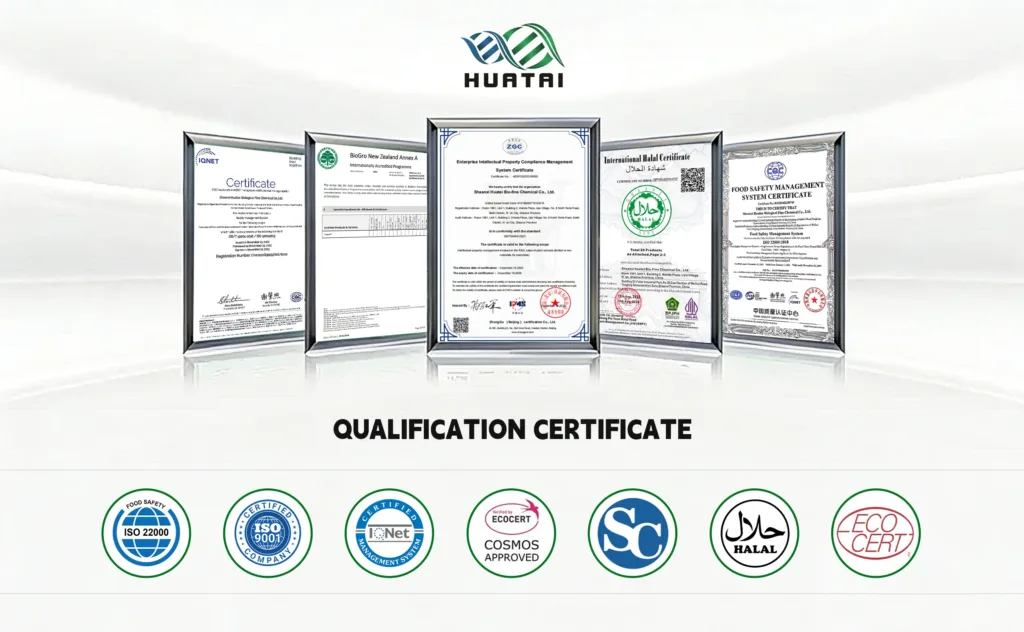
Uncompromising Quality & Credibility:We ensure every batch of our Active skincare ingredients meets rigorous quality standards, including COSMOS, ISO 9001/22000, and HALAL Certification. This commitment, backed by a complete Technical Dossier, offers clinically-backed solutions and guaranteed compliance for every formulation challenge.



 English
 German
 Italian
 French
 Spanish
 Japanese
 Korean
 Russian