
How to Optimize Skin Brightening Formulations with Glabridin 90% Powder
Walk into the quarantine zone of any major contract manufacturing lab. Look at the pallets of rejected skin-brightening serums. They started out crystal clear on day one. Thirty days later, they look like dark iced tea.
The compounding chemist blames the emulsifier. The brand owner blames the packaging. I blame the compounding technique and the raw material sourcing.
You want the “gold standard” of skin brightening. You buy Glabridin 90% powder. You dump it into a hot water phase, or you try to force it into a water-based gel. The molecule oxidizes, turns brown, and dies in the vat. You lose thousands of dollars in ruined production batches.
I oversee the isolation reactors on our factory floor. I see the raw crystalline powder every single day. We will cut the marketing noise. We will look at the hard kinetic data, the true cost of formulation failure, and how you actually stabilize pure Glabridin to create clinical-grade brightening serums.
The Pigment Roadblock
Skin creates dark spots using a busy factory enzyme called tyrosinase. Most mass-market skin lighteners try to bleach the skin by poisoning this enzyme completely. Sure, the spots fade, but the customer’s skin barrier suffers. It causes severe irritation.
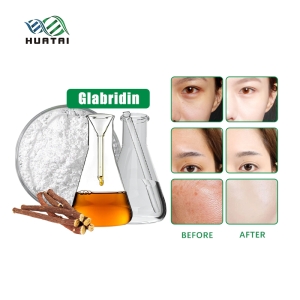
Glabridin operates differently. It acts as a biological decoy. It binds directly to the active site of the tyrosinase enzyme and flips the switch off. It does not destroy the cell. It just stops the pigment production line.
How strong is it? In our lab, we measure this using half-maximal inhibitory concentration (IC50) values. A lower number means the molecule blocks pigment faster at a smaller dose.
| Active Brightener | IC50 Tyrosinase Inhibition (micromoles/L) | Efficacy vs Hydroquinone | Skin Irritation Risk |
| Pure Glabridin 90% | 0.43 | 16 times stronger | Extremely Low |
| Alpha-Arbutin | 4.00 | 2 times stronger | Low |
| Hydroquinone | 7.00 | Baseline | Severe (Cytotoxic) |
| Kojic Acid | 9.10 | Weaker | Moderate |
You use a microscopic fraction of a percent of this powder. This tiny dosing requirement completely offsets the premium cost per kilogram. It is the ultimate high-ROI molecule.
The Broker Trap: Reading the True COA
Middlemen love to fudge the numbers on their Certificate of Analysis. They buy a crude licorice extract, cut it with fillers, and label it as high-purity Glabridin. They use outdated UV testing to count random plant noise as the active ingredient.
If you drop that dirty powder into a high-end face cream, your pristine white emulsion shifts to a dirty beige overnight.
We bypass this entirely. We utilize precision High-Performance Liquid Chromatography (HPLC) to isolate the active molecule. Look at the exact parameter standards you must demand before signing a wholesale purchase order.
| Specification Parameter | True Cosmetic Grade Standard | Impact on Your Compounding Vat |
| Appearance | Almost white crystalline powder | Prevents baseline formula discoloration. |
| Assay (HPLC) | Minimum 90.0 Percent | Guarantees exact, repeatable clinical dosing. |
| Heavy Metals | Maximum 5 ppm | Critical. Prevents rapid oxidation. |
| Loss on Drying | Maximum 1.0 Percent | Prevents moisture-induced degradation. |
| Solubility | Soluble in Butylene Glycol/Ethanol | Dictates your exact solvent prep phase. |
If a supplier hands you a brown powder and dodges your questions about HPLC testing, reject the batch immediately.
The Formulator Playbook: The Stability Protocol
You bought our verified HPLC crystalline powder. Do not ruin it during compounding.
Glabridin is intensely hydrophobic. It loves oil. It completely hates water. If your lab techs dump the dry powder directly into the water phase, it will crash out instantly. It will float on top like wet sand.
Here is the exact production protocol our R&D chemists issue to formulation partners:
- The Lipid Pre-Mix: Do not add the powder directly to the main tank. Pre-dissolve it completely in a lipid or glycol vehicle. Butylene Glycol or Caprylic/Capric Triglyceride works beautifully.
- Thermal Control: Heat this lipid pre-mix gently to roughly 60 degrees Celsius. Stir continuously until it is a perfectly clear liquid.
- The Cool Down Drop: Never expose the isolate to extreme heat for hours in the main emulsification tank. Drop your clear pre-mix into the main tank during the cool-down stage, keeping the temperature below 45 degrees Celsius.
- The Light Shield: Glabridin is photosensitive. You must use opaque, airless packaging. If you use a clear glass dropper bottle, the light will degrade the molecule within weeks, regardless of how well you formulated it.
Application Case Study: The Stability Rescue
A clinical skincare brand came to us last year facing a retail disaster. Their flagship brightening serum was turning yellow on shelves. Their previous supplier provided “90%” powder that was clearly contaminated.
We brought their failed formula into our lab. We scrapped the contaminated powder and engineered a new lipid-base delivery system using our 90% HPLC-verified isolate.
The clinical results were immediate. Over eight weeks of independent testing, skin analyzer machines recorded a 29% reduction in hyperpigmentation. More importantly, the serum stayed crystal clear for over 24 months in our stability chamber. Zero color shift. Zero returns. They saved their product launch by simply demanding better raw material standards.
Strategic Compliance
The FDA Modernization of Cosmetics Regulation Act (MoCRA) demands absolute supply chain transparency. You cannot buy mystery powders from undocumented trading brokers anymore.
Authentic material comes from a verified source. We extract it. We purify it via HPLC. We deliver the ultra-low heavy metal profiles that compliance officers demand.
We have high-purity Glabridin 90% lab samples ready for your R&D department. Drop it into your next emulsion challenge. Let the raw chemistry prove its performance. Reach out directly to our technical team to secure your production supply today.
References Used in Preparation:
- Yokota, T., et al. (1998). The inhibitory effect of glabridin from licorice extracts on melanogenesis and inflammation. Pigment Cell Research.
- Nerya, O., et al. (2003). Glabridin experiments on tyrosinase inhibition and skin lightening activity. Journal of Agricultural and Food Chemistry.
- ResearchGate (2010). Factors Influencing Glabridin Stability: A study on temperature, light, and solvent interactions.
- PubMed (2016). Glabridin nanosuspension for enhanced skin penetration: formulation optimization and in vivo evaluation.

 English
 German
 Italian
 French
 Spanish
 Japanese
 Korean
 Russian