Kojic acid has been a standard brightening active in cosmetic formulations for decades. Glabridin has more recently gained traction in mainstream formulation practice but exhibits a distinctly different physicochemical and formulation profile. The comparison is valuable not because one is inherently superior, but because the two exhibit fundamentally different strengths and failure modes. Understanding both helps formulators make rational, function-driven decisions rather than trend-driven choices.
Mechanism of Action
Both ingredients target tyrosinase, but via different inhibition chemistry.
Glabridin inhibits tyrosinase through a predominantly non-competitive or mixed-type inhibition pattern, reducing enzymatic activity without relying solely on competition with the substrate (L-tyrosine), and is therefore considered to involve potential conformational modulation of enzyme function. In addition, glabridin has been reported to modulate inflammatory pathways, including COX-related prostaglandin (such as PGE₂) signaling, which may provide an additional benefit in addressing inflammation-associated pigmentation concerns such as post-inflammatory hyperpigmentation (PIH) — a mechanism not typically associated with kojic acid (Yokota et al., 1998).
Kojic acid (5-hydroxy-2-(hydroxymethyl)-4H-pyran-4-one) inhibits tyrosinase primarily through copper ion chelation at the enzyme's active site, thereby reducing catalytic activity. Its kinetic behavior has been reported as competitive or mixed-type depending on experimental conditions. The copper chelation mechanism is well established, while its apparent inhibition pattern may vary across studies.
Kojic acid's copper-chelating activity is central to its inhibition of tyrosinase, a copper-dependent enzyme. However, this strong affinity for copper ions also leads to interactions with trace levels of copper present in formulation systems, which can have important implications for product stability and color integrity.
Potency: IC₅₀ Comparison
| Ingredient | IC₅₀ (μmol/L) | Relative Potency vs Glabridin |
|---|---|---|
| Glabridin | 0.09 | — |
| Kojic Acid | 16.67 | 185× less potent |
Source: Nerya et al., 2003 — under comparable in vitro assay conditions.
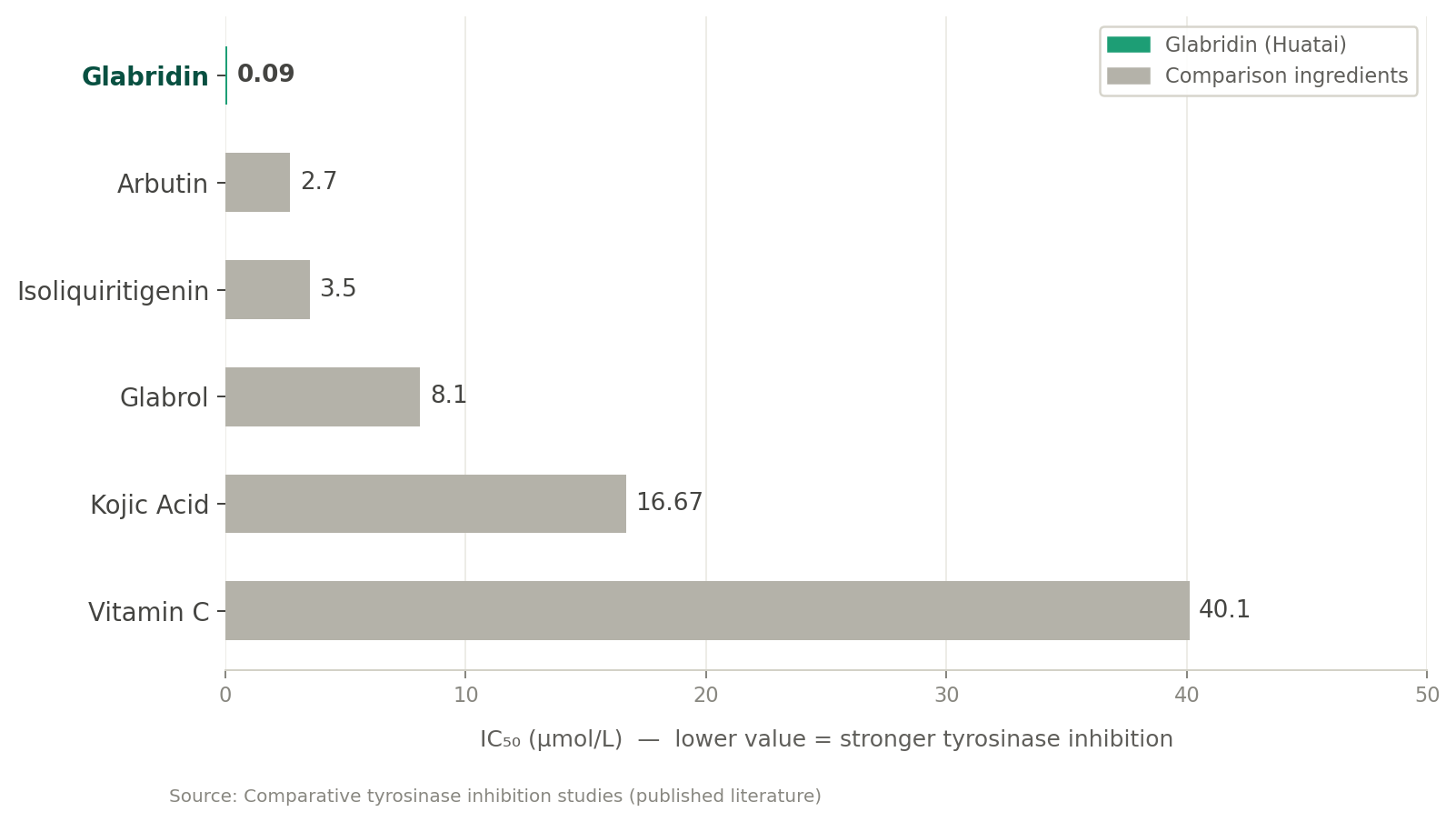
On a molar basis, glabridin exhibits a lower IC₅₀ than kojic acid, indicating higher apparent tyrosinase inhibitory potency under reported experimental conditions. Kojic acid compensates for lower molar potency with higher use concentrations — typically 0.5–2.0% in finished products — while glabridin shows efficacy at low active levels, including a 0.03% concentration as demonstrated in a Huatai-commissioned 4-week human efficacy study, with a 16.8% reduction in melanin index (MI) and statistical significance observed from Week 1 (P<0.05).
Formulation Stability: Where the Real Differences Lie
This is the area where the comparison is most practically relevant for formulators.
Kojic Acid — Stability Challenges
Kojic acid is one of the more formulation-challenging brightening actives in commercial use. Its instability stems from multiple simultaneous degradation mechanisms:
1. Metal chelation and non-specific complexation
Kojic acid's copper-chelating activity is central to its inhibition of tyrosinase but also contributes to its interaction with trace metal ions in formulation systems. Iron (Fe³⁺) and copper ions — present at trace levels in water, botanical co-ingredients, and processing equipment — can form coordination complexes with kojic acid. These metal–ligand complexes are typically yellow to brown in color and may develop rapidly under certain formulation conditions. Such metal complexation is a key contributing factor to the discoloration observed in kojic acid-containing formulations.
2. Photodegradation
Kojic acid is susceptible to UV-induced oxidative degradation. Formulations containing kojic acid in transparent or semi-transparent packaging may develop visible color changes over time under light exposure.
3. pH sensitivity
Kojic acid exhibits optimal stability in the pH range of approximately 3.5–6.0. At higher pH values, degradation processes are accelerated, primarily associated with increased susceptibility to oxidative reactions. This stability range partially overlaps with that of glabridin (approximately 4.0–6.5), while kojic acid generally exhibits greater susceptibility to degradation under alkaline conditions.
Stabilization strategies for kojic acid typically include the use of chelating agents (e.g., EDTA), antioxidants, UV-protective packaging, and pH control systems. Despite these approaches, kojic acid formulations may still exhibit color development over shelf life due to its sensitivity to metal ions, light, and oxidative conditions.
Glabridin — Predictable Degradation Pathways
Glabridin's stability challenges are real but mechanistically well-understood and addressable:
- Oxidation of phenolic hydroxyl groups: managed through antioxidant protection and metal ion control
- Instability under alkaline conditions (pH >7.0): managed through pH control at 4.0–6.5
- Photodegradation: managed with UV-protective or opaque packaging
The key difference from kojic acid is that glabridin degradation is mainly associated with oxidative pathways that may generate color-forming products (such as yellowing), which can be systematically managed through formulation design. Kojic acid also faces oxidative stability challenges, but its strong metal-chelating activity introduces additional formulation considerations through interactions with trace metal ions.
| Stability Factor | Glabridin | Kojic Acid |
|---|---|---|
| Primary stability challenge | Oxidation of phenolic hydroxyl groups | Oxidative degradation, light sensitivity, and trace metal ion interactions |
| Color development | Yellowing/color shift (manageable with antioxidant system) | Yellow-to-brown or pink-brown discoloration (more challenging to control) |
| pH optimum | ~4.0–5.5 | ~3.5–6.0 |
| Chelator requirement | EDTA 0.05–0.1% or sodium phytate | Greater reliance on metal ion control strategies |
| Photostability | Moderate | Poor |
| Packaging requirement | Airless + UV-blocking | UV-blocking essential; opaque strongly recommended |
Skin Compatibility
This is an important area where differences in skin tolerance and formulation considerations may become apparent.
Glabridin: A third-party CMA-accredited human closed patch test of a glabridin-containing formulation demonstrated good skin tolerance in 30 subjects, with no observed adverse reactions at evaluated observation time points (0.5h, 24h, and 48h after removal). In addition, glabridin has been reported to modulate inflammatory pathways, including COX-related signaling, which may provide additional benefits for inflammation-associated pigmentation concerns (Report No. GZA01-23080632-JC-01, Guangdong Weipu Testing Technology Co., Ltd.).
Kojic acid: Kojic acid has a long history of use in brightening formulations. However, contact dermatitis has been reported in a subset of users in the published literature, indicating that skin tolerance may vary depending on individual susceptibility and formulation conditions. This highlights the importance of concentration control and careful formulation design, particularly for sensitive skin applications.
For formulators designing products for:
- Sensitive or reactive skin types
- Fitzpatrick III–VI (where PIH is the primary concern)
- Post-procedure or compromised barrier skin
- Products marketed for long-term daily use
Glabridin's safety profile, together with its reported anti-inflammatory activity, may provide advantages in formulation design for these target skin applications.
Regulatory Status
| Market | Glabridin | Kojic Acid |
|---|---|---|
| EU (CosIng) | Listed in cosmetic ingredient inventory | Listed in cosmetic ingredient inventory |
| Japan | Permitted cosmetic ingredient | Permitted and widely used in whitening products |
| China | Permitted in cosmetics | Permitted with concentration guidance |
| US | Used in cosmetic and personal care formulations | Used in cosmetic and personal care formulations |
| COSMOS | COSMOS-certified grades available | Accepted as permitted substance |
Kojic acid has been evaluated in toxicological and dermatological studies, including data on skin sensitization and in vitro genotoxicity under certain experimental conditions. It remains permitted for use in cosmetic products in major markets, typically subject to concentration limits or formulation considerations depending on regional regulatory frameworks. As with many long-established cosmetic actives, formulation design and exposure conditions are important factors in ensuring safe use.
Glabridin is currently used in cosmetic formulations across major markets, with available safety data indicating good skin tolerance in evaluated studies. There are no widely reported regulatory restrictions or safety actions specifically targeting glabridin in major cosmetic regulatory frameworks.
3D Skin Model Data: Direct Comparison
In a UVB-stimulated 3D reconstructed skin model, groups tested included untreated control, UVB control, glabridin, and kojic acid. Glabridin showed:
- A greater reduction in melanin production compared with the kojic acid group
- Lower total melanin content and reduced melanin deposition within epidermal layers
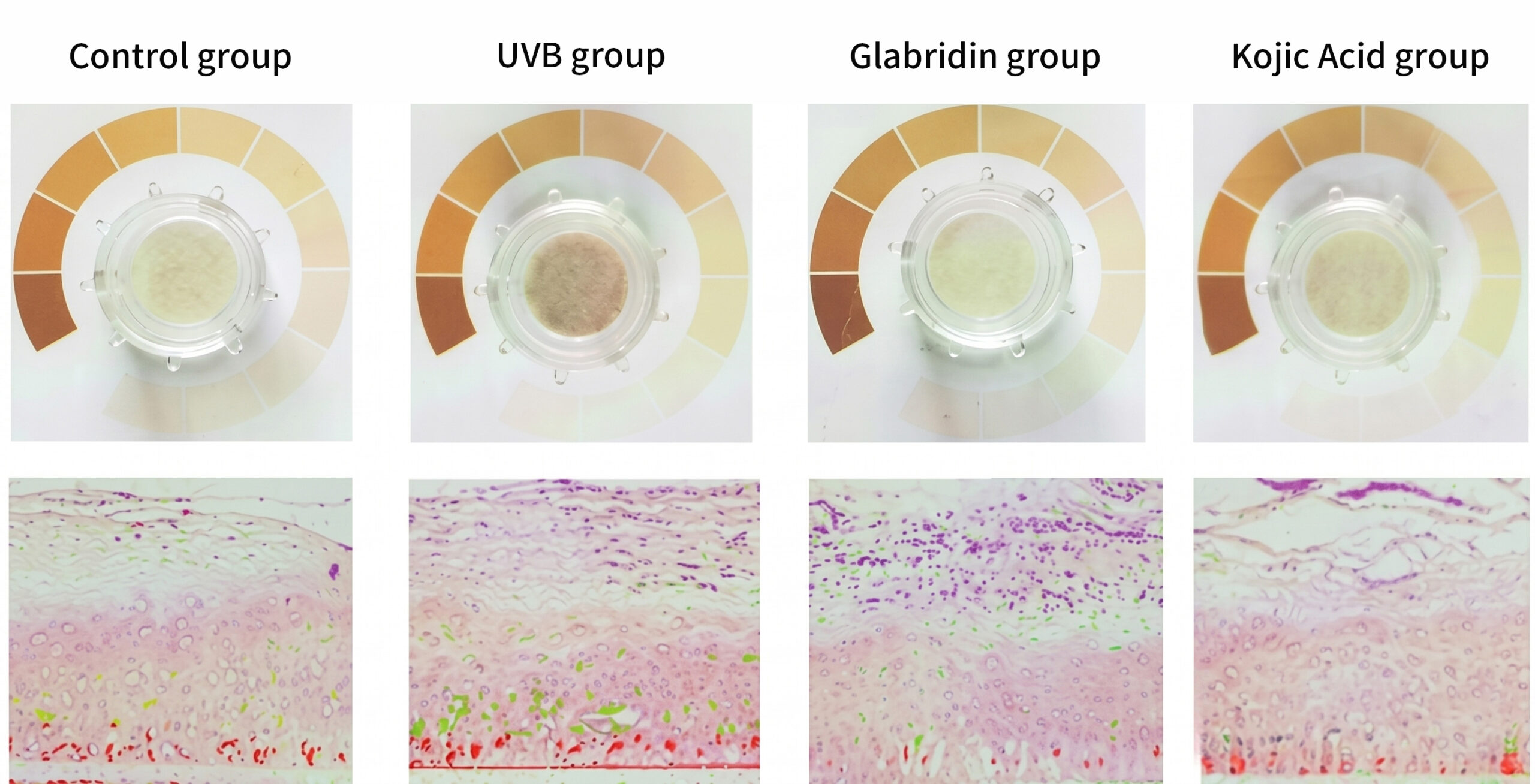
This in-vitro comparative data may support formulation development, suggesting that under the tested conditions, glabridin exhibits greater melanin inhibition than kojic acid.
Decision Framework
| Formulation Priority | Recommended Active |
|---|---|
| Higher brightening potency | Glabridin |
| Sensitive skin / reactive skin | Glabridin — well tolerated; anti-inflammatory activity |
| PIH-focused (post-acne, post-procedure) | Glabridin — anti-inflammatory activity may help address inflammation-related pigmentation pathways |
| Formulation stability / color stability | Glabridin — more predictable, manageable degradation |
| Regulatory simplicity (multi-market) | Glabridin — no widely reported regulatory concerns in major markets |
| Cost-sensitive mass-market application | Kojic acid — lower raw material cost; established supply base |
| Japanese market traditional positioning | Kojic acid — long-established use; strong consumer recognition |
| Clean formulation / minimal chelator load | Glabridin — lower chelator requirement |
Every batch ships with COA, TDS, and SDS/MSDS. Additional testing available upon request.
References
- Yokota T, Nishio H, Kubota Y, Mizoguchi M. The inhibitory effect of glabridin from licorice extracts on melanogenesis and inflammation. Pigment Cell Research, 11(6), 355–361, 1998. DOI: 10.1111/j.1600-0749.1998.tb00494.x.
- Nerya O, Vaya J, Musa R, Izrael S, Ben-Arie R, Tamir S. Glabrene and isoliquiritigenin as tyrosinase inhibitors from licorice roots. Journal of Agricultural and Food Chemistry, 51(5), 1201–1207, 2003. — IC₅₀ comparative data under comparable in vitro assay conditions.
- Parvez S, Kang M, Chung HS, Bae H. Naturally occurring tyrosinase inhibitors: mechanism and applications in skin health, cosmetics and agriculture industries. Phytotherapy Research, 21(9), 805–816, 2007.
- Guangdong Weipu Testing Technology Co., Ltd. (CMA No. 202119135666). Report No. GZA01-23080632-JC-01. Human skin brightening efficacy study + patch test, 0.03% Glabridin. Commissioned by Huatai Bio-Fine Chemical.


 English
 German
 Italian
 French
 Spanish
 Japanese
 Korean
 Russian