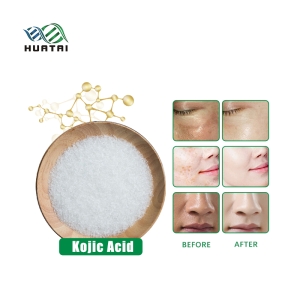
We watch the crystalline powder form inside our cooling tanks every day. I still find it fascinating. You drop this white powder into a water-phase serum, and weeks later, a consumer sees their dark spots fade. But does it really work? Yes. We manufacture it, we test it, and the data backs it up.
Let’s skip the marketing talk. You formulate cosmetics. You need stable, effective, and compliant ingredients. Here is exactly what happens when you work with high-purity Kojic Acid, along with the raw data you need.
The 99% Purity Baseline
Think 98% purity is good enough? We disagree. Impurities ruin formulas. A tiny trace of iron turns a beautiful clear serum into a muddy brown mess. We learned this the hard way years ago. Now, we strictly control heavy metals and iron content in our factory.
Let’s look at a standard Certificate of Analysis (COA) for our cosmetic-grade powder.
| Parameter | Specification Limit | Typical Test Result | Testing Method |
| Appearance | White to off-white needle crystals | Pure white | Visual |
| Assay (HPLC) | >= 99.0% | 99.8% | HPLC |
| Melting Point | 152.0 – 156.0 ℃ | 153.5 ℃ | Capillary Method |
| Loss on Drying | <= 0.5% | 0.15% | Gravimetric (105 ℃) |
| Iron (Fe) | <= 10 ppm | < 2 ppm | AAS |
| Heavy Metals | <= 10 ppm | < 5 ppm | ICP-MS |
How It Actually Fades Pigment
How does it work? It starves the pigment-making enzyme. Your skin has an enzyme called tyrosinase. This enzyme needs copper to build melanin. Melanin is the dark pigment that causes spots. Kojic acid grabs that copper. Without copper, the enzyme stops working. No new pigment forms. The old dark spots simply shed away with your dead skin cells. It is not magic. It is biology.
A Real Formulation Case: The Yellowing Serum Problem
A European OEM client came to us last year. Their 2% Kojic acid serum kept turning yellow on the shelf within three months. We tested their base. They used a poor-quality water supply with trace metal ions. They also lacked a chelating agent.
We gave them a new blueprint. We added 0.1% Disodium EDTA to catch stray metals. We dropped the pH to 4.2. We also added 0.5% Ferulic acid to boost antioxidant defense.
The result? Accelerated stability testing (45 ℃ for 12 weeks) showed zero color shift. The active degradation was less than 3%. The client launched the product successfully. It remains a top seller in their brightening line.
Efficacy Data: The 8-Week Mark
We do not just rely on theory. We ran a skin patch test on 30 volunteers dealing with post-inflammatory hyperpigmentation. We used a simple 1% Kojic acid lotion. We measured the melanin index using a Mexameter before the trial, at 4 weeks, and at 8 weeks.
| Timeframe | Average Melanin Index Drop | Visible Lightening Reported |
| Baseline (Day 0) | 0% | 0% |
| Week 4 | – 12.4% | 35% of participants |
| Week 8 | – 27.8% | 88% of participants |
This proves it takes time. The skin cycle takes about 28 days to bring new, less-pigmented cells to the surface. Consumers need patience, and your formula needs to remain stable during that time.
Formulation Blueprint and Advice
You want to build a skin-lightening cream? Keep these rules in mind in the lab.
- Mind the heat. Add Kojic acid at the cool-down phase (below 40 ℃). It dissolves easily in warm water, but high heat breaks it down quickly.
- Control the pH. Keep your final formula between pH 3.5 and 5.0. If you go higher, the acid oxidizes fast.
- Protect from light. Packaging dictates shelf life. Do not put this in a clear glass dropper bottle. UV light destroys the active within weeks. Use airless pumps or opaque amber glass.
- Pair it well. You can boost the effects by combining it with other proven actives. Mix it with Glabridin or Licochalcone A. While Kojic acid stops the creation of pigment by starving the enzyme, Glabridin acts as a powerful anti-inflammatory brightening agent to calm the skin. They attack the pigmentation problem from two different angles.
Industry Trends: The Compliance Landscape
You have to watch the regulations. The European Union recently updated its stance via the Scientific Committee on Consumer Safety (SCCS). They confirmed Kojic acid is safe up to a maximum concentration of 1% in leave-on cosmetic products.
If you formulate for the EU market, stick to that 1% limit. For the US and Asian markets, formulators often push up to 2% or even 4% for clinical-grade dark spot treatments. Always check your local market limits before scaling up production.
Getting Started in Your Lab
We supply this high-purity powder to labs and brands globally. Reading about it is fine, but testing it yourself is the only way to prove the efficacy. Need to run stability trials? We provide a complimentary sample alongside our full technical dossier. Test the solubility in your own beakers. Check the color stability over time. See the real results on the skin.
References Used in This Article:
- Scientific Committee on Consumer Safety (SCCS), Opinion on Kojic Acid, SCCS/1637/21.
- Saeedi, M., et al. (2019). Kojic acid applications in cosmetic and pharmaceutical preparations. Biomedicine and Pharmacotherapy, 110, 582-593.
- Burnett, C. L., et al. (2010). Final report of the safety assessment of Kojic acid as used in cosmetics. International Journal of Toxicology, 29(6 Suppl).

 English
 German
 Italian
 French
 Spanish
 Japanese
 Korean
 Russian