Unlocking Kojic Acid Benefits for Skin: The Gold Standard for Safe Depigmentation
Why did your brilliant new brightening cream turn a nasty dark brown after three weeks on the retail shelf? We watch formulators cry over this exact disaster every single month. You mix a beautiful, pristine white emulsion. You put it in the stability oven. It comes out looking like muddy water.
You blame the raw material. But let us look at the actual chemistry. We manufacture these active powders from the ground up. If you treat Kojic Acid like simple sugar, your product will fail.
How does this molecule actually work? Think of your skin’s dark spot production as a factory. The main machine in this factory is an enzyme called tyrosinase. This machine requires copper to run. Kojic Acid acts as a molecular thief. It physically grabs the copper and holds it hostage. Without copper, the machine dies. The dark spots stop forming.
But here is the catch. Kojic Acid does not just grab copper in the skin. It grabs trace iron in your factory mixing tanks. When Kojic Acid binds with iron, it turns blood red. Your cream turns brown.
We ran stability tests in our application lab to show exactly how purity impacts shelf life. Look at the raw data below.
| Purity Grade | Heavy Metal Content | Tyrosinase Inhibition Power | Formula Color Shift (4 Weeks at 45 C) |
| 90% Crude Extract | High (> 50 ppm) | Weak / Inconsistent | Severe Browning |
| 98% Standard Grade | Moderate (~20 ppm) | Moderate | Yellowing |
| 99.5% Premium Crystal | Trace (< 10 ppm) | Maximum | Highly Stable (White) |
Last winter, an indie skincare brand brought us a massive manufacturing emergency. They formulated a 2% Kojic Acid spot treatment. During their scale-up run, the entire 500-liter batch turned rust-colored. They used standard stainless-steel mixing paddles. Their factory water filtration was weak. Trace iron leaked into the batch.
We completely rebuilt their processing protocol on our lab bench.
First, we added 0.1% Disodium EDTA to their water phase. EDTA acts as a sacrificial shield. It grabs the rogue metal ions before the Kojic Acid can reach them. Second, we locked their water phase strictly at pH 4.0 using a citric acid buffer. Kojic Acid demands an acidic home. Finally, we forced them to dissolve our 99.5% pure crystals in room-temperature water. They added this mixture to the main tank only during the final cool-down phase below 40 degrees Celsius.
The redesigned batch passed a 12-week accelerated heat test flawlessly. The cream stayed pearl white.
Your procurement team must audit the Certificate of Analysis (COA) aggressively. Do not accept a generic PDF. You get exactly what you pay for.
| Critical COA Parameter | Our Manufacturing Standard | Production Floor Purpose |
| Assay (HPLC) | Greater than 99.5% | Guarantees consistent clinical spot-fading speed |
| Appearance | Pure white needle crystals | Keeps your final clear serums from looking dirty |
| Heavy Metals (as Pb) | Less than 10 ppm | Prevents metal-catalyzed color degradation |
| Loss on Drying | Less than 0.5% | Stops the powder from clumping inside the drum |
You build the best products when you attack pigment from multiple angles. Combine 1.0% Kojic Acid with 2.0% Alpha Arbutin. The Kojic Acid starves the factory of copper. The Alpha Arbutin acts as a decoy to distract the machine further. You shut down the dark spots entirely.
The global regulatory landscape is tightening rapidly. The European Scientific Committee on Consumer Safety (SCCS) recently issued a strict limit. You can only use a maximum of 1% Kojic Acid in face creams. The days of dumping 4% into a formula are dead.
You do not need massive, irritating doses. You just need pure molecules and stable processing.
Stop playing guessing games with your formulations. Request a technical validation sample for your R&D chemists. Dissolve the pure crystals in your buffered water phase. Put the emulsion through your own incubator. Let the stability data prove the performance.
References from Public Literature:
- Cabanes, J., et al. (1994). “Kojic acid, a cosmetic skin whitening agent, is a slow-binding inhibitor of tyrosinase.” Journal of Pharmacy and Pharmacology, 46(12), 982-985.
- SCCS (Scientific Committee on Consumer Safety). (2022). “Opinion on the safety of Kojic acid in cosmetic products.” European Commission.
- Burnett, C. L., et al. (2010). “Final report of the safety assessment of Kojic acid as used in cosmetics.” International Journal of Toxicology, 29(6_suppl), 244S-273S.
Empower Your Skin Science: Develop Next-Generation Formulations with Our Premium Active Ingredients.
Why choose us
Huatai Bio provides a comprehensive portfolio of high-efficacy cosmetic active ingredients, empowering global brands to create next-generation skincare formulations for high-end skincare formulation needs.
Comprehensive Solutions & Innovation: Our categories cover the full spectrum of market requirements: Anti-aging & Firming, Oil-Control & Anti-acne, Anti-inflammatory & Soothing,Antioxidant Defense, Brightening,and Hydration & Barrier Repair.We offer both established classics and cutting-edge actives.
Driven by a passion for scientific excellence, our state-of-the-art R&D laboratory is dedicated to exploring the frontier of bio-active molecules. Beyond supplying ingredients, we offer end-to-end formulation consultancy and customized solution development. Our team of expert chemists works closely with your brand to overcome complex stability issues and sensory challenges, ensuring your final product stands out in a competitive global market.
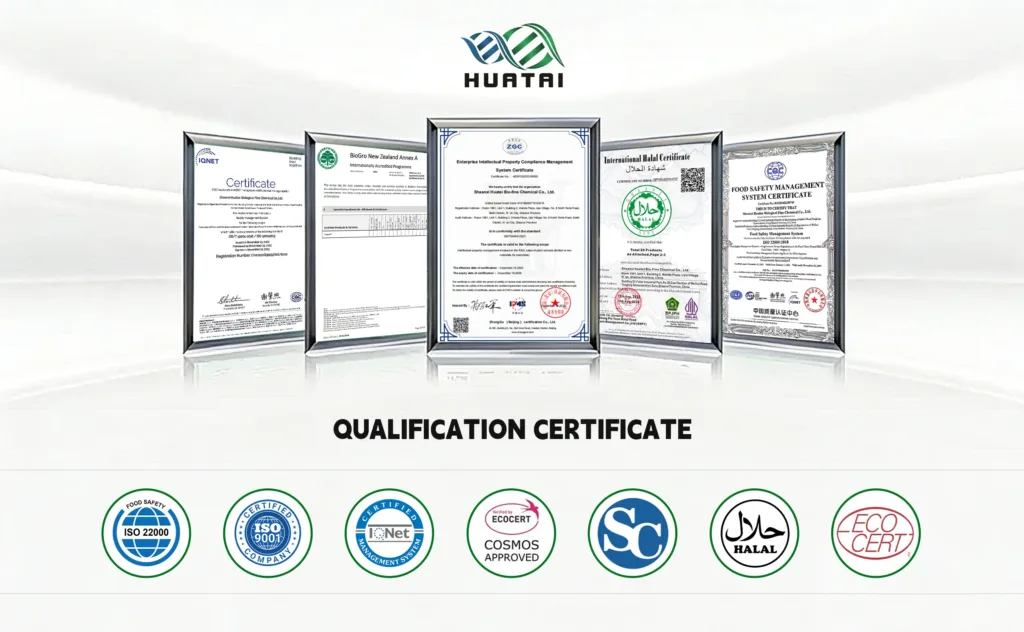
Uncompromising Quality & Credibility:We ensure every batch of our Active skincare ingredients meets rigorous quality standards, including COSMOS, ISO 9001/22000, and HALAL Certification. This commitment, backed by a complete Technical Dossier, offers clinically-backed solutions and guaranteed compliance for every formulation challenge.

 English
 German
 Italian
 French
 Spanish
 Japanese
 Korean
 Russian