
You mix a 2 percent Alpha Arbutin serum. You put it in the heat chamber for stability testing. Thirty days later, you pull it out. The clear liquid is now a dark, rusty brown. What went wrong? The active molecule broke apart. It turned into hydroquinone. You just created a toxic, illegal product.
I see this formulation nightmare every week on our manufacturing floor at Shaanxi Huatai Bio-Fine Chemicals Co., Ltd. Formulators love Alpha Arbutin. It fades dark spots beautifully. It brightens dull skin. But they treat it like a simple water-soluble powder. It is not. It is highly sensitive to acid.
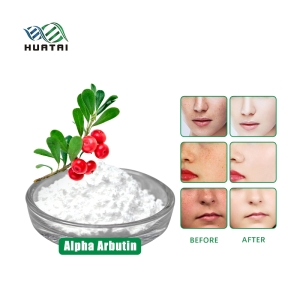
Why do we even use it? Think of your skin’s pigment factory. The engine running that factory is an enzyme called tyrosinase. Alpha Arbutin acts like a wedge. It slides into the engine and stops it from spinning. The skin stops producing excess melanin. The dark patches slowly fade away.
But you have a choice. You can buy Beta Arbutin, or you can buy Alpha Arbutin. Look at the actual bench data before you purchase your raw materials.
| Brightening Active | Tyrosinase Inhibition Strength | Stability in Water Phase | Skin Irritation Risk |
| Alpha Arbutin | Extremely High (Fast fading) | High (If pH is buffered) | Low |
| Beta Arbutin | Weak (Needs high dosage) | Low (Degrades easily) | Moderate |
| Hydroquinone | Maximum | Very Poor (Oxidizes rapidly) | Extremely High |
Alpha Arbutin works nearly ten times stronger than the Beta version. You use less powder. You get faster skin clarity.
A contract manufacturer called us last year. Their client rejected a massive batch of brightening body lotion. The lotion smelled metallic. The pH dropped to 3.5 during the mixing process. The cheap Alpha Arbutin they sourced completely hydrolyzed. We overhauled their protocol. We supplied them with our 99 percent high-purity Alpha Arbutin. We forced them to lock the emulsion pH strictly between 5.0 and 7.0. We added a mild chelating agent. The new batch survived a brutal 12-week accelerated heat test. It stayed pure white.
You cannot achieve this with dirty raw materials. Cheap extracts contain leftover hydroquinone directly from the factory. You must demand strict safety data. Here is the Certificate of Analysis (COA) standard you need for professional cosmetics:
| Testing Parameter | High-Purity Specification | Why Formulators Care |
| Physical Appearance | White crystalline powder | Dark powder indicates immediate oxidation |
| Assay Purity (HPLC) | 99.0 Percent Minimum | Guarantees exact clinical efficacy |
| Hydroquinone Limit | Less than 10 ppm | Prevents severe skin toxicity and legal bans |
| pH of 1 Percent Solution | 5.0 to 7.0 | Indicates a stable, unhydrolyzed raw powder |
| Heavy Metals | Less than 10 ppm | Meets global regulatory safety laws |
How do you actually mix this powder on the lab bench? Respect the molecule.
| Formulation Phase | Professional Lab Advice | The Chemistry Behind It |
| Phase Addition | Dissolve directly in the water phase | The molecule is highly hydrophilic (water-loving) |
| Temperature Control | Keep the batch below 40 Celsius | High heat destroys the delicate glycoside bond |
| pH Environment | Buffer strictly between 5.0 and 7.0 | Severe acidity breaks the molecule into hydroquinone |
| Synergy System | Pair with Niacinamide | Creates a dual-action pigment blocking loop |
Global cosmetics laws are tightening right now. The European Union Scientific Committee on Consumer Safety (SCCS) recently issued strict caps. You can legally use a maximum of 2 percent Alpha Arbutin in face creams. You can use 0.5 percent in body lotions. You cannot just dump massive amounts of powder into a tank to get faster results. You must use high-purity raw materials to maximize the brightening power within these strict legal limits.
Stop fighting oxidized formulas. Upgrade your active matrix. We provide samples of our high-purity Alpha Arbutin for your internal lab trials. Test the water solubility yourself. Monitor the pH stability over time on your own bench.
References used in formulating this insight:
- Sugimoto, K., et al. (2004). “Inhibitory effects of alpha-arbutin on melanin synthesis in cultured human melanoma cells and a three-dimensional human skin model.” Biological and Pharmaceutical Bulletin.
- European Commission (2023). “SCCS Opinion on the safety of Alpha-Arbutin and Beta-Arbutin in cosmetic products.”
- Draelos, Z. D. (2007). “Skin lightening preparations and the hydroquinone controversy.” Dermatologic Therapy.


 English
 German
 Italian
 French
 Spanish
 Japanese
 Korean
 Russian