
Retinol causes redness. It triggers inflammation. Inflammation triggers the skin to produce more melanin. You use retinol to clear dark spots, but the irritation actually creates new ones. Dermatologists call this post-inflammatory hyperpigmentation. How do you break this frustrating cycle? You pair your retinoid with Tranexamic Acid.
They are the perfect formulation couple. They do entirely different jobs. Retinol acts as the accelerator. It speeds up cell turnover and sheds old, pigmented cells. Tranexamic Acid acts as the brake. It blocks the plasmin pathway in the skin. It actively stops the skin from producing new pigment when it gets irritated by the retinol.
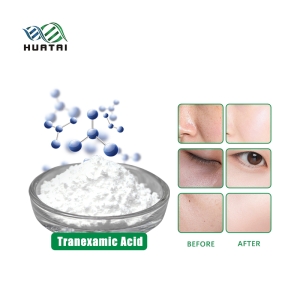
We see brands struggle with this constantly on our manufacturing floor at Shaanxi Huatai Bio-Fine Chemicals Co., Ltd. A clinical skincare brand recently brought us a failed nighttime serum. Their formula relied on 0.5 percent pure Retinol. After three weeks of human testing, subjects dropped out. Their skin burned. Worse, their sun spots actually looked darker.
We stripped the formula down. We kept the Retinol but added 3.0 percent high-purity Tranexamic Acid. The clinical shift was massive. The Tranexamic Acid acted like a biological fire extinguisher. It calmed the redness while simultaneously fading the dark marks.
Look at the raw clinical performance data. We measure how these actives behave alone versus together.
| Formulation Strategy | Cell Turnover Rate | Redness Risk | Hyperpigmentation Rebound Risk |
| Retinol Alone (0.5 Percent) | High | Extremely High | High |
| Tranexamic Acid Alone (3.0 Percent) | Baseline | Very Low | None |
| Retinol and Tranexamic Acid Blend | High | Low | Near Zero |
You cannot achieve this synergy with cheap raw materials. Low-grade Tranexamic Acid shifts the pH of your water phase wildly. That pH shift will destroy your retinol. You must demand strict product specifications from your supplier.
Here is the exact Certificate of Analysis (COA) standard you need for cosmetic-grade manufacturing:
| Testing Parameter | High-Purity Specification | Real-World Formulation Impact |
| Physical Appearance | White crystalline powder | Ensures a clean and colorless final serum |
| Assay Purity (HPLC) | 99.0 Percent Minimum | Guarantees the exact clinical dosage hits the skin |
| pH of 5 Percent Solution | 7.0 to 8.0 | Confirms the raw powder is chemically stable |
| Loss on Drying | Less than 0.5 Percent | Prevents the powder from clumping in the warehouse |
| Heavy Metals | Less than 10 ppm | Meets strict global regulatory safety laws |
How do you actually mix these two molecules on the lab bench? They live in completely different environments. Tranexamic Acid loves water. Retinol hates water and loves oil. You must respect their physical boundaries.
| Formulation Phase | Professional Lab Advice | The Chemistry Behind It |
| Solvent Separation | Dissolve Tranexamic Acid in water, Retinol in oil | Prevents phase separation and respects distinct solubility |
| pH Alignment | Buffer the final emulsion to 6.0 | Tranexamic Acid tolerates this pH, Retinol demands it |
| Heat Management | Add Retinol phase below 40 Celsius | High heat permanently destroys the retinoid structure |
| Antioxidant System | Pair with Vitamin E or BHT | Protects the Retinol from rapid oxidation in the bottle |
Global cosmetics regulations are changing rapidly. Regulators in the European Union recently capped pure Retinol at 0.3 percent for face creams. You can no longer rely on massive doses of Retinol to get clinical brightening results. You need a booster. Tranexamic Acid faces no such strict regulatory caps. It boosts the brightening power of low-dose retinol without triggering regulatory safety alarms.
Stop burning your customers’ faces just to clear a dark spot. Upgrade your active matrix. We provide samples of our high-purity Tranexamic Acid powder for your internal lab trials. Dissolve it in your water phase. Add your retinoid to the oil phase. Watch the clinical results change on your own lab bench.
References used in formulating this insight:
- Tse, T. W., & Hui, E. (2013). “Tranexamic acid: an important adjuvant in the treatment of melasma.” Journal of Cosmetic Dermatology.
- Na, J. I., et al. (2013). “Effect of tranexamic acid on melasma: a clinical trial with histological evaluation.” Journal of the European Academy of Dermatology and Venereology.
- European Commission (2023). “Draft Commission Regulation amending Regulation (EC) No 1223/2009 as regards the use of Vitamin A in cosmetic products.”

 English
 German
 Italian
 French
 Spanish
 Japanese
 Korean
 Russian