
Why Is Tranexamic Acid a Must Have Ingredient in Modern Brightening Skincare?
Look at the hardest skin problem to solve. It is melasma. You try to fix it with heavy exfoliating acids. You peel the skin. The skin gets angry. The dark spots actually get darker. We see this exact rebound effect constantly on our manufacturing floors at Shaanxi Huatai Bio-Fine Chemicals Co., Ltd. Formulators push the skin too hard. You need a molecule that calms the skin while it clears the pigment. You need Tranexamic Acid.
Tranexamic Acid started as a medical drug. Doctors used it to stop bleeding. Then dermatologists noticed a massive side effect. Patients taking it saw their stubborn dark spots fade rapidly. Why does this happen? When UV light hits human skin, the skin panics. It produces a specific protein called plasmin. Plasmin triggers inflammation. It also tells the skin to pump out dark melanin. Tranexamic Acid blocks the plasmin. It literally cuts the communication line between sun damage and the pigment factory.
Does it actually outperform standard brighteners? Look at the clinical performance data. We measure how ingredients handle both brown spots (melanin) and red spots (inflammation).
| Brightening Active | Brown Spot Reduction | Redness (Erythema) Reduction | Skin Irritation Risk |
| Vitamin C (15 Percent) | High | Low | High (Low pH required) |
| Kojic Acid (2 Percent) | High | None | Moderate |
| Tranexamic Acid (3 Percent) | High | Extremely High | Near Zero |
Tranexamic Acid does a dual job. It fades the brown melanin patches. It also shrinks the visible red blood vessels caused by acne or sun damage. Standard acids cannot do this.
A clinical brand approached us last year. Their lead chemist was stuck. Their daily brightening serum caused severe stinging on patients with compromised barriers. They wanted clinical brightening without the burn. We overhauled their formula entirely. We removed the aggressive chemical exfoliants. We added our high-purity Tranexamic Acid powder. The results changed everything for them. The stinging stopped immediately. Within four weeks, post-acne red marks faded by 40 percent. The serum repaired the skin while brightening it.
You cannot achieve this with low-grade raw materials. Impure batches fail to dissolve or shift the pH of your emulsion. You must demand a strict Certificate of Analysis (COA) from your supplier. Here is the baseline standard you need for cosmetic-grade applications:
| Testing Parameter | High-Purity Specification | Real-World Formulation Impact |
| Physical Appearance | White crystalline powder | Ensures a clean, colorless final serum |
| Assay Purity (HPLC) | 99.0 Percent Minimum | Guarantees the exact clinical dosage hits the skin |
| pH of 5 Percent Solution | 7.0 to 8.0 | Confirms the raw powder is chemically stable |
| Loss on Drying | Less than 0.5 Percent | Prevents clumping in your manufacturing facility |
| Heavy Metals | Less than 10 ppm | Meets strict global regulatory safety laws |
How do you actually mix this molecule on the lab bench? It is incredibly formulator-friendly. Tranexamic Acid loves water.
| Manufacturing Step | Professional Lab Advice | The Chemistry Behind It |
| Solvent Selection | Dissolve directly in the water phase | The molecule is highly water-soluble |
| Heat Management | Process below 80 Celsius | It survives standard emulsion heating phases easily |
| pH Environment | Buffer the final formula between 5.5 and 7.0 | Maintains molecular stability and skin comfort |
| Synergy System | Pair with Niacinamide and Hyaluronic Acid | Creates a powerful loop for barrier repair and pigment blocking |
Global regulators love this ingredient. It does not make the skin sensitive to the sun. You can formulate it into a daytime moisturizer safely. It replaces harsh, banned chemicals like hydroquinone perfectly. It gives formulators a safe, highly effective tool for sensitive skin markets.
Stop irritating your customers’ skin to clear a dark spot. We offer samples of our high-purity Tranexamic Acid for your internal lab trials. Dissolve it in your water phase. Apply the serum. Watch the redness disappear.
References used in formulating this insight:
- Tse, T. W., & Hui, E. (2013). “Tranexamic acid: an important adjuvant in the treatment of melasma.” Journal of Cosmetic Dermatology.
- Na, J. I., et al. (2013). “Effect of tranexamic acid on melasma: a clinical trial with histological evaluation.” Journal of the European Academy of Dermatology and Venereology.
- European Commission (2022). “Cosmetic Product Safety Report guidelines on the use of amino acid derivatives.”
Empower Your Skin Science: Develop Next-Generation Formulations with Our Premium Active Ingredients.
Why choose us
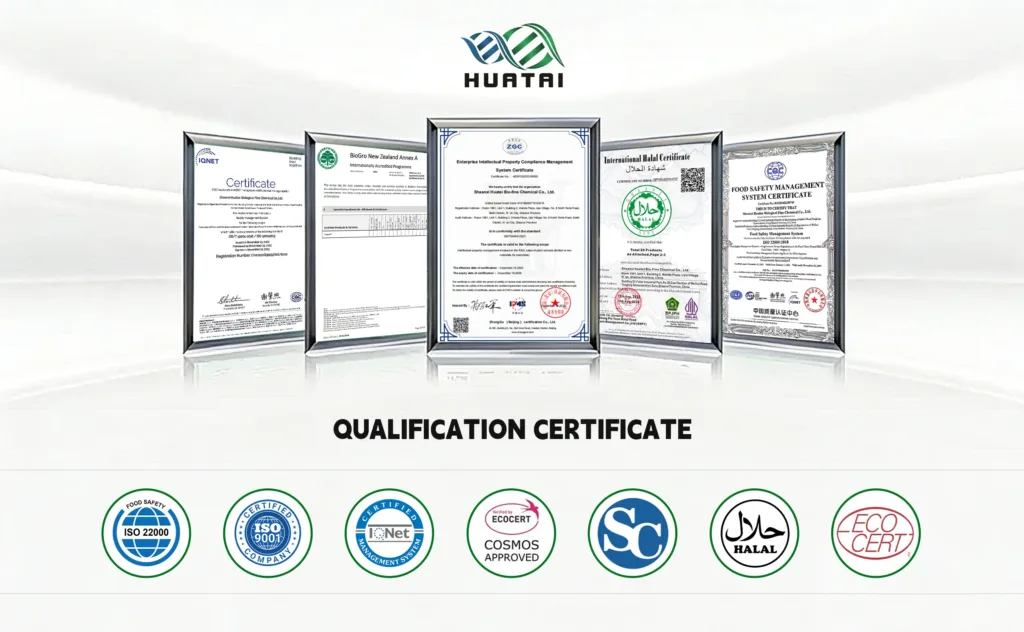
Huatai Bio provides a comprehensive portfolio of high-efficacy cosmetic active ingredients, empowering global brands to create next-generation skincare formulations for high-end skincare formulation needs.
Comprehensive Solutions & Innovation: Our categories cover the full spectrum of market requirements: Anti-aging & Firming, Oil-Control & Anti-acne, Anti-inflammatory & Soothing,Antioxidant Defense, Brightening,and Hydration & Barrier Repair.We offer both established classics and cutting-edge actives.
Driven by a passion for scientific excellence, our state-of-the-art R&D laboratory is dedicated to exploring the frontier of bio-active molecules. Beyond supplying ingredients, we offer end-to-end formulation consultancy and customized solution development. Our team of expert chemists works closely with your brand to overcome complex stability issues and sensory challenges, ensuring your final product stands out in a competitive global market.
Uncompromising Quality & Credibility:We ensure every batch of our Active skincare ingredients meets rigorous quality standards, including COSMOS, ISO 9001/22000, and HALAL Certification. This commitment, backed by a complete Technical Dossier, offers clinically-backed solutions and guaranteed compliance for every formulation challenge.



 English
 German
 Italian
 French
 Spanish
 Japanese
 Korean
 Russian