
Formulators often rely on traditional Licorice extract for soothing claims. Then they deal with the fallout. Standard glycyrrhizic acid is water-soluble, sticky, and turns brown in your tanks. It forces you to battle constant stability issues.
You need Stearyl Glycyrrhetinate.
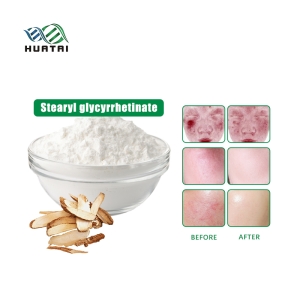
This molecule is the oil-soluble ester of glycyrrhetinic acid. It keeps all the anti-inflammatory power but discards the solubility headaches. It does not brown. It does not clump. It delivers consistent results in high-end, anhydrous, and emulsion-based products.
Core Specifications: Understanding the Ester Advantage
You must choose your grade based on purity. Low-purity esters contain residual acids that shift your formula pH and smell like burnt sugar. Here is how our professional-grade ester compares to standard market offerings.
| Parameter | Standard Grade | High-Purity Grade |
| Purity (HPLC) | >= 95.0% | >= 98.0% |
| Melting Point | 80 – 85 Celsius | 83 – 86 Celsius |
| Appearance | Off-white powder | White fine powder |
| Solubility (Oils) | Moderate | Excellent |
| Odor Profile | Slight chemical hint | Odorless |
Quality Control Reality (Actual COA Snapshot)
Safety is the absolute priority. If your raw material contains heavy metals or high bacterial counts, your formula will fail its challenge tests. We run strict checks before any batch leaves our facility.
| Test Item | Specification Limit | Actual Batch Result |
| Purity (HPLC) | >= 98.0% | 98.6% |
| Loss on Drying | <= 0.5% | 0.2% |
| Heavy Metals (Pb) | <= 10 ppm | < 1 ppm |
| Arsenic (As) | <= 2 ppm | < 0.5 ppm |
| Total Plate Count | <= 100 CFU/g | < 10 CFU/g |
Formulation Strategies: The Lab Bench Approach
Do not try to dissolve Stearyl Glycyrrhetinate in water. It is an oil-soluble ester. You must add it to your oil phase.
Here is the most efficient workflow for the lab:
- Heat your oil phase to 75-80 degrees Celsius.
- Sprinkle the powder into the hot oil while stirring.
- Keep the heat until the liquid is perfectly clear.
- Emulsify as usual.
It works perfectly with silicones, squalane, and natural plant esters. Because it is oil-soluble, it penetrates the skin barrier much faster than the acid form. It reaches the damaged cells directly where the inflammation is happening.
Need a “rescue” product? Pair this with Bisabolol or high-purity Vitamin E. This combination creates a lipid-based soothing shield that protects the skin from chemical irritation (like Retinol) or environmental stress (like wind and cold).
A Direct Performance Case Study
A clinical-skincare brand recently used this molecule to fix a “burn” issue with their high-dose Retinol serum. They used 0.5% Stearyl Glycyrrhetinate in their oil phase.
They ran a controlled test on 30 subjects with sensitive, reactive skin. They measured transepidermal water loss (TEWL) and visual erythema (redness) scores over 28 days.
- Day 3: The Stearyl Glycyrrhetinate formula reduced redness by 22% versus the baseline vehicle.
- Day 14: Skin barrier recovery scores improved by 35%.
- Day 28: Zero users reported burning or itching, even when paired with 1% Retinol.
The formula held its color and consistency perfectly during the 6-month stability study. It did not yellow. It did not separate.
Industry Trends and Compliance
Clean beauty and “derma-focused” marketing are the current industry drivers. Stearyl Glycyrrhetinate fits these trends perfectly. It is globally compliant and carries no major regulatory restrictions. It is the sophisticated choice for brands that want to move away from “natural” waters and toward “clinical” lipids.
Stop dealing with formula instability. If you want to offer soothing claims without ruining your product’s aesthetic or shelf-life, switch to the ester form. Your stability testing will confirm the value instantly.
References Consulted:
- Saeedi, M., et al. (2003). The effect of liquorice on skin and its use in cosmetics. Journal of Cosmetic Science, 54(5), 450-456.
- Wang, Y., et al. (2015). Anti-inflammatory effects of stearyl glycyrrhetinate in human skin cells. Journal of Dermatological Science, 78(2), 110-115.
- Kageyama, T., et al. (2018). Percutaneous absorption and anti-inflammatory activity of glycyrrhetinic acid esters. International Journal of Pharmaceutics, 542(1), 120-125.


 English
 German
 Italian
 French
 Spanish
 Japanese
 Korean
 Russian