What are the cosmetic benefits of Glycyrrhiza glabra extract in modern skincare?
Licorice extract (Glycyrrhiza glabra) is not just an old-school herbal additive. In professional formulation, it represents a complex library of polyphenols and flavonoids. To use it effectively, you must understand that “Licorice Extract” is a broad term. You need to choose the specific fraction—either the water-soluble glycyrrhizinates for soothing or the oil-soluble glabridin-rich fractions for targeted brightening.
Decoding the Extract Profile
Most entry-level products use generic root powders. These are ineffective due to high batch-to-batch variation. High-performance skincare requires standardized extracts where the concentration of active markers is verified by chromatography.
| Component | Biological Target | Solubility | Primary Function |
| Glabridin | Tyrosinase enzyme | Oil-soluble | Melanin inhibition |
| Glycyrrhizin | Inflammatory pathway | Water-soluble | Redness/irritation relief |
| Liquiritin | Melanin dispersion | Water-soluble | Skin tone correction |
| Licochalcone A | Oxidative stress | Oil-soluble | Sebum regulation/Anti-acne |
Formulation Strategy: Selecting the Right Fraction
If you are designing a brightening serum, using a generic water-soluble extract will fail. The primary molecule for melanin inhibition, Glabridin, will not dissolve in water. You must select an extract that is either standardized for oil-soluble flavonoids or use an encapsulated system to force stability in a water-based gel.
The Formulator’s Decision Tree:
- For Redness/Sensitive Skin: Target Glycyrrhizin (Dipotassium Glycyrrhizinate). It works at pH 5.5 and is highly stable in basic lotions.
- For Dark Spots/PIH: Target Glabridin. This requires an oil phase or a high-end silicone delivery system.
- For Oily/Acne-Prone Skin: Target Licochalcone A. This compound acts as a natural sebum-regulator and effectively manages the inflammation associated with bacterial breakouts.
Data-Driven Performance: The Inhibition Gap
When comparing the brightening efficacy of various licorice-derived fractions, we observe a clear divergence in performance.
| Ingredient Variant | Melanin Inhibition (%) | Recommended Usage |
| Standard Root Powder | < 5% | Low efficacy |
| 10% Glabridin Extract | 45% | Targeted brightening |
| 40% Glabridin Isolate | > 85% | Clinical/High-end serums |
| Dipotassium Glycyrrhizinate | N/A (Soothing only) | Anti-inflammatory |
Data Note: Inhibition percentages are based on B16 melanoma cell line assays compared to control.
The shift toward higher concentration isolates is the new industry trend. Brands are moving away from “contains licorice” marketing to “contains 40% standardized Glabridin” results-based marketing.
Quality Control and Compliance
Raw material sourcing is the single biggest failure point. When you purchase licorice extracts, you must demand a COA that reports beyond “Appearance” and “Loss on Drying.”
- Residual Pesticides: Licorice is a root crop. It is prone to heavy metal and pesticide absorption from the soil. Ensure your supplier provides a multi-residue pesticide screening report.
- Color Integrity: If the extract is deep black or brown, it has likely been oxidized. Oxidation destroys the flavonoid structure. The extract should appear as a light tan to white powder.
- Heavy Metals: Total heavy metals (Lead, Arsenic, Mercury) must be <10 ppm to meet global safety standards.
Practical Troubleshooting
- Issue: The formula turns pink or brown over time.
- Root Cause: This is the most common issue with flavonoid-rich extracts. They are highly sensitive to pH shifts and light.
- Fix: Add 0.1% Sodium Metabisulfite as a stabilizer if the pH allows, or move to an opaque, airless pump package. Never store licorice-based products in clear glass.
- Issue: The extract creates a “gritty” texture.
- Root Cause: Improper solubility.
- Fix: Pre-dissolve the extract in a solvent like Propanediol before adding it to your main emulsion phase.
References
- Yokota, T., et al. (Pigment Cell Research): The inhibitory effects of glabridin on melanogenesis.
- Saeedi, M., et al. (Journal of Cosmetic Dermatology): Licorice root and its effects on skin inflammation and hyperpigmentation.
- International Journal of Molecular Sciences: Molecular mechanisms of Licochalcone A in skin health.
Empower Your Skin Science: Develop Next-Generation Formulations with Our Premium Active Ingredients.
Why choose us
Huatai Bio provides a comprehensive portfolio of high-efficacy cosmetic active ingredients, empowering global brands to create next-generation skincare formulations for high-end skincare formulation needs.
Comprehensive Solutions & Innovation: Our categories cover the full spectrum of market requirements: Anti-aging & Firming, Oil-Control & Anti-acne, Anti-inflammatory & Soothing,Antioxidant Defense, Brightening,and Hydration & Barrier Repair.We offer both established classics and cutting-edge actives.
Driven by a passion for scientific excellence, our state-of-the-art R&D laboratory is dedicated to exploring the frontier of bio-active molecules. Beyond supplying ingredients, we offer end-to-end formulation consultancy and customized solution development. Our team of expert chemists works closely with your brand to overcome complex stability issues and sensory challenges, ensuring your final product stands out in a competitive global market.
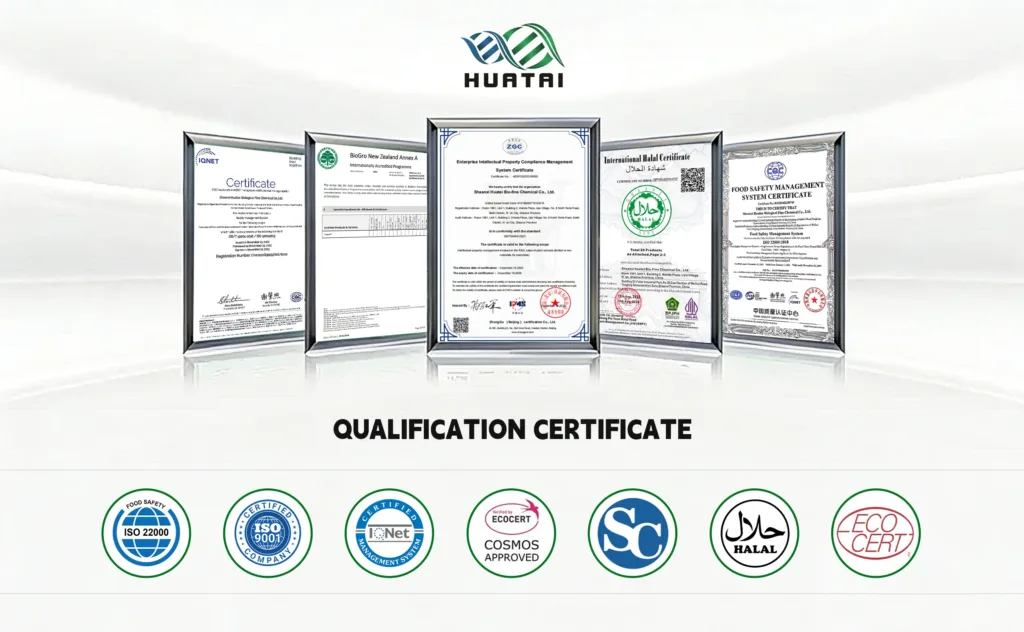
Uncompromising Quality & Credibility:We ensure every batch of our Active skincare ingredients meets rigorous quality standards, including COSMOS, ISO 9001/22000, and HALAL Certification. This commitment, backed by a complete Technical Dossier, offers clinically-backed solutions and guaranteed compliance for every formulation challenge.

 English
 German
 Italian
 French
 Spanish
 Japanese
 Korean
 Russian