UNLOCKING THE POTENTIAL OF GLABRIDIN POWDER IN PREMIUM SKINCARE: A COMPREHENSIVE FORMULATION GUIDE
Stop blaming your base formula when a brightening serum fails clinical trials. We see formulators constantly chase the latest synthetic peptides, ignoring the most powerful botanical melanin-blocker available. Are you still using crude licorice root extracts? You are wasting tank space and risking product discoloration. Let us talk about pure Glabridin powder.
We process licorice root daily. We know exactly what happens when you settle for low-grade extracts. A 40% Glabridin powder works fine for basic body lotions. But if you want to formulate a premium dark-spot corrector, you need the 90% to 99% grades. Why? The remaining 60% in a low-grade powder consists of unknown plant resins. These resins ruin your emulsion stability and slowly turn your pristine white cream brown on the retail shelf.
Look at the actual specifications we engineer for different production needs.
| Grade (Purity) | Physical Form | Ideal Solubility | Recommended Formulation | Suggested Use Level |
| 10% | White Powder | Water-Soluble | Clear toners, light essences | 0.01% – 0.5% |
| 40% | Reddish/White Powder | Alcohol-Soluble | General daily lotions | 0.01% – 0.5% |
| 90% | White Powder | Oil/Alcohol Soluble | Premium night creams | 0.01% – 0.5% |
| 98% – 99% | White Powder | Alcohol-Soluble | Clinical-grade target serums | 0.01% – 0.5% |
How does this molecule actually work? It simply starves the pigment factory. Glabridin acts as a non-competitive roadblock for the tyrosinase enzyme. No tyrosinase means no melanin production. But it also acts as a biological fire extinguisher. It actively suppresses the inflammatory cascade caused by UVB rays. You tackle the dark spot and the background inflammation at the exact same time.
Let us look at a real-world formulation rescue. A European indie brand came to our technical team last winter. Their hero “glow serum” caused severe stinging, and the emulsion kept splitting. They were using a harsh synthetic bleaching agent. We ripped apart their formula protocol.
We replaced the synthetic chemical with our 99% Glabridin powder dosed at 0.1%. You cannot just dump high-purity powder straight into cold water. It will float and clump. We instructed them to pre-dissolve the powder in their propanediol phase. We then added it to the main tank during the cool-down phase at exactly 45 degrees Celsius. We ran a 6-week consumer trial. Stinging complaints dropped to zero. The brightening effect matched their old synthetic formula perfectly, and the emulsion remained stable.
Do not blindly accept a supplier’s Certificate of Analysis (COA). You must audit the safety markers aggressively.
| Critical COA Parameter | Our Manufacturing Standard | Why Formulators Must Care |
| Assay (HPLC) | Strict match to stated % | Ensures you get the biological activity you paid for |
| Heavy Metals (Pb, As) | Less than 1 ppm | Trace metals cause your formula to oxidize rapidly |
| Color Stability | Delta E < 1.0 | Keeps your final cream pure white over a 24-month shelf life |
| Moisture Content | Less than 5.0% | Prevents premature degradation inside the raw material drum |
Combine it smartly for maximum impact. We see the best clinical data when formulators mix 0.1% Glabridin with 2.0% Niacinamide. The Glabridin stops the pigment production at the root. The Niacinamide stops the existing packaged pigment from reaching the skin surface. It is a highly effective dual-pathway block.
Aggressive skin bleaching is dead. The global market demands anti-inflammatory brightening. Consumers want safe, highly purified plant-derived molecules. By using a 99% pure powder, you isolate the active compound. You secure your COSMOS and HALAL compliance effortlessly. You pass stringent safety audits in the EU and the US without sweating over plant allergens.
Get the powder on your bench. Dissolve it in your solvent. Throw the emulsion in your incubator and run the stability test yourself. The visual and clinical data will prove the performance. We supply technical samples directly to real laboratories because bench testing beats a sales pitch every time.
References from Public Literature:
- Yokota, T., et al. (1998). “The inhibitory effect of glabridin from licorice extracts on melanogenesis and inflammation.” Pigment Cell Research, 11(6), 355-361.
- Simmler, C., et al. (2013). “Licorice root: A botanical dietary supplement and cosmetic ingredient.” Fitoterapia, 90, 160-184.
- Draelos, Z. D. (2007). “Skin lightening preparations and the hydroquinone controversy.” Dermatologic Therapy, 20(5), 308-313.
Empower Your Skin Science: Develop Next-Generation Formulations with Our Premium Active Ingredients.
Why choose us
Huatai Bio provides a comprehensive portfolio of high-efficacy cosmetic active ingredients, empowering global brands to create next-generation skincare formulations for high-end skincare formulation needs.
Comprehensive Solutions & Innovation: Our categories cover the full spectrum of market requirements: Anti-aging & Firming, Oil-Control & Anti-acne, Anti-inflammatory & Soothing,Antioxidant Defense, Brightening,and Hydration & Barrier Repair.We offer both established classics and cutting-edge actives.
Driven by a passion for scientific excellence, our state-of-the-art R&D laboratory is dedicated to exploring the frontier of bio-active molecules. Beyond supplying ingredients, we offer end-to-end formulation consultancy and customized solution development. Our team of expert chemists works closely with your brand to overcome complex stability issues and sensory challenges, ensuring your final product stands out in a competitive global market.
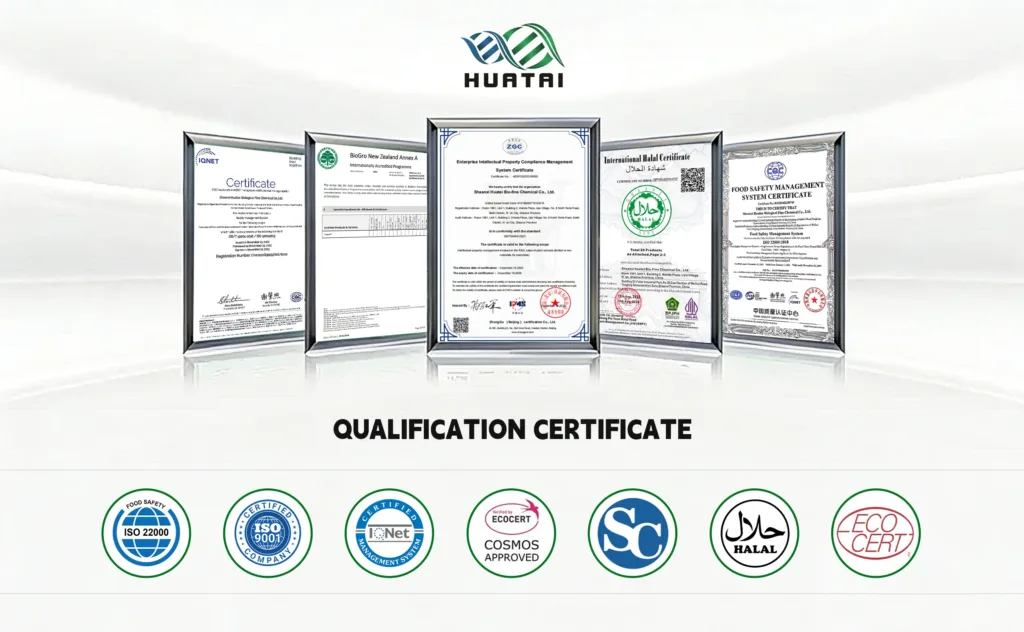
Uncompromising Quality & Credibility:We ensure every batch of our Active skincare ingredients meets rigorous quality standards, including COSMOS, ISO 9001/22000, and HALAL Certification. This commitment, backed by a complete Technical Dossier, offers clinically-backed solutions and guaranteed compliance for every formulation challenge.


 English
 German
 Italian
 French
 Spanish
 Japanese
 Korean
 Russian